Headless architecture has become one of the most discussed concepts in modern commerce. B2C brands adopted it to build faster storefronts and custom experiences. Vendors promote it as the future of commerce platforms. Analysts write reports positioning headless as essential for digital transformation.
For B2B commerce leaders, this creates confusion. Does headless solve the problems they actually face—complex pricing, quote management, approval workflows, sales collaboration? Or is it primarily an architectural choice that addresses different concerns?
Understanding what headless architecture actually enables—and what it does not—helps businesses evaluate whether it matters for their specific operational needs or whether other capabilities should take priority.
of B2B leaders confused about headless benefits
of B2B leaders confused about headless benefits
of B2B leaders confused about headless benefits
average cost of wrong architecture choice
average cost of wrong architecture choice
average cost of wrong architecture choice
typical headless implementation timeline
typical headless implementation timeline
typical headless implementation timeline
What Is Headless Architecture?
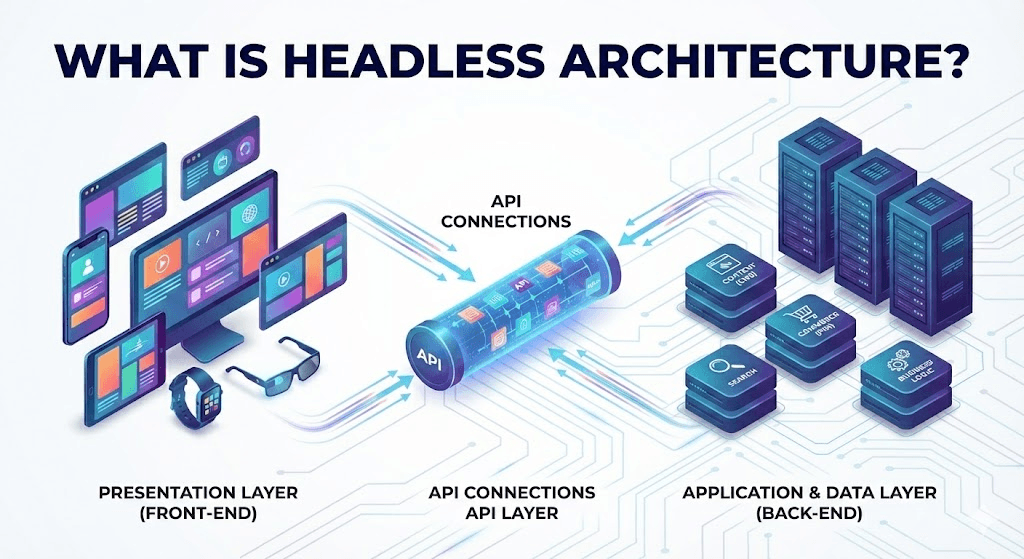
Headless architecture separates the frontend presentation layer of a system from the backend business logic and data management. In traditional commerce platforms, the storefront, product catalog, pricing engine, and order management are tightly integrated into a single application. Changing how the storefront looks or functions often requires modifying backend code, which creates dependencies and slows down development.
In headless architecture, these layers are decoupled. The backend exposes its functionality through APIs—interfaces that allow the frontend to request data and perform actions without needing direct access to backend code. The frontend consumes these APIs to display information and process user interactions, but it operates independently from the backend systems.
This separation means the frontend can be rebuilt, redesigned, or replaced without modifying backend logic. A business could launch a new customer-facing storefront, create a mobile app, or build specialized portals for different customer segments, all connecting to the same backend systems through APIs.
The term "headless" reflects this decoupling—the "head" (frontend) is separated from the "body" (backend), and they communicate through defined interfaces rather than being built as a single unit.
What headless actually enables is flexibility in how users interact with commerce systems.
It does not inherently change what those systems can do—their capabilities for pricing, inventory management, order processing, and workflow automation remain functions of the backend architecture.
Why Headless Emerged in Commerce
Headless architecture emerged in response to limitations that became apparent as businesses tried to adapt monolithic commerce platforms to changing requirements.
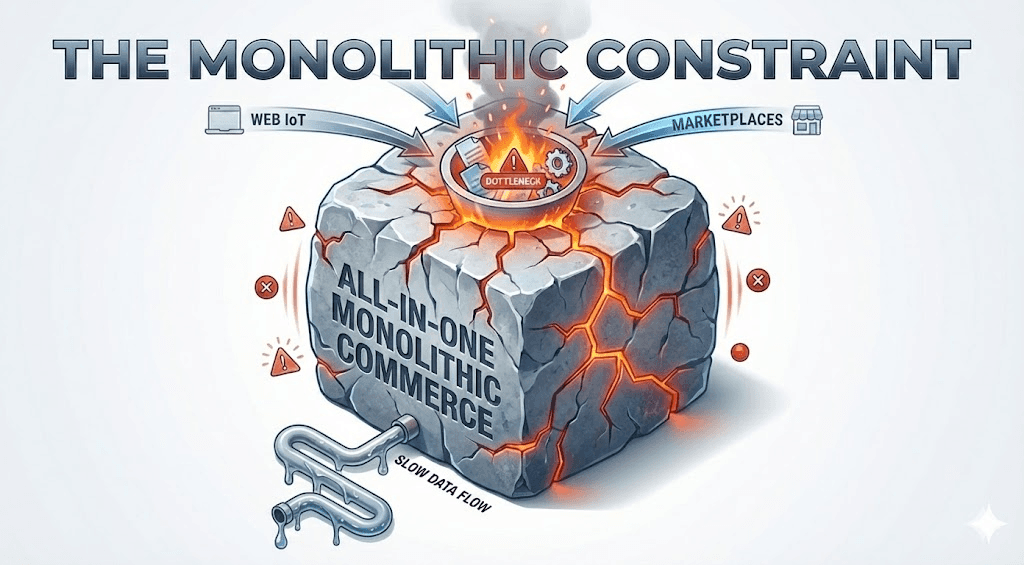
The monolithic constraint
In tightly coupled systems, modifying the storefront often meant touching backend code, which required development resources, testing cycles, and careful coordination to avoid breaking functionality. Simple design changes could take weeks or months because they cascaded through the entire system.
Frontend flexibility demands
Businesses wanted to experiment with different user experiences, test new design approaches, and update interfaces quickly in response to customer feedback. When the frontend and backend were coupled, this iteration speed was limited by backend complexity and deployment cycles.
Multi-channel requirements
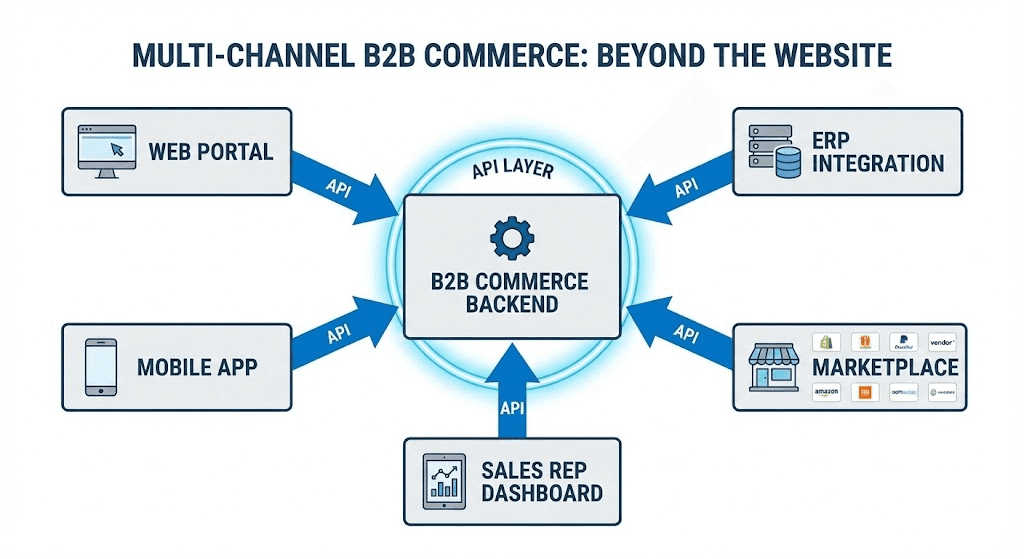
A company might need a web storefront, a mobile app, a sales representative portal, and a partner ordering system—all accessing the same product, pricing, and inventory data. Building these as separate monolithic applications created data synchronization problems and duplicated business logic. Headless architecture allowed multiple frontends to share the same backend.
Technology evolution
New frameworks and design tools emerged regularly, offering better performance or developer productivity. Businesses using monolithic platforms often could not adopt these innovations without replatforming entirely. Headless architecture allowed frontend technology updates without backend disruption.
These drivers were strongest in B2C commerce, where storefronts are the primary customer touchpoint and visual differentiation matters significantly. The question for B2B businesses is whether these same pressures apply to their operations, or whether different architectural priorities matter more.
Why Headless Alone Does Not Solve B2B Commerce
The most common misconception about headless architecture in B2B contexts is that frontend flexibility addresses the core challenges B2B businesses face. It does not.
❌ What Headless Doesn't Solve
❌ What Headless Doesn't Solve
✅ What Headless Solves
Without CPQ
With Nova Core CPQ
✗ Complex B2B pricing logic
✗ Complex B2B pricing logic
✗ Complex B2B pricing logic
27-81+ separate SKUs
1 product with option groups
✗ Quote-to-order workflows
✗ Quote-to-order workflows
✗ Quote-to-order workflows
Update each SKU (hours)
Update option prices (minutes)
✓ Multi-channel interfaces
✓ Multi-channel interfaces
Track stock per SKU combination
Track stock per option value
✗ Sales collaboration tools
✗ Sales collaboration tools
✗ Sales collaboration tools
Manual validation, frequent mistakes
Automatic resolution, zero errors
Unknown cost per configuration
The fundamental insight: UI freedom does not equal workflow capability.
Headless architecture gives businesses more control over how users interact with commerce systems, but it does not change what those systems can do operationally.
Where Headless Does Add Value in B2B
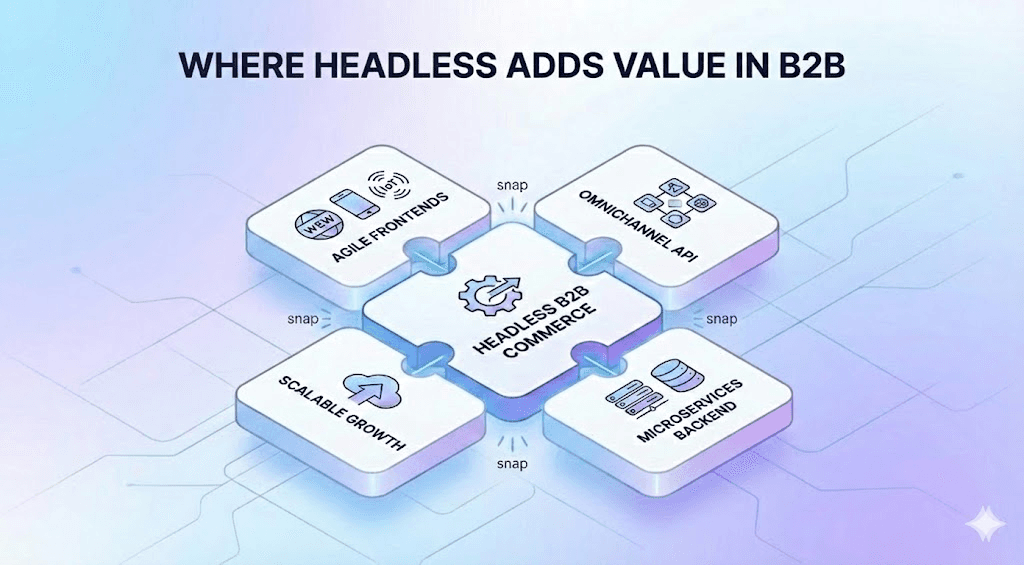
While headless architecture does not solve core B2B workflow challenges, it provides value in specific scenarios where frontend flexibility matters operationally.
Different interfaces for retailers vs distributors, sharing backend systems
Different interfaces for retailers vs distributors, sharing backend systems
Different interfaces for retailers vs distributors, sharing backend systems
Sales Tools & Internal UIs
Sales Tools & Internal UIs
Optimized interfaces for rep productivity and speed
Optimized interfaces for rep productivity and speed
Optimized interfaces for rep productivity and speed
Different interfaces for retailers vs distributors, sharing backend systems
Different interfaces for retailers vs distributors, sharing backend systems
Different interfaces for retailers vs distributors, sharing backend systems
Sales Tools & Internal UIs
Sales Tools & Internal UIs
Optimized interfaces for rep productivity and speed
Optimized interfaces for rep productivity and speed
Optimized interfaces for rep productivity and speed
Headless vs Composable vs Monolithic (Clarified)
These terms are often used interchangeably or confused, which obscures their actual meanings and relationships.
How Buyience Thinks About Headless
Buyience is built as a backend B2B layer that extends existing e-commerce platforms. The architecture prioritizes workflows—quote-to-order, pricing, CPQ, sales collaboration—over frontend flexibility.
Headless principles are supported in the sense that Buyience exposes functionality through APIs that can be accessed by different frontends. Businesses using Buyience can build custom buyer portals, sales tools, or partner interfaces that connect to Buyience's backend capabilities. But headless is an enabler rather than the centerpiece of the value proposition.
The philosophy is workflow-first. B2B businesses adopt Buyience to solve operational problems: pricing that is too complex for manual management, quoting processes that create bottlenecks, configuration logic that requires validation, sales collaboration that needs structure. These are backend challenges. Whether the frontend accessing these capabilities is coupled to the backend or decoupled through APIs matters less than whether the backend can handle the workflow complexity.
This reflects mid-market reality. Most mid-market B2B businesses are not building multiple custom frontends. They need one solid buyer portal, one effective sales tool, and integration with their existing systems. Frontend flexibility is useful when it enables incremental improvements—updating the interface without touching backend logic, adding a mobile experience alongside the web portal—but it is not the primary driver of value.
The approach allows incremental adoption of headless principles as needs evolve. A business might start with standard frontends that work well for their use case, then later build specialized interfaces for specific customer segments or internal tools for sales operations, connecting to the same backend capabilities they have already implemented.
The philosophy is workflow-first.
B2B businesses adopt Buyience to solve operational problems: pricing that is too complex for manual management, quoting processes that create bottlenecks, configuration logic that requires validation, sales collaboration that needs structure.
When a B2B Business Actually Needs Headless
Headless architecture is not appropriate for every business at every stage, and recognizing when it provides value helps avoid unnecessary complexity.
Clear indicators headless adds value:
Needing multiple distinct frontends for different user types
Planning significant customization that standard platform templates cannot accommodate
Operating across regions or brands requiring different interfaces with shared backend systems
Having development resources capable of building and maintaining custom frontends
When headless is often overkill:
Standard storefront templates meet customer needs
No need for specialized sales tools or partner portals
Limited development resources to build custom frontends
Backend workflow capabilities are the primary constraint
Cost and complexity tradeoffs matter significantly. Headless architecture requires frontend development expertise, ongoing maintenance of APIs, and coordination between teams working on different layers of the system. For businesses with small technical teams or limited budgets, these costs may outweigh the flexibility benefits.
The decision should be driven by specific operational requirements, not architectural ideology. If you can articulate concrete reasons why you need frontend flexibility—multiple customer segments requiring different interfaces, plans to build specialized tools, anticipated frequent changes to customer-facing experiences—headless makes sense. If the rationale is primarily that headless is modern or that industry trends favor it, the investment may not be justified.
When a B2B Business Actually Needs Headless
What is headless B2B commerce?
What is headless B2B commerce?
What is headless B2B commerce?
Is headless architecture required for B2B commerce?
Is headless architecture required for B2B commerce?
Is headless architecture required for B2B commerce?
How is headless different from composable architecture?
How is headless different from composable architecture?
How is headless different from composable architecture?
Does headless architecture improve B2B sales workflows?
Does headless architecture improve B2B sales workflows?
Does headless architecture improve B2B sales workflows?
Is implementing headless architecture expensive?
Is implementing headless architecture expensive?
Is implementing headless architecture expensive?
Conclusion
Headless is about frontend options, not backend solutions. It provides architectural flexibility for businesses that need multiple interfaces or significant customization, but it does not address the workflow complexity that defines B2B commerce—pricing engines, quote management, sales collaboration, approval processes.
For mid-market B2B companies, the question is not whether to be headless but whether frontend flexibility solves a problem you actually have. Most businesses benefit more from capable backend systems that handle their operational workflows than from the ability to build custom frontends. Headless becomes relevant when interface requirements justify the investment, not because architectural trends suggest it should.
The platforms that matter in B2B will be judged on their ability to handle complex workflows, not on whether they separate the frontend from the backend. Headless will be available as an option, but success will depend on solving the hard operational problems regardless of architectural choices.
Launch Offer: 19 of 50 spots remaining
Ready to Transform Your B2B Commerce?
Ready to Transform Your B2B Commerce?
Ready to Transform Your B2B Commerce?
Start your 14-day free trial. No credit card required. Full platform access with all features unlocked.