
Buyience vs Shopify Plus for B2B: Which Fits Wholesale Distributors
Shopify Plus and Buyience solve different problems. Shopify is catalogue-and-checkout commerce with a strong B2B layer added — excellent if your wholesale motion is buyers logging in and ordering from a catalogue at their agreed prices. Buyience is quoting-and-negotiation commerce — built for distributors whose deals are won or lost on how fast and how accurately they can quote, revise, and negotiate. If most of your revenue arrives through self-service reordering, Shopify is likely the better fit. If most of it arrives through quotes, it probably isn't.

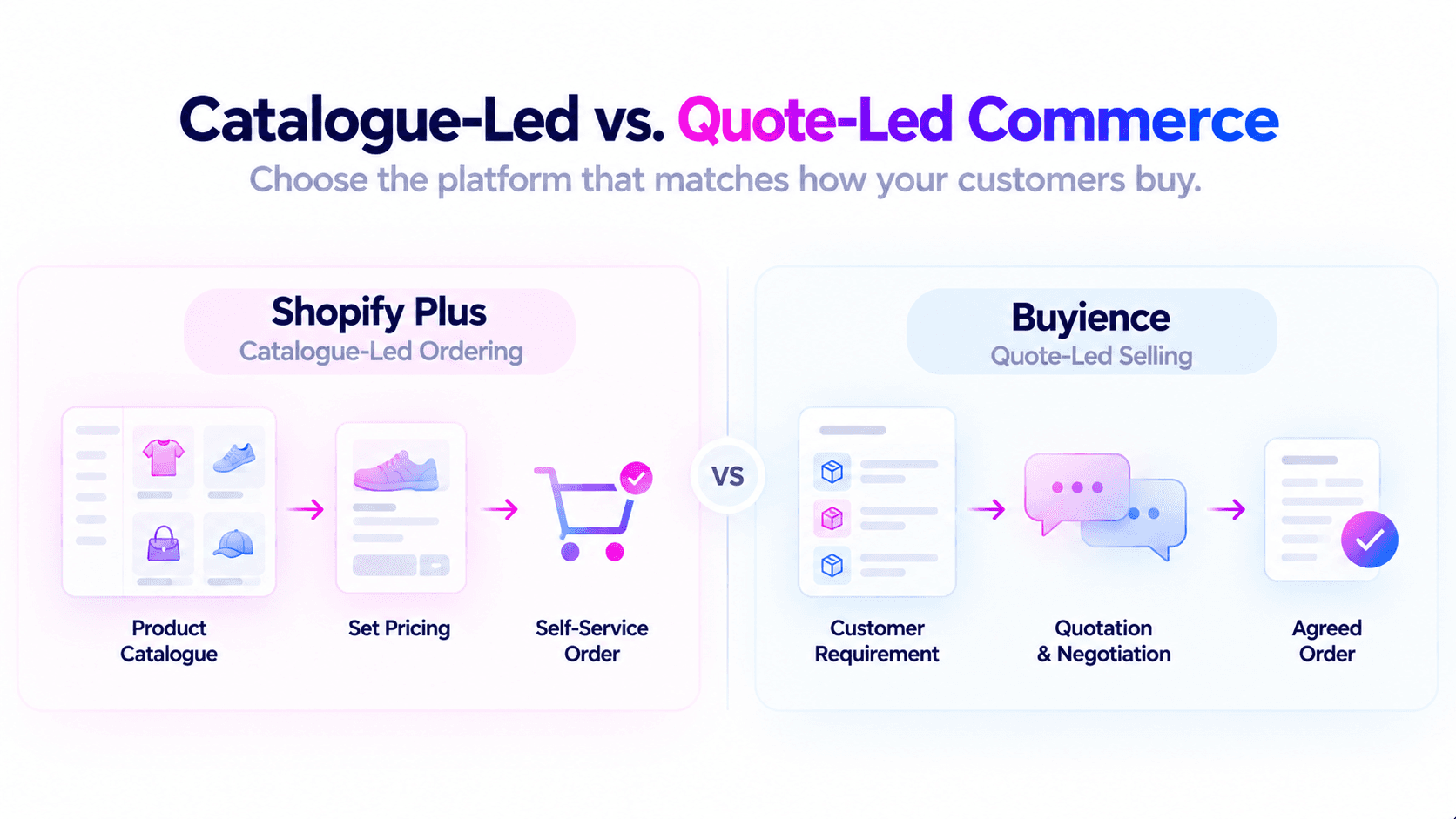
Comparisons written by vendors are usually worth reading sceptically, so here is the bias declared upfront: we build Buyience. What follows is an attempt at an honest account of where each platform genuinely fits, including the cases where Shopify is the better answer — because a distributor who buys the wrong platform is a bad outcome for everyone, including us.
What changed in Shopify's B2B offering in 2026
Any comparison written before mid-2026 is now misleading, because Shopify materially expanded what its B2B layer does.
As of April 2026, most B2B features are available on every paid Shopify plan — company accounts, customer-specific pricing catalogues, net payment terms including Net 30/60/90, purchase order numbers, self-serve buyer ordering, quick order lists, and Flow automations no longer require a Plus subscription. What remains Plus-only is a narrower set: unlimited pricing catalogues, a dedicated B2B storefront on its own domain, vaulted card storage for buyer accounts, deposit and partial payment workflows, and checkout extensibility.
This matters for anyone evaluating platforms, because several capabilities distributors used to shop around for are now table stakes on Shopify. Company profiles, custom catalogues and pricing, net terms, and a dedicated B2B checkout now run on the same backend as DTC commerce. If you read older comparison content claiming Shopify can't do tiered B2B pricing or payment terms, that content is out of date.
Shopify's other genuine strength is implementation speed. Shopify Plus B2B implementations using native features consistently launch in around 90 days, with ERP integration often achieved in roughly 30 days — though ERP integration considerations still apply — considerably faster than legacy enterprise B2B platforms.
Where Shopify Plus is genuinely the better choice
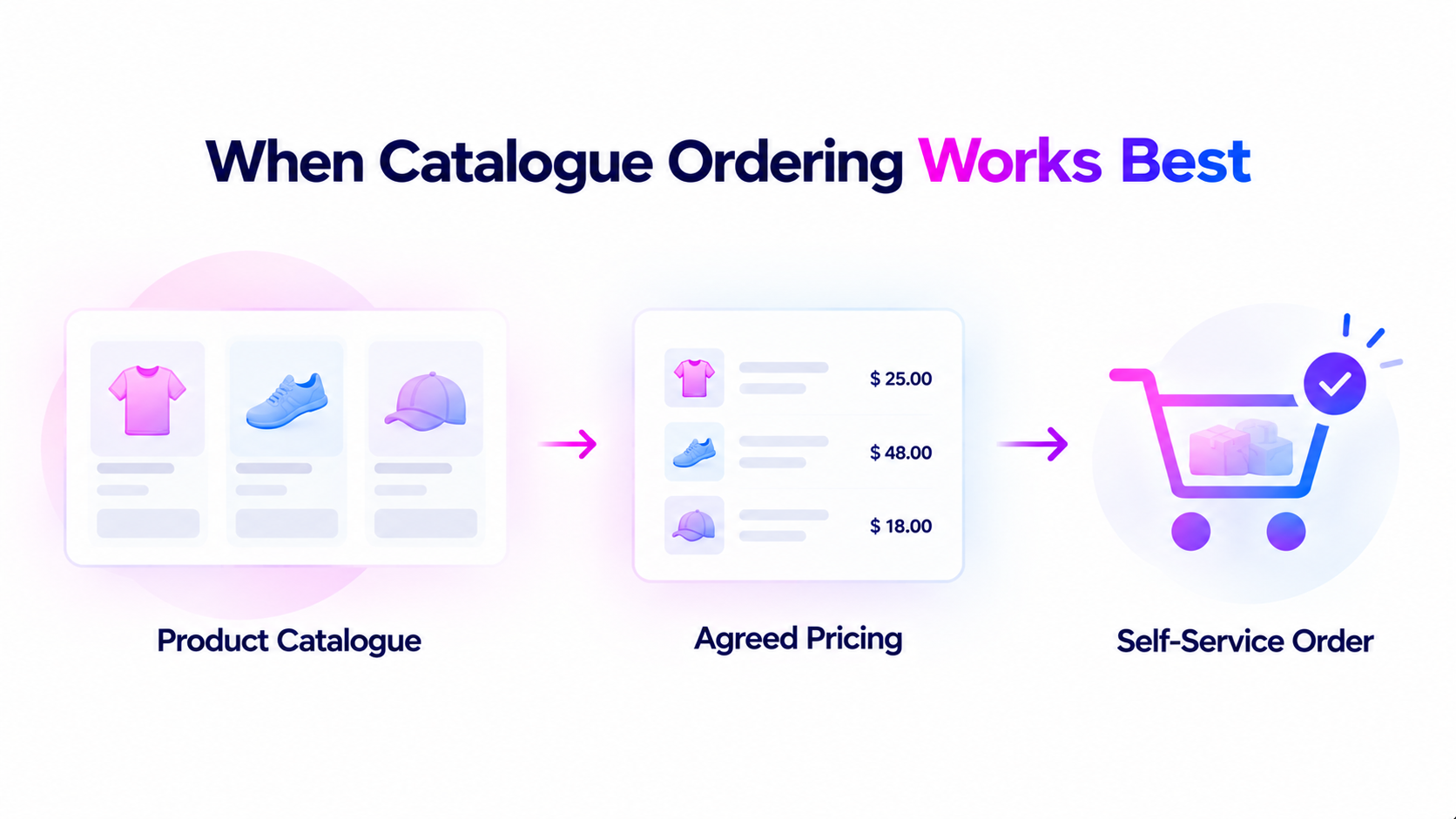
- You sell a catalogue, and buyers order from it — If your wholesale customers log in, see their agreed prices, and place orders without negotiation, Shopify's B2B layer covers that well. Adding a quoting-led platform to a catalogue-led business adds complexity you don't need.
- You run DTC and wholesale together — This is Shopify's strongest structural advantage. One product catalogue, one inventory pool, one order stream serving both retail and trade customers. A gifting brand selling to consumers and corporate clients, or a manufacturer with a consumer line alongside trade accounts, gets real value from not running two systems.
- You need to launch quickly with a small team — The ecosystem, documentation, and available implementation partners are far deeper than any smaller platform can offer.
- Your pricing is stable and rule-based — Fixed tiers per company, applied consistently, without live negotiation on individual line items.
If those describe your business, the rest of this post probably isn't relevant to you, and Shopify is a reasonable answer.
Where the fit breaks down for distributors
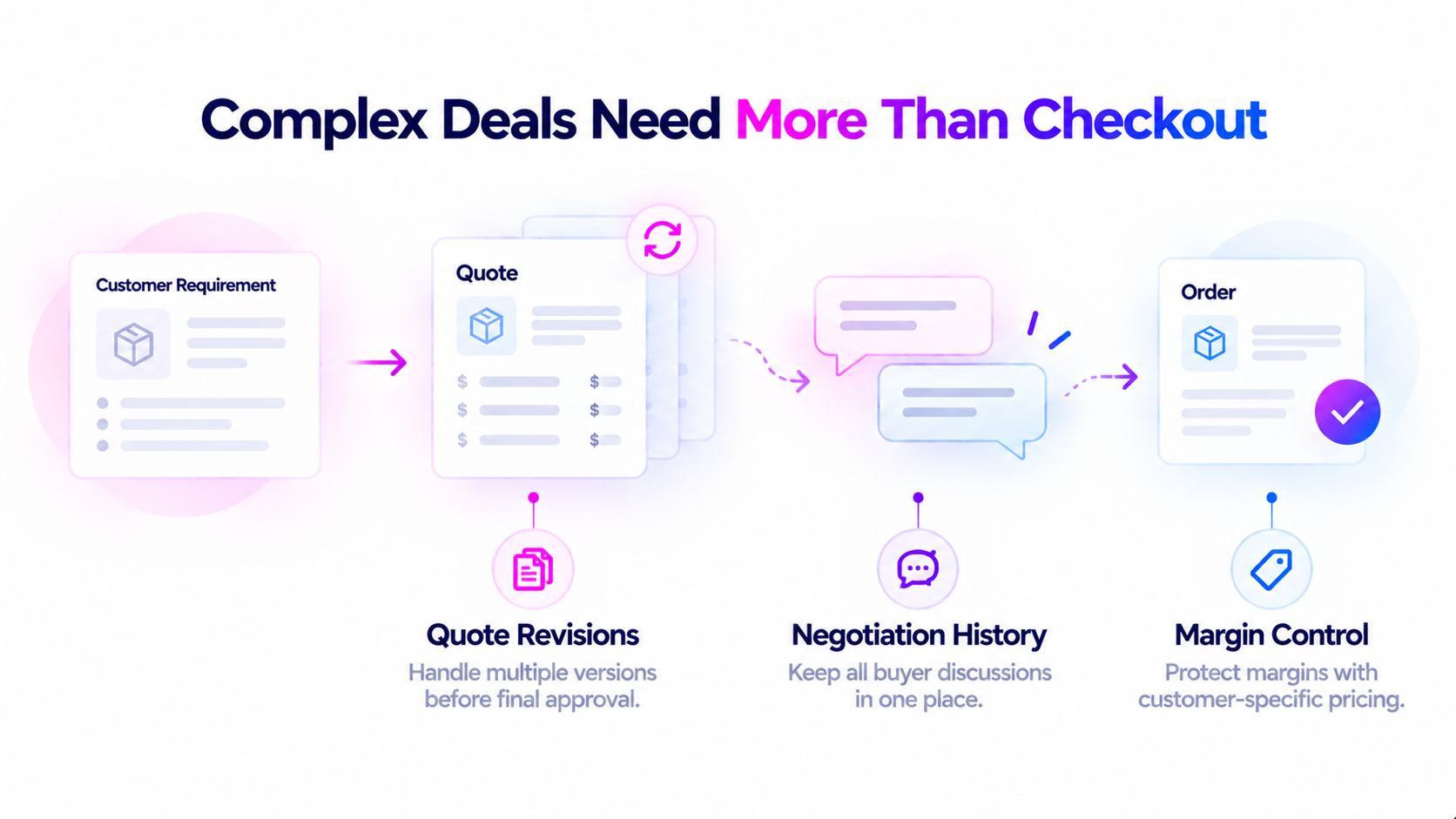
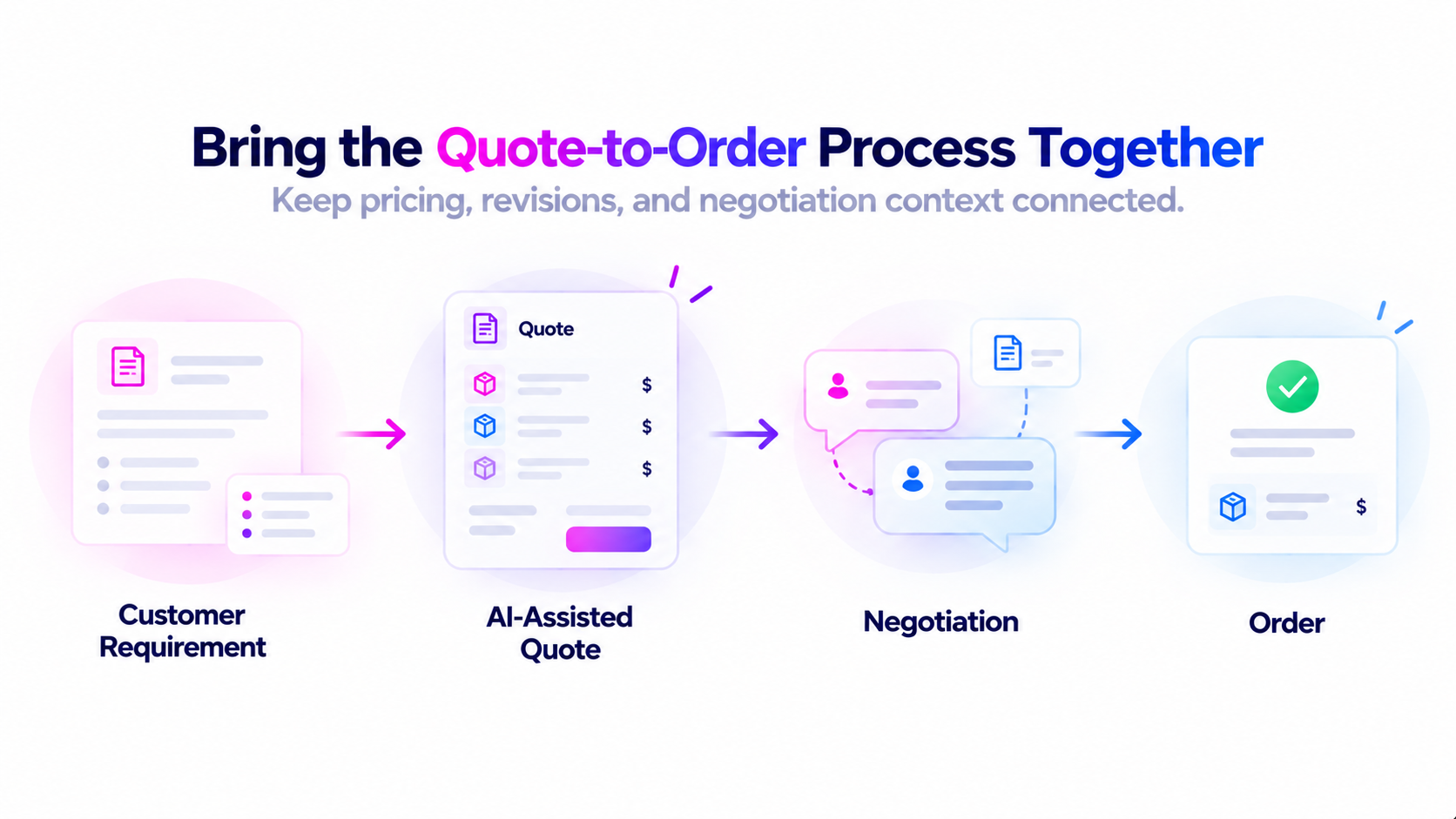
The gap isn't in Shopify's B2B feature list. It's architectural: Shopify is built around a catalogue and a checkout. The B2B layer, however capable, extends that model rather than replacing it. For distributors whose sales motion is fundamentally quote-led rather than catalogue-led, that difference shows up in specific places.
- Quoting isn't the centre of the model — Shopify supports draft orders and, with apps, various RFQ workflows. But the platform's primary path is a buyer choosing from a catalogue at a pre-set price. A distributor whose typical deal starts with a customer describing a requirement, receives a quote, negotiates it, and converts it to an order is working against the grain of that model. Independent implementation guidance identifies this directly: forcing complex RFQ and approval workflows into a platform designed for simpler B2B models is a recognised implementation mistake.
- Negotiation happens elsewhere — In a quote-led business, the negotiation is the sale. On Shopify, that conversation happens in email or on a call, outside the platform — which means no single current version of the quote, no preserved negotiation history, and no visibility into what the buyer actually engaged with. That gap is exactly what a digital sales room is built to close.
- Margin protection isn't enforced at the point of concession — Catalogue pricing assumes the price is the price. When a rep negotiates below agreed rates, there's no native margin floor checking that concession against cost before it's committed.
- Line-level complexity — A multi-line quote where the buyer pushes on three specific lines, with volume breaks and contract rates needing line-level pricing resolution, is a different problem from a cart with per-company pricing applied.
- Cost at the distributor scale — Shopify Plus runs in the region of $2,300/month before apps and implementation. For an SMB distributor with a handful of reps, that's a substantial commitment — reasonable if the platform's strengths match your model, expensive if you're mainly using it as a place for quotes to end up.
Side-by-side
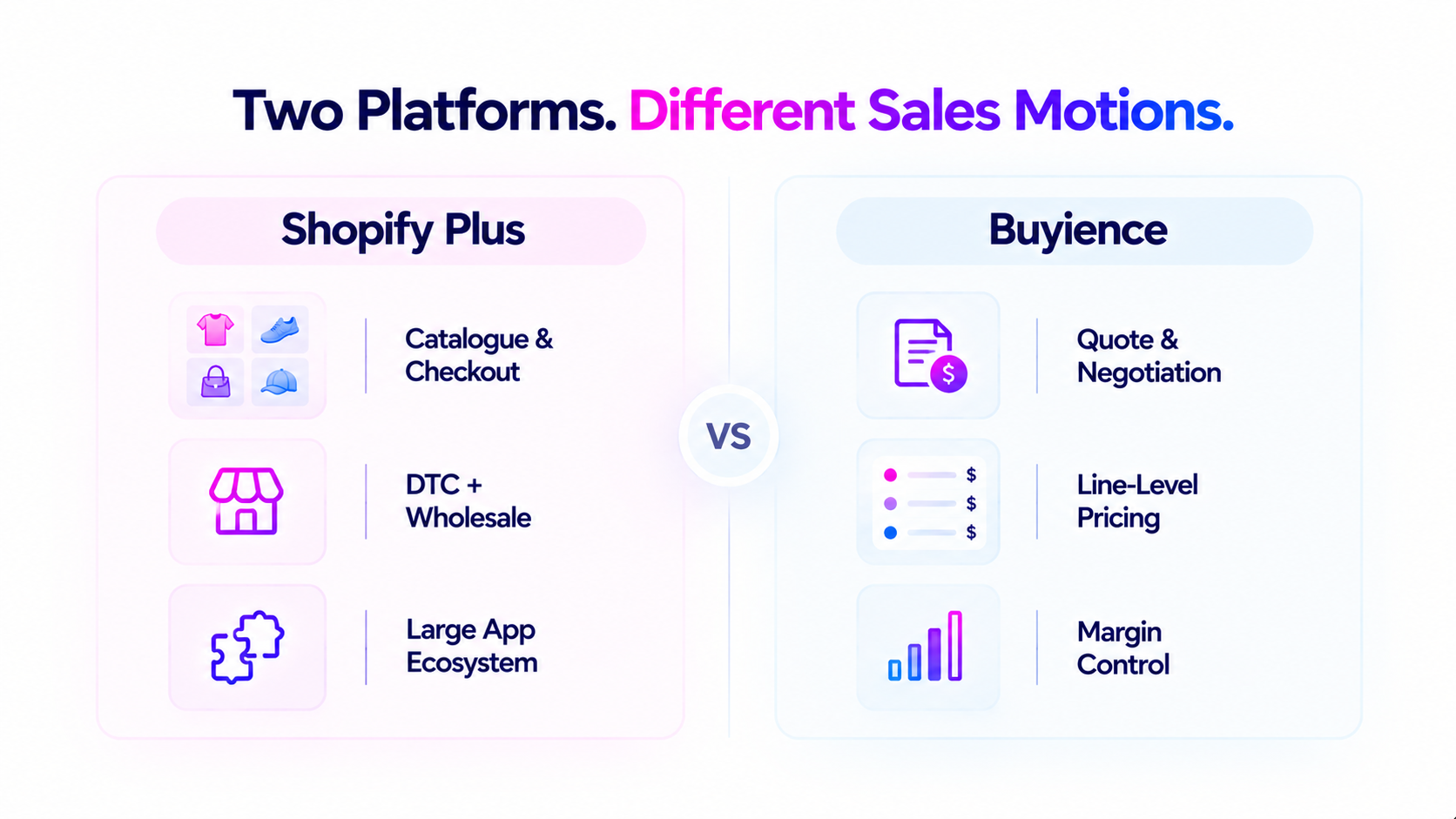
| Shopify Plus | Buyience (Nova Core) | |
|---|---|---|
| Core model | Catalogue and checkout | Quote and negotiation |
| B2B pricing | Company catalogues, quantity rules, custom pricing | Tier × volume × contract resolved per line item |
| Net terms | Native (Net 30/60/90) | Native (Net 30/60/90) |
| Quoting | Draft orders; RFQ via apps | AI Quote Engine as the primary path |
| Live negotiation | Not native — happens off-platform | Digital Sales Room with preserved history |
| Margin floor enforcement | Not native | Enforced at line level before send |
| DTC + wholesale together | Strong — shared catalogue and inventory | B2B-focused |
| Multi-warehouse inventory | Supported | Available-to-promise at quote time |
| Implementation speed | ~90 days typical for native B2B builds | Fast setup, smaller scope |
| Ecosystem | Very large app and partner ecosystem | Smaller, newer |
| Indicative cost | ~$2,300/month plus apps | SMB-tier subscription pricing |
Two entries deserve emphasis, in fairness: Shopify's ecosystem and maturity are genuinely far ahead of ours, and its DTC-plus-wholesale story is something we don't attempt to match. Those are real advantages, not caveats.
The question that actually decides it
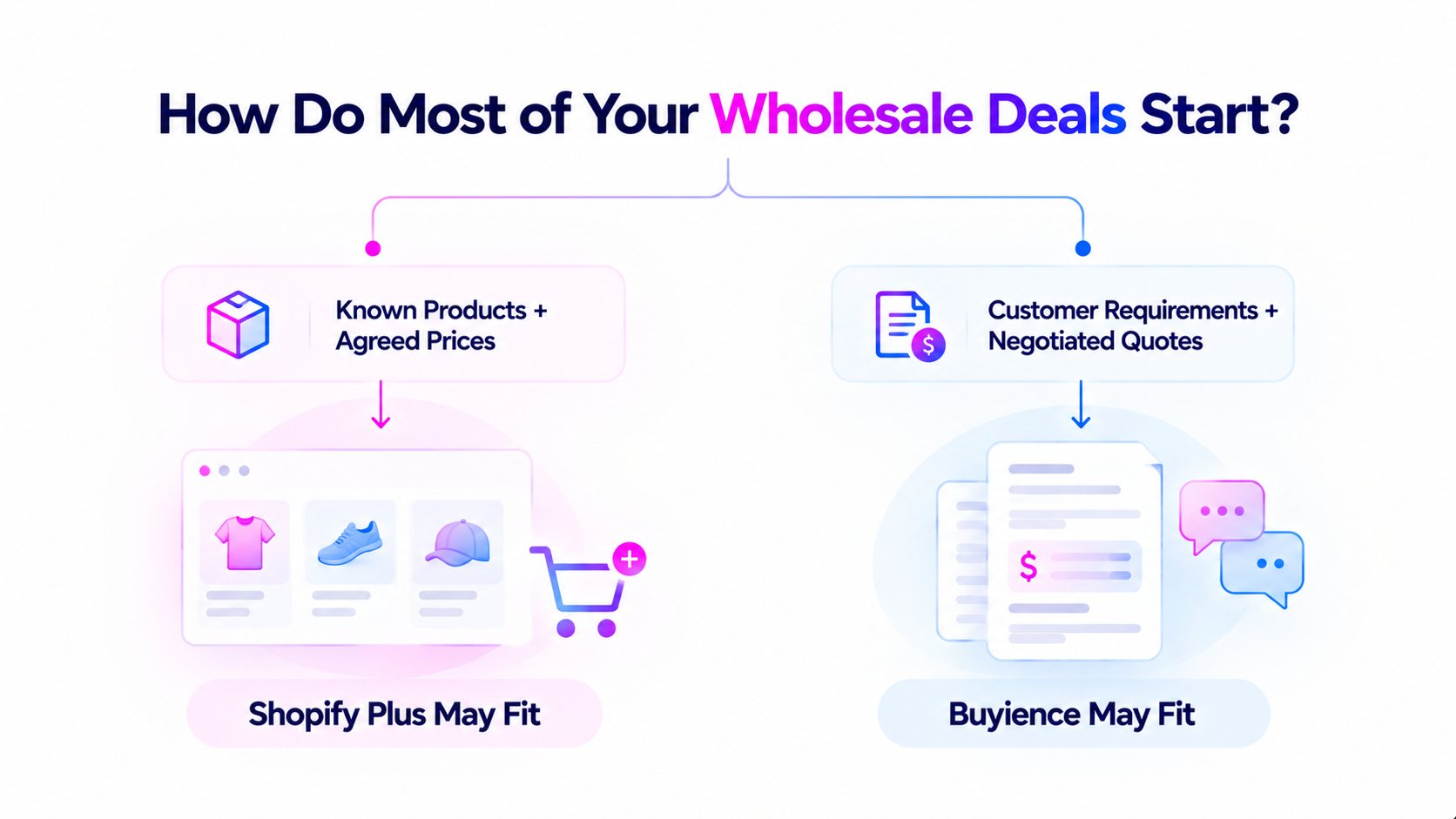
Not "which platform has more features," but: does your revenue arrive through a catalogue or through a quote?
Look at last quarter's orders. What share came from a buyer selecting from known products at known prices, versus a buyer describing a requirement and receiving a quote that was then discussed?
If it's mostly the first, Shopify's model matches your business and its maturity is a genuine asset.
If it's mostly the second — common in fastener and MRO distribution, industrial supply, and custom or configured products — then the platform's core path isn't the path your revenue takes. You'd be running your actual sales process in email and using the platform to record the outcome. That works, but you're paying enterprise pricing for a fit that's partial, and the parts that matter most to your win rate and margin sit outside the system.
What we don't do well
Worth stating plainly, since a comparison that finds no weaknesses in its own product isn't a comparison.
We're newer, with a much smaller ecosystem and partner network. If you need a specific app integration that exists on Shopify, we may not have it. We don't serve DTC alongside wholesale — if you need one platform for both, that's a real reason to choose Shopify. Our track record is shorter, and for some buyers that matters appropriately.
What we do offer is a NOVA Core B2B commerce platform built around quoting and negotiation as the primary motion, at SMB pricing, for distributors whose deals are won on quote speed and lost on margin erosion.
Start your free trial → — 14 days, no card required.
Trying to work out which model fits your sales motion? Request a demo and we'll be straight with you about whether it's a fit.
Questions, answered
Does Shopify Plus support B2B pricing and net terms natively?
Yes. Company accounts, customer-specific pricing catalogues, and Net 30/60/90 payment terms are available across paid Shopify plans as of April 2026, with unlimited catalogues and a dedicated B2B storefront remaining Plus-only features.
What's the main architectural difference between the two platforms?
Shopify is built around a catalogue and checkout, with B2B capabilities extending that model. Buyience is built around quoting and negotiation as the primary path. The difference matters most for distributors whose deals start with a quote rather than a product selection.
Can Shopify Plus handle RFQ and quote workflows?
Through draft orders and third-party apps, yes, though implementation guidance notes that forcing complex RFQ and approval workflows into a platform designed for simpler B2B models is a common mistake. How well it fits depends on how central quoting is to your sales motion.
How long does a Shopify Plus B2B implementation take?
Native-feature B2B builds on Shopify Plus commonly launch in around 90 days, with ERP integration often completed in roughly 30 days.
Which platform is better for a business selling both DTC and wholesale?
Shopify, clearly. Running both from one catalogue, inventory pool, and order stream is a genuine structural advantage that a B2B-focused platform doesn't offer.
When is Shopify Plus the wrong choice for a distributor?
When most revenue comes through negotiated quotes rather than catalogue ordering. In that case the negotiation — where win rate and margin are actually determined — happens outside the platform, and you're paying enterprise pricing for a partial fit.
Related articles
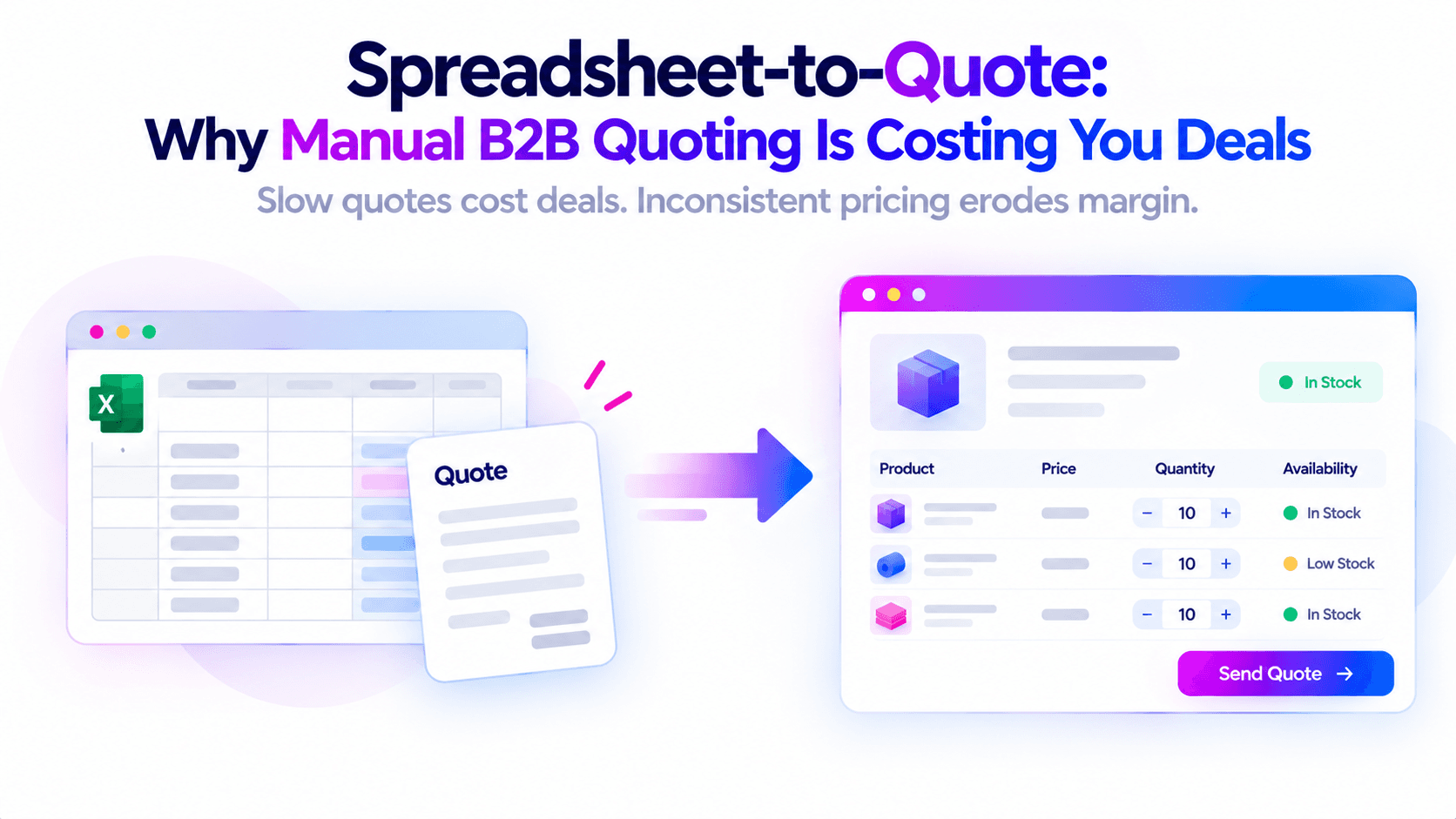
Spreadsheet-to-Quote: Why Manual B2B Quoting Is Costing You Deals
Manual quoting rarely loses a deal in a way anyone records. It loses deals through delay — the quote that arrives after the buyer decided — and it loses margin through inconsistency nobody traces back. The cost is invisible precisely because the failures look like normal business: a slow week, a competitive loss, a thin month. This post maps the five stages where a spreadsheet quote leaks, and which one to fix first.
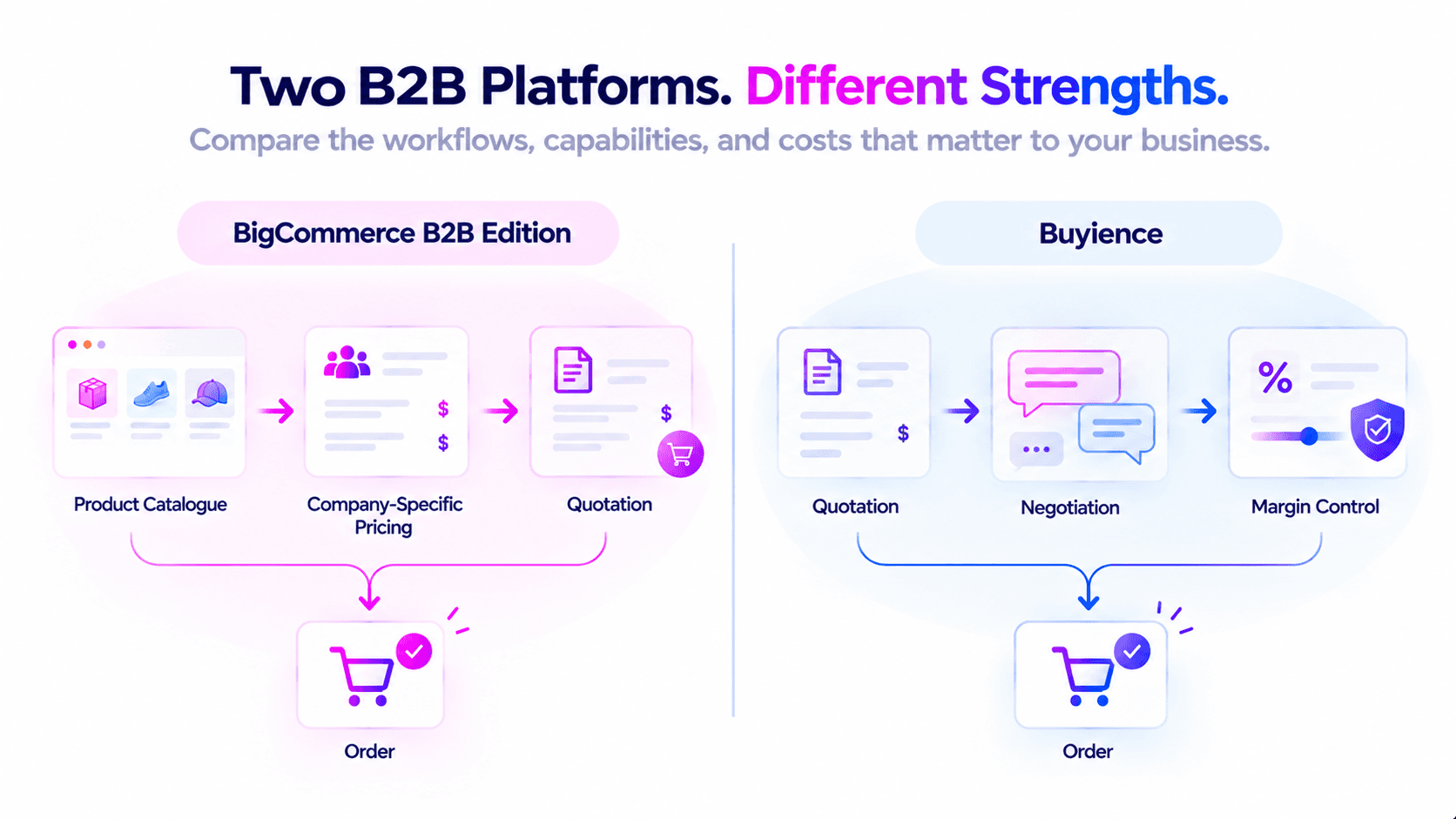
Buyience vs BigCommerce B2B Edition: A Side-by-Side Comparison
BigCommerce B2B Edition is a genuinely capable B2B platform with native quoting, company accounts, price lists and purchase order workflows — it is not a consumer cart with wholesale bolted on. The honest comparison with Buyience comes down to two things: cost tier, since B2B Edition is Enterprise-only with custom pricing, and what happens during negotiation rather than during quoting. If you have the budget and your quoting is structured rather than negotiated, B2B Edition is a strong choice.
The Best B2B Commerce Platforms for SMB Distributors in 2026
Most "best B2B platform" lists are published by vendors who rank themselves first. This one is too — we build Buyience — so the useful thing we can offer is published pricing where it exists, honest placement of where each platform actually fits, and a clear statement of which distributors should rule us out. For SMB distributors the real shortlist is short: BigCommerce B2B or Shopify for catalogue-led wholesale, Sana or an ERP-led option if your ERP governs pricing, OroCommerce if you have genuine enterprise complexity and the budget, and quoting-led platforms including ours if your revenue arrives through negotiated quotes.
