
How MACH Architecture Enables Modern B2B Commerce
Traditional B2B commerce platforms were built to solve simpler problems. When they launched, the typical B2B workflow was relatively predictable.

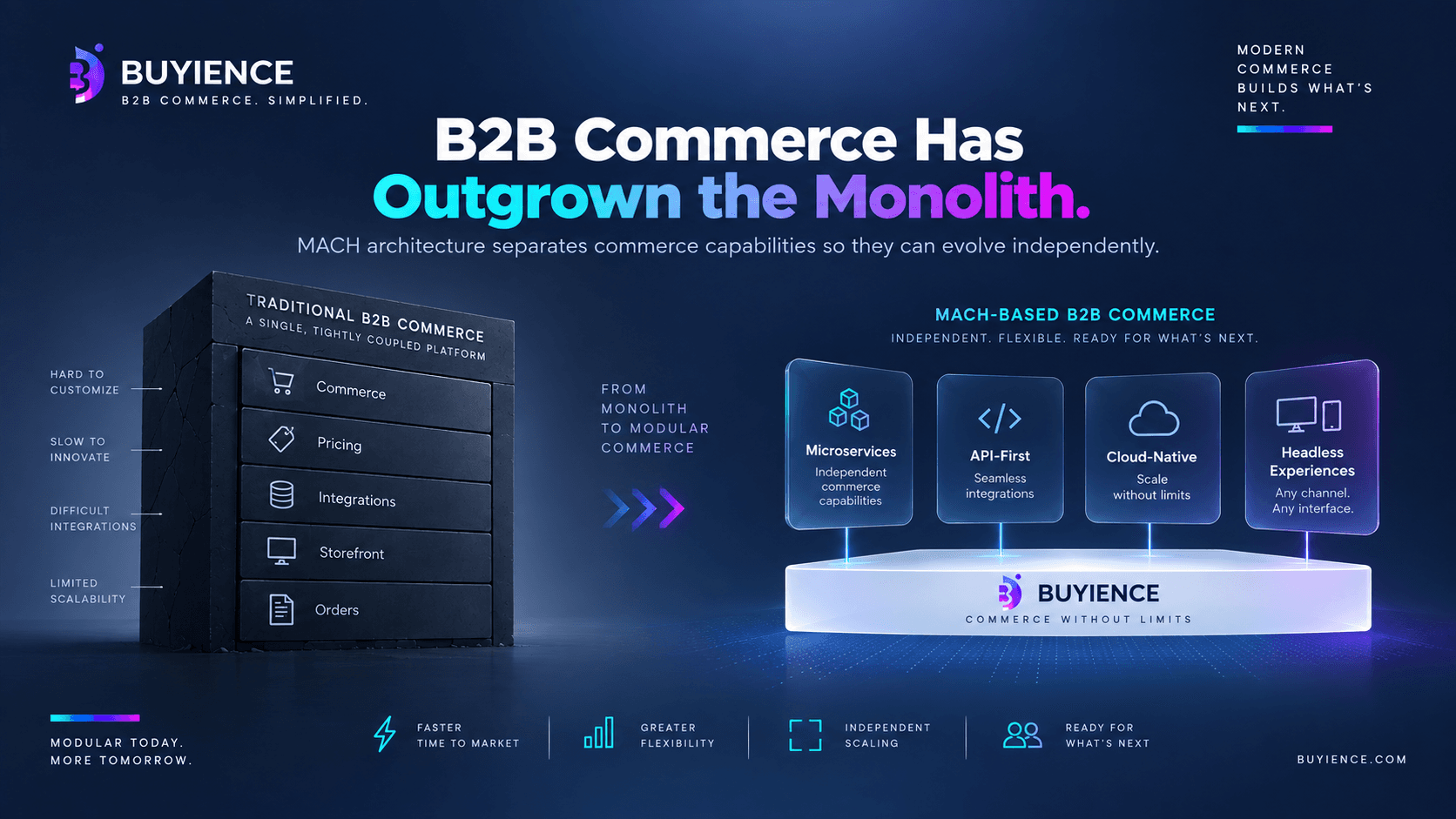
The B2B Commerce Architecture Crisis
The traditional B2B commerce model is now broken.
Modern B2B commerce isn't just catalog browsing. It includes:
- Contract-based pricing that varies by customer, region, and volume
- Sales teams needing to quote complex configurations in real-time
- Procurement teams integrating with a dozen supply-chain systems
- Multinational companies managing pricing in different currencies, compliance rules in different regions, and approval workflows that route to different stakeholders
A single B2B buyer might access your platform through a mobile app, a desktop portal, a voice assistant, or embedded directly into their own procurement system via API. Each channel expects different features, different pricing rules, and different data formats.
The real bottleneck isn't features anymore. It's architecture.
Monolithic B2B platforms—where the commerce engine, pricing logic, storefront, and integrations are all built on a single codebase—hit walls fast:
- Every customization requires backend changes
- Every new channel means extending the same system
- Every integration increases technical debt
The platform becomes the constraint, not the accelerator.
This is where MACH architecture becomes more than a buzzword. For B2B commerce, it's become a requirement.
What MACH Architecture Really Means (In Practice)
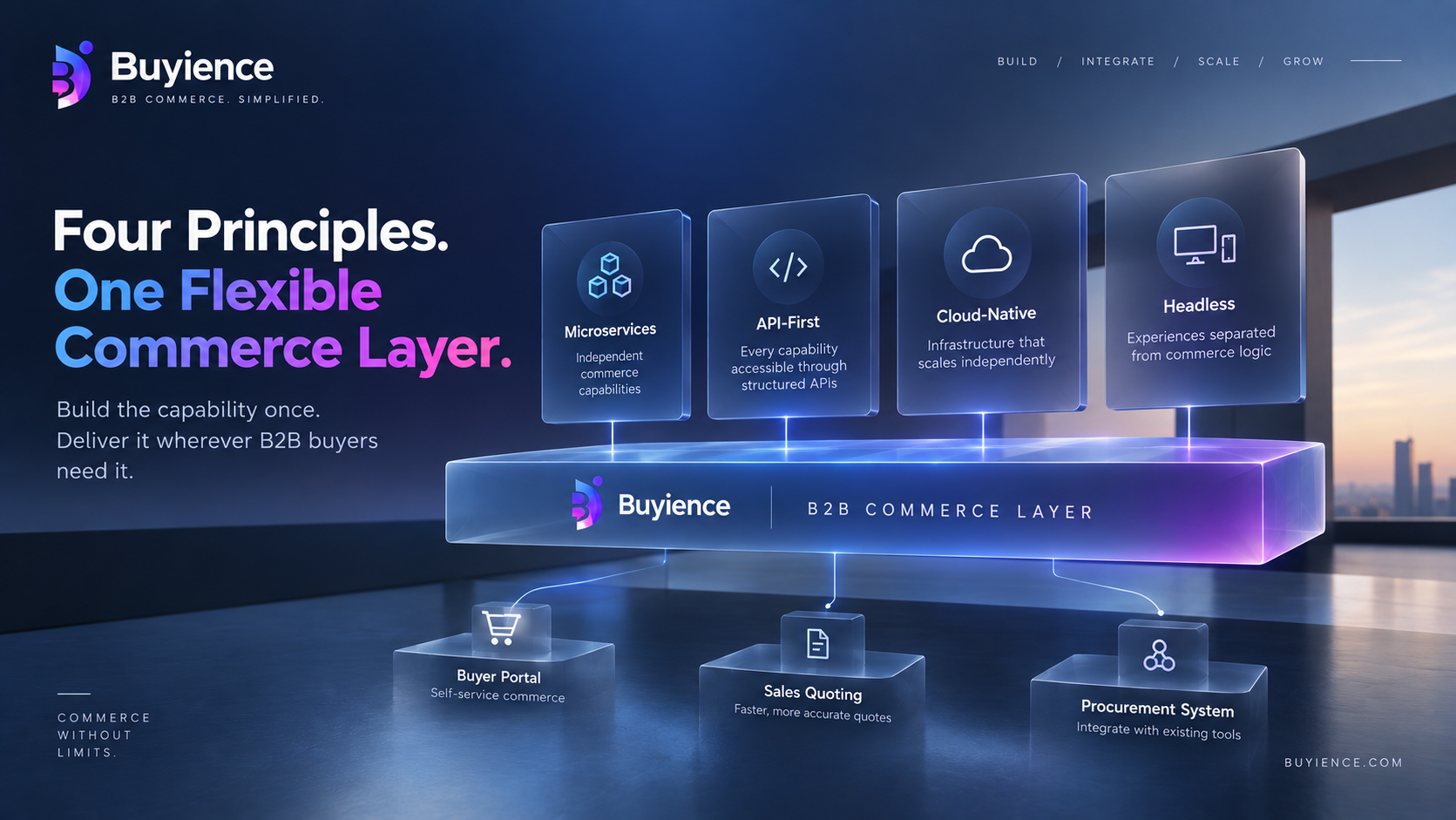
MACH stands for Microservices, API-first, Cloud-native, and Headless. But these terms are often explained as definitions, not as solutions to real B2B problems.
Here's what each layer actually enables:
- Microservices — Pricing logic, order management, inventory, and customer-specific workflows run on independent services, not one monolith. You can update pricing rules without redeploying your checkout flow. You can scale your ERP adapter separately from your catalog service. Each service owns its own database and evolves independently.
- API-first — Every piece of functionality is exposed through structured APIs, not just UI layers. A sales team's quoting tool doesn't just submit orders through the website—it calls the pricing API directly, gets real-time margin analysis, and integrates with the CRM. Procurement systems call the order API to sync with their own systems of record.
- Cloud-native — Your infrastructure doesn't run on legacy server hardware that forces you to provision a year in advance. It scales with demand. It's maintainable without a dedicated infrastructure team. New capabilities ship faster because deployment isn't a quarterly gate.
- Headless — The commerce logic layer is completely separate from the presentation layer. You're not building a single "Buyience storefront"—you're building multiple experiences: a self-service portal for retail buyers, a quote configuration tool for enterprise sales, an embedded procurement interface for OEM partners. All consume the same commerce layer, but each experience is optimized for its specific user.
For B2B, this separation is critical. Your customers don't want your interface. They want to integrate with their systems and workflows. Headless is what makes that possible.
How MACH Directly Solves B2B Complexity
Map the complexity back to the architecture.
- Contract-based pricing and approval workflows — With MACH, pricing rules live in a dedicated microservice that evaluates customer-specific contracts, volume tiers, promotional agreements, and negotiated terms in real-time. When a sales rep quotes a configuration, the pricing service executes the entire contract logic and returns margin-adjusted pricing. When the buyer approves and submits an order, the order service enforces the same rules. The backend and the sales tool stay synchronized because they call the same API. In a monolith, pricing rules are baked into the database schema and business logic layer. Changing a customer's contract means data migrations and code redeploys. Sales tools sync separately, creating shadow pricing logic. Discrepancies multiply.
- Complex ERP integration — With MACH, your ERP integration is its own microservice. It has a single responsibility: translate between your commerce APIs and your ERP's data model. When the ERP changes its schema, only this service changes. When you add a new commerce feature, the integration layer adapts to it without reverse-engineering the ERP. ERPs and commerce operate as peers, not as master-slave. In a monolith, the ERP sits behind the commerce platform. It's accessed through a single integration layer that entangles commerce logic, data mapping, and ERP workflows. Changing one thing breaks others.
- Multi-channel buyer experiences — With MACH and headless, your procurement team can embed a quote configurator directly into their own portal. Your sales team gets a mobile app for field quoting. Your distributors get a brand-customized storefront. Large accounts get a dedicated account management experience. Every experience runs on the same commerce layer, but each is architecturally independent. Deploying a fix to one channel doesn't affect the others. In a monolith, every new channel means extending the platform. Every extension increases risk. The QA surface explodes.
- Scalability across customers, regions, and catalogs — Becomes architectural, not organizational. With microservices, you can scale your catalog indexing separately from your order processing. You can run pricing calculations in multiple regions for low-latency responses. You can scale customer-specific workflows independently from your core commerce layer. This is infrastructure flexibility, not just engineering flexibility. In a monolith, scaling one feature means scaling the entire platform. You provision for your peak load, then pay idle capacity the rest of the time.
Why Monolithic B2B Platforms Struggle
The technical challenges of monoliths are well-known in enterprise architecture. But they hit B2B commerce especially hard.
- Tight coupling — A change to the customer management system affects pricing, order management, and fulfillment. Every release requires regression testing across all business workflows. Risk accumulates. Release cycles slow down. Features that should take days take weeks because they touch the shared codebase.
- Slow innovation cycles — New B2B requirements—like a contract-approval workflow or a specific ERP integration—take three to six months to ship. By then, the market has moved on. Your competitors who built with MACH shipped it in three weeks.
- Risky upgrades — A constant organizational cost. You're trapped on a version because the new version breaks a critical workflow. You can't upgrade your API framework because it'll require redeploying your entire system. Vendors lock you into old dependencies.
- Limited customization without technical debt — The real killer. B2B customers are all different. They have different pricing models, different approval hierarchies, different ERP systems. In a monolith, you customize by adding conditional logic. You add configuration tables. You create plugins. After three years, the codebase is unmaintainable. No engineer knows what actually runs in production anymore.
These aren't theoretical problems. They're why mature B2B companies abandon their platforms every seven to ten years.
Headless Commerce as the B2B Experience Layer
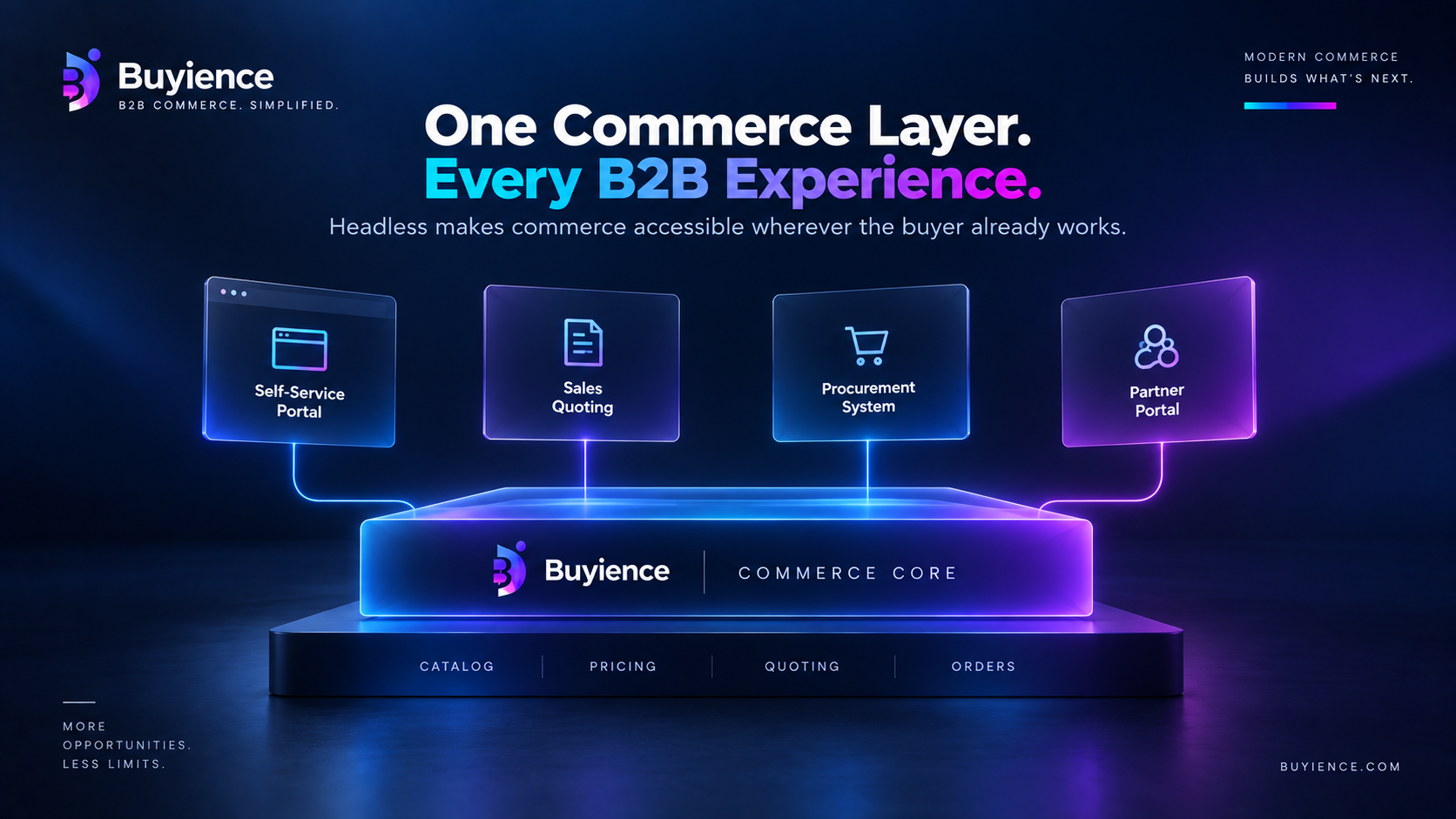
Headless is often explained as a UX trend—"you can design better storefronts now." That misses the point entirely.
Headless is how B2B commerce becomes embedded, not visited.
A traditional storefront assumes a buyer logs in, browses products, and checks out. But that's not how modern B2B procurement works. A procurement manager logs into their own ERP or purchasing portal. From there, they need to source products from multiple suppliers. They don't want to switch tabs between five different vendor storefronts.
With headless architecture, you expose your catalog and ordering capability through APIs. The procurement manager's own system integrates directly with your commerce layer. They browse, configure, and order without leaving their primary system. From the vendor's perspective, they've removed the gate—the storefront—and made the underlying commerce directly accessible.
Sales teams benefit similarly. A sales rep quotes complex configurations during a call. With a headless design, the rep's quoting tool calls your pricing and catalog APIs, generates a quote, and syncs it to the CRM—all without opening a browser to your platform.
B2B is becoming less about visits and more about integrations. Headless is the architectural pattern that enables this shift.
Where Buyience Fits in a MACH-Based B2B Stack
Buyience doesn't replace an ERP, a CMS, a PIM, or a payment processor. It occupies a specific layer: B2B commerce orchestration and intelligence.
In a MACH-native B2B stack, you'll have an ERP system as your system of record for inventory and fulfillment. You'll have a PIM for product data. You'll have a CMS for content. Buyience sits as the orchestration layer that connects these systems and exposes commerce APIs.
Specifically, Buyience handles B2B-specific commerce logic: contract-based pricing rules, approval workflows, customer hierarchies, multi-entity buying, and complex order configurations. It translates between your ERP's inventory format and what your buyers need to see. It enforces contract terms in real-time. It generates quotes, processes orders through approval workflows, and syncs back to the ERP.
This is fundamentally different from what monolithic platforms do. A monolith tries to be the system of record for everything. Buyience is designed to be an intelligent middleware that knows B2B commerce deeply but defers to specialized systems for what they do best.
This approach matters because it means you're not betting your entire commerce operation on a single vendor. If you need a different PIM next year, you swap it. The commerce layer remains. If your ERP needs to change, you update the integration, not the whole stack.
Architecture as a Competitive Advantage in B2B
The winners in B2B commerce aren't the companies that built faster websites or added one more feature. They're the ones that reduced the time to ship new commerce capabilities.
A competitor wants to offer dynamic discounts based on customer lifetime value? With MACH architecture, it's a microservice change. Three weeks. With a monolith, it's a core platform enhancement. Six months.
A customer wants to integrate their procurement system directly into your platform? With headless APIs, you hand them documentation and a sandbox. One week to integrate. With a monolith, they get a webhook—something bolted onto the side.
This isn't about innovation theater. It's about organizational velocity. Companies that can ship faster win market share because they respond faster to customer needs.
MACH has moved from "nice to have" to "necessary" in B2B commerce. The market is fracturing between companies building on modern, composable architectures and companies still managing monolithic platforms they can't exit.
If you're building B2B commerce capabilities now, you're not choosing MACH because it's trendy. You're choosing it because the alternative—waiting for a monolithic platform to deliver your requirements—is too slow to compete.
FAQ
Questions, answered
What is MACH architecture in B2B commerce?
MACH architecture is a composable approach using microservices, API-first design, cloud-native infrastructure, and headless delivery to support complex B2B commerce workflows such as contract pricing, ERP integration, and multi-channel buying.
Why is MACH important for B2B ecommerce platforms?
B2B commerce involves complex pricing, approvals, integrations, and buyer journeys. MACH architecture allows these capabilities to evolve independently, reducing technical debt and accelerating innovation.
How does MACH differ from traditional monolithic B2B platforms?
Monolithic platforms bundle storefronts, logic, and integrations into a single system. MACH separates these concerns, enabling faster changes, safer upgrades, and better scalability.
Is headless commerce required for B2B?
For modern B2B buying—where procurement systems, sales tools, and partner portals interact directly with commerce—headless architecture is increasingly essential.
Does MACH architecture replace ERP systems?
No. MACH-based B2B commerce platforms integrate with ERPs rather than replacing them. ERP remains the system of record, while commerce orchestration operates independently.
Related articles
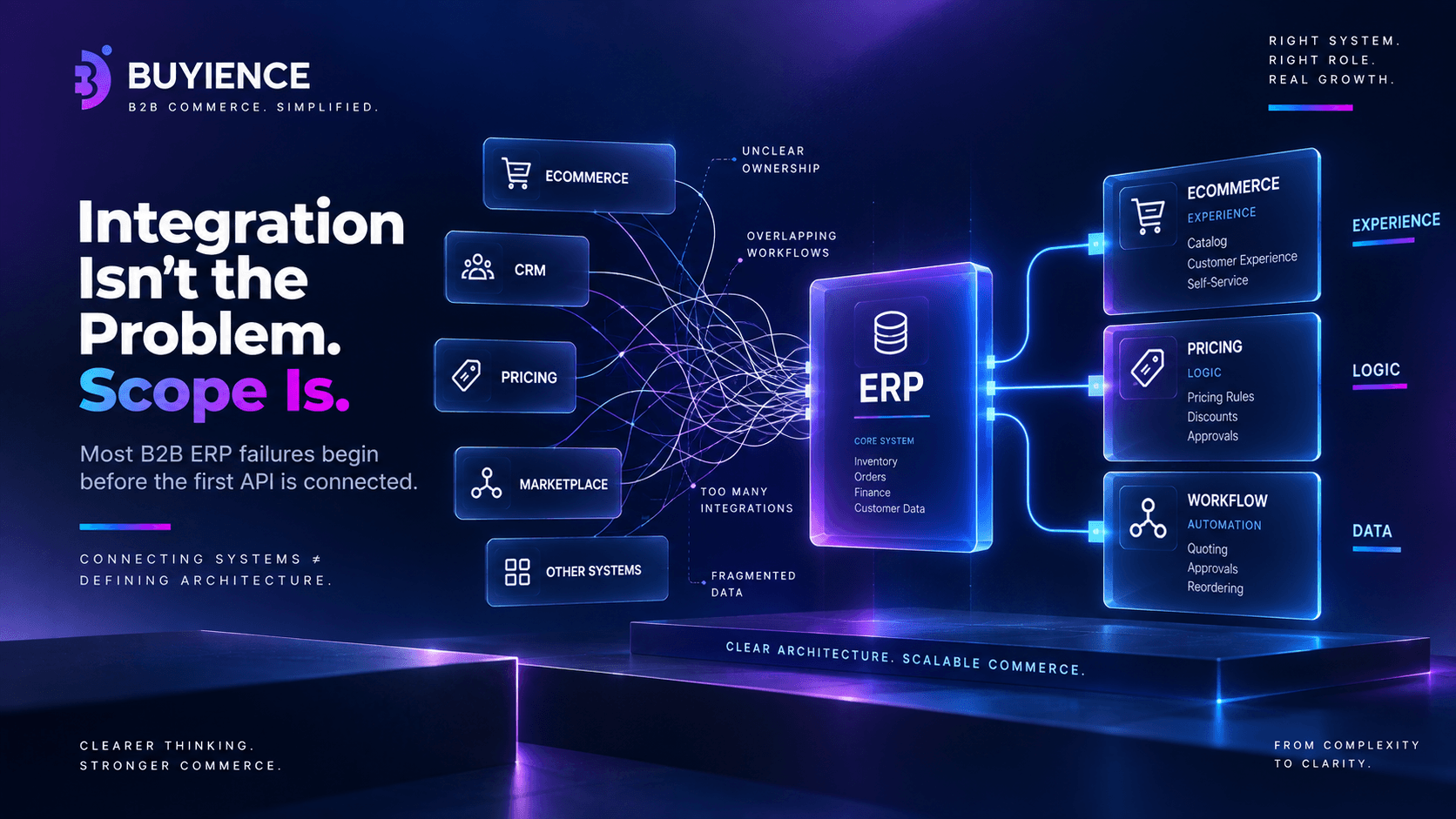
Why Most B2B ERP Integrations Fail
B2B ERP integration challenges refer to the difficulties of connecting ERP systems with ecommerce, pricing, and workflow tools—often resulting in slow performance, inconsistent data, and failed implementations due to poor planning and unclear system responsibilities.
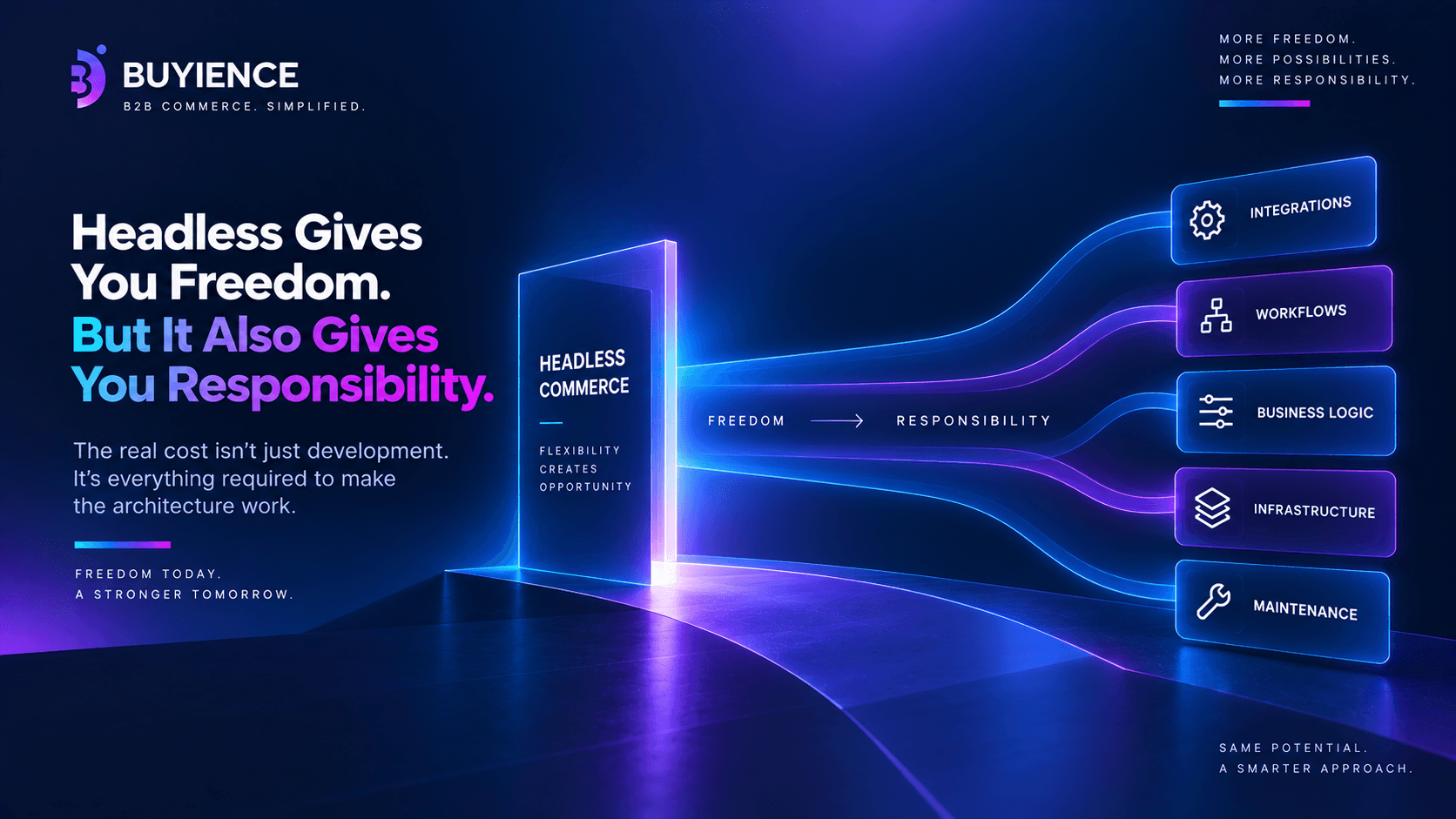
The Real Cost of Headless Commerce for B2B Companies
The cost of headless commerce in B2B includes not just development and infrastructure, but also ongoing expenses from integration complexity.
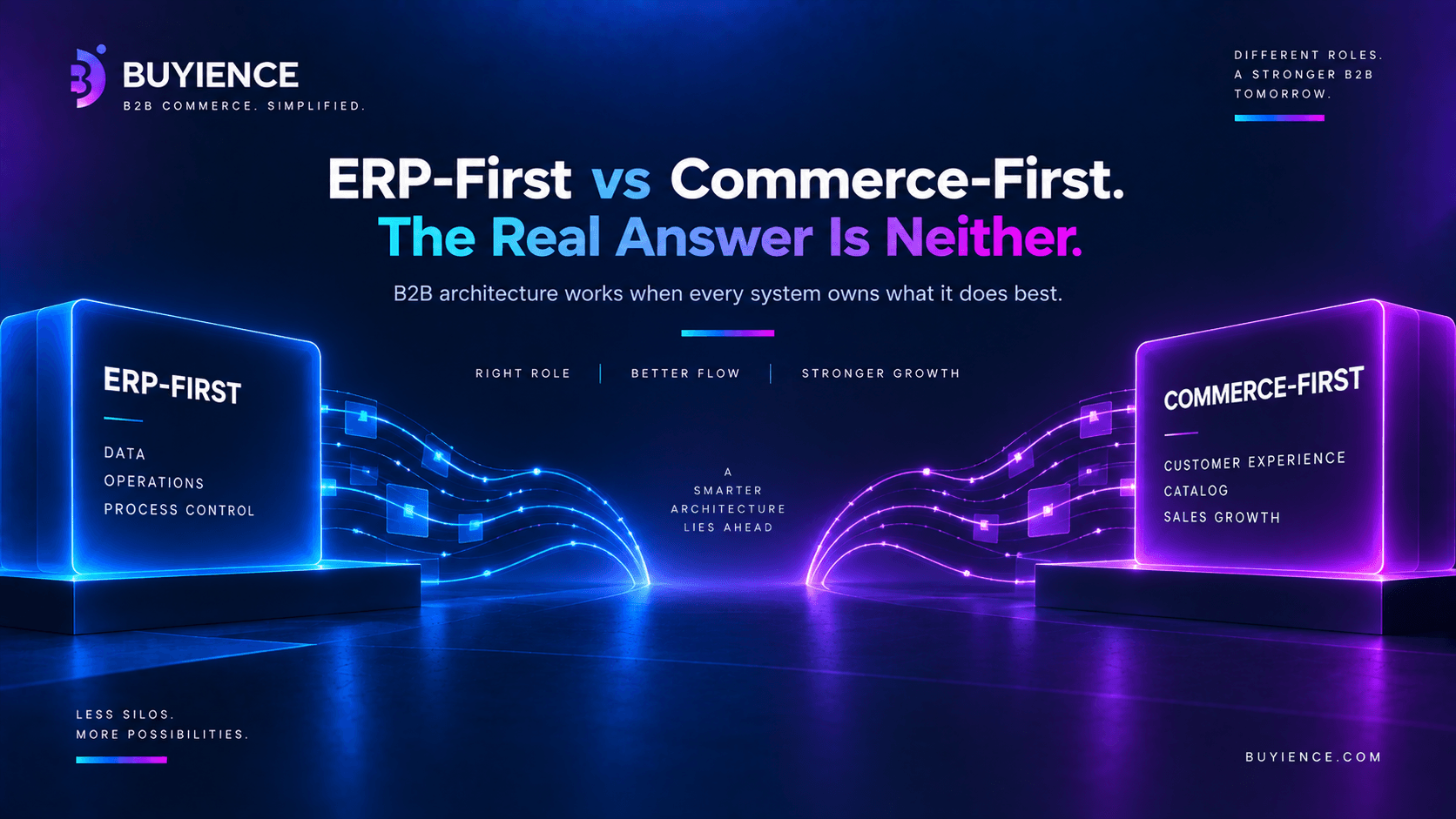
ERP-First vs Commerce-First Architecture in B2B — What Actually Works
ERP ecommerce integration in B2B is the process of connecting your ERP system with your ecommerce platform to sync data like pricing, inventory, orders, and customers—while enabling real-time workflows across systems.