
How Distributors Can Automate Quote-to-Order Processes (2026 Playbook)
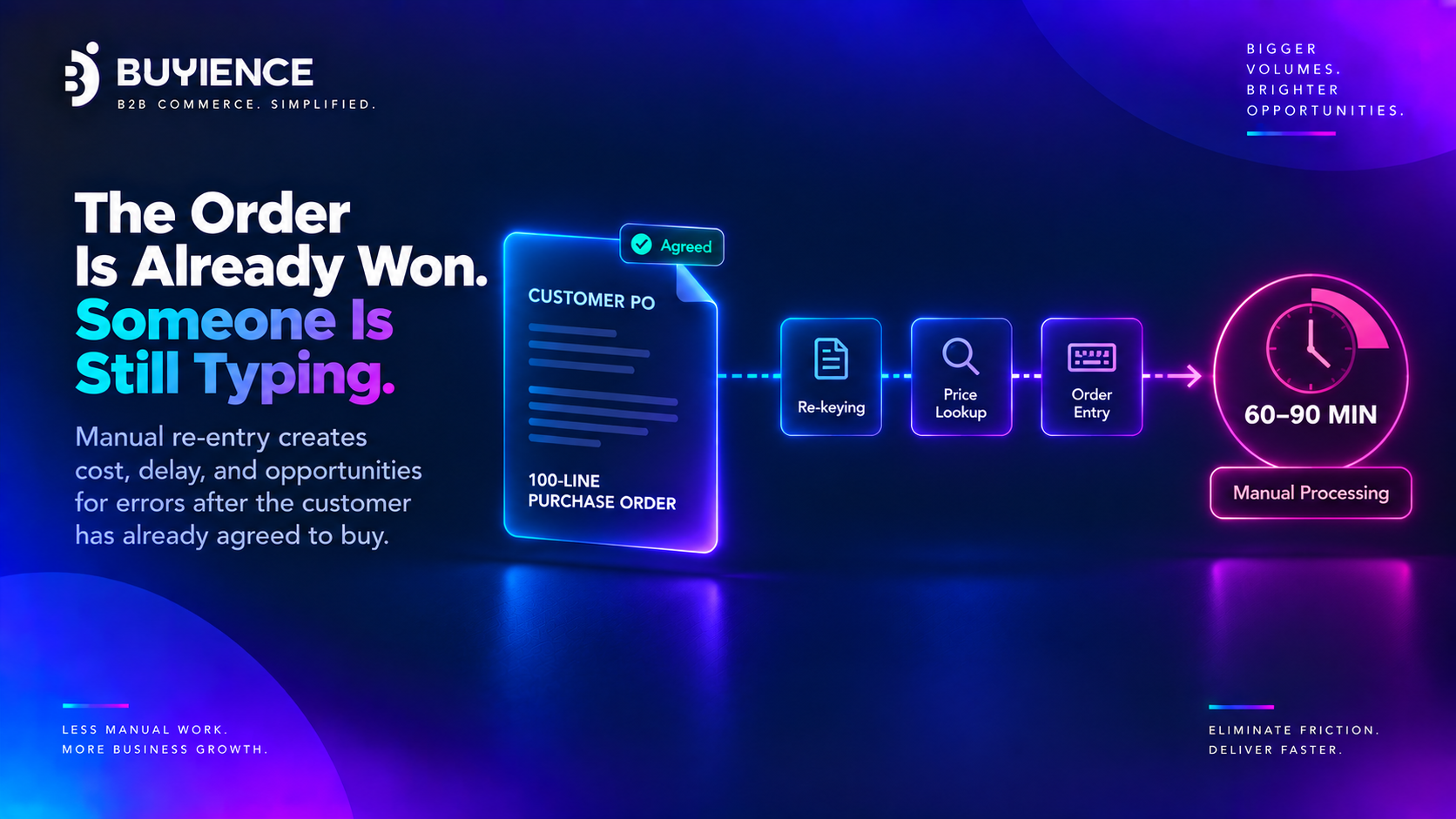
It's 7:45 AM. Your best customer service rep sits down, coffee in hand, and opens her inbox. At the top is a 100-line PDF purchase order from a contractor she's worked with for eight years. The part numbers are the customer's, not yours. The pricing tier has to be looked up. The ship-to is one of four addresses on file. She takes a breath and starts typing.

That exact moment plays out thousands of times every morning across distribution. Here's the part that should keep you up at night: the order has already been agreed to. The customer has spent their budget. The only thing standing between revenue earned and revenue booked is somebody, typing.
This is the quote-to-order gap, and for most distributors it's quietly draining hours, margin, and customer loyalty every single day. The good news: in 2026, quote-to-order automation has matured to the point where it can eliminate the overwhelming majority of that manual work — in weeks, not months. This playbook breaks down exactly where the friction lives, what it's costing you, and how to automate it end to end.
The Real Cost of Manual Quote-to-Order Processing
Before you can justify fixing a problem, you have to size it. And the numbers on manual quote-to-order work are worse than most distributors realize, because so much of the cost is hidden inside "how we've always done it."
Your salespeople aren't selling
Start with where the time actually goes. Inside sales teams in distribution report spending up to 80% of their time quoting, not selling — and order entry stacks on top of that. In one 2026 field survey, 63% of distributors said their CSRs spend at least half the workday on manual order entry and quoting combined.
Think about what that means. You didn't hire five customer service reps to be professional typists. You hired them to answer technical questions, upsell, solve problems, and build relationships. Every hour they spend re-keying a PO that's already been agreed to is an hour not spent on the work that actually grows the business.
Every order carries a real dollar cost
Manual order entry isn't free labor — it's expensive labor. Estimates put the cost of manual B2B order entry between $30 and $100 per order in direct labor alone. A single 100-line PO can take 60 to 90 minutes to enter by hand. For a distributor processing thousands of orders a month, that's six figures in labor cost before you count a single error.
Errors compound downstream
And errors are not rare. Even good CSRs make mistakes on 1–2% of manual entries when they're rushed or distracted, with an average cost per error around $75 once you factor in corrections, customer service time, potential re-ships, and customer frustration. Zoom out to the whole order lifecycle and it gets worse:
- Industry data suggests only about 5% of purchase orders match correctly on the first attempt
- Roughly 39% of invoices contain errors
Each mistake triggers follow-ups, corrections, and rework that stretch the cycle even further — and every one of them chips away at the trust you spent years building.
Speed decides who wins the deal
Here's the competitive sting. When a plumbing distributor receives a 150-line RFQ and a rep spends hours retyping it into the ERP, the contractor has often already sourced the materials elsewhere by the time the quote comes back. Contractors, engineers, and maintenance teams don't operate on your timeline — they expect quotes in minutes. When you lag, they move on. You don't lose these deals because of effort. You lose them because of speed.
The math that used to work is broken
For decades, distributors handled rising volume the same way: add a CSR every time order counts jumped. That model breaks in 2026. Costs are up, customers expect more, and margins are tighter. You cannot hire your way to a healthier margin when every incremental order costs you 40-plus minutes of fully loaded labor to process. This is a structural shift in the industry, not a temporary backlog — and the distributors who learn to process more orders with the same headcount, accurately, are the ones who'll still be standing in five years.
Why the Quote-to-Order Process Is So Hard to Fix Manually
If it were easy, you'd have solved it already. The quote-to-order process resists manual improvement because it's not one task — it's a fragmented chain of decisions and handoffs, each of which introduces delay and risk.
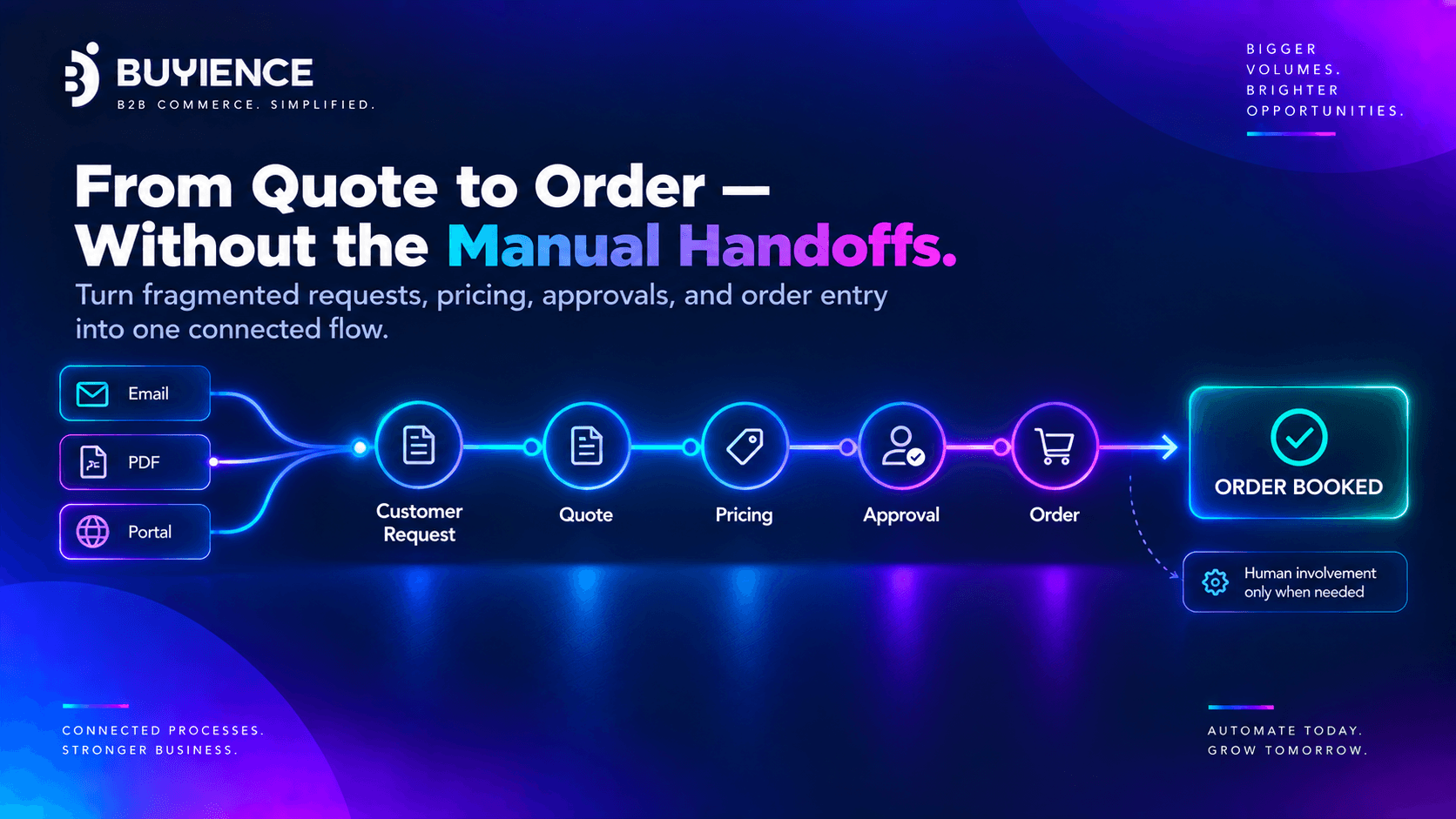
Consider everything that has to happen between "customer wants a price" and "order is booked in the ERP":
- A request arrives in some format — email, PDF, spreadsheet, phone, or web form
- Someone has to interpret it and match the customer's part numbers to yours
- Contract-specific pricing tiers have to be looked up
- Real-time availability has to be confirmed so you're not quoting something that's out of stock
- For configurable products, someone has to know which combinations are actually feasible — knowledge that usually lives in a veteran sales engineer's head, not in a structured system
- Discounts and margins have to be checked against thresholds, which kicks off approvals that move through email chains, chat messages, or verbal sign-offs that never get documented
- Only then does the order get keyed into the ERP
No wonder this process can take days or weeks in complex environments. And every handoff is a place where the deal can stall, an error can creep in, or a competitor can slip ahead. Configuration errors in particular tend to stay hidden until production planning begins — by which point they're expensive to fix.
What End-to-End Quote-to-Order Automation Actually Looks Like
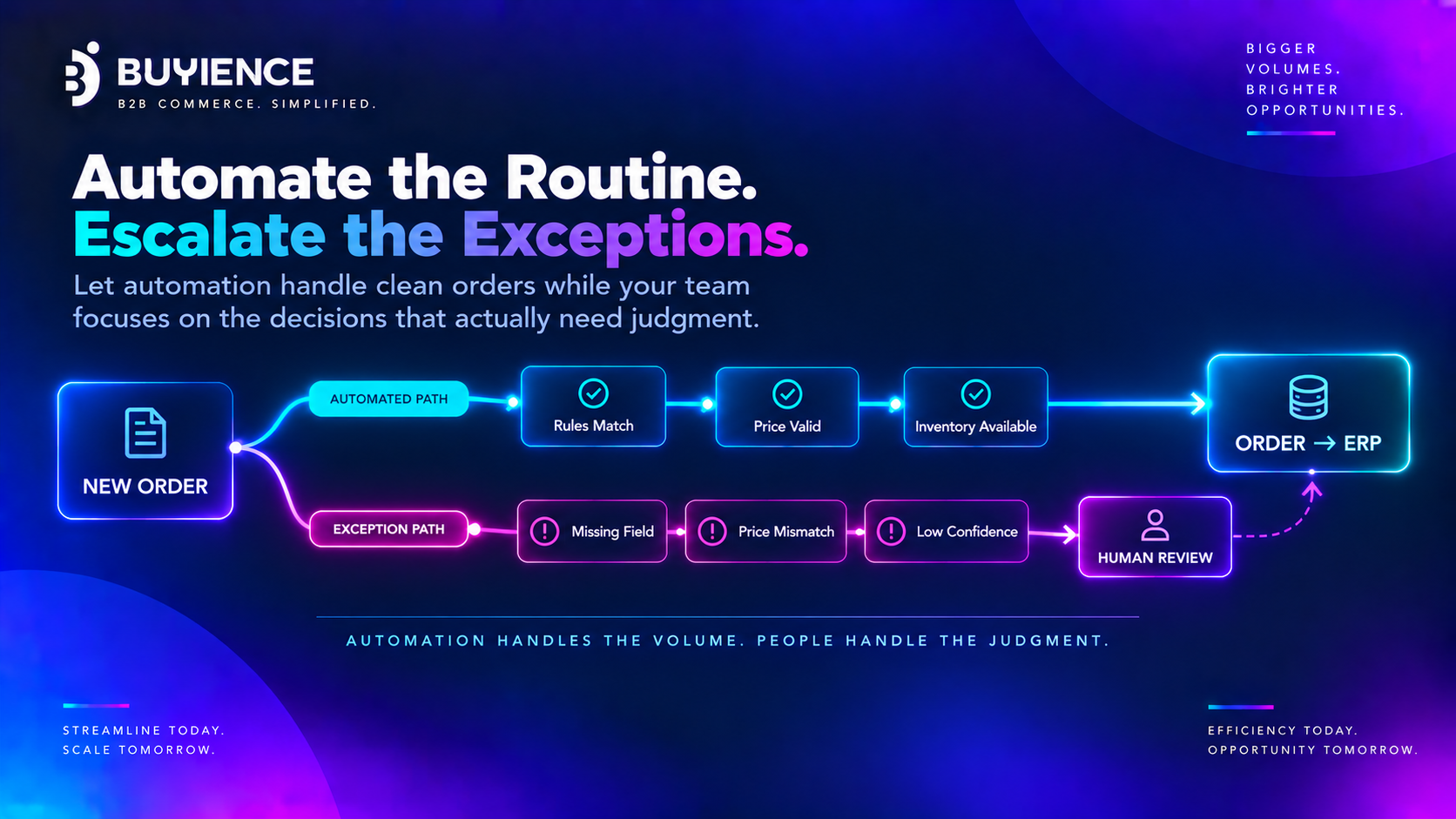
Modern quote-to-order automation isn't a single feature bolted onto your existing chaos. It's a connected workflow that carries a request from inbound to booked order with human involvement limited to the exceptions that genuinely need judgment. Here's what that looks like in practice, stage by stage.
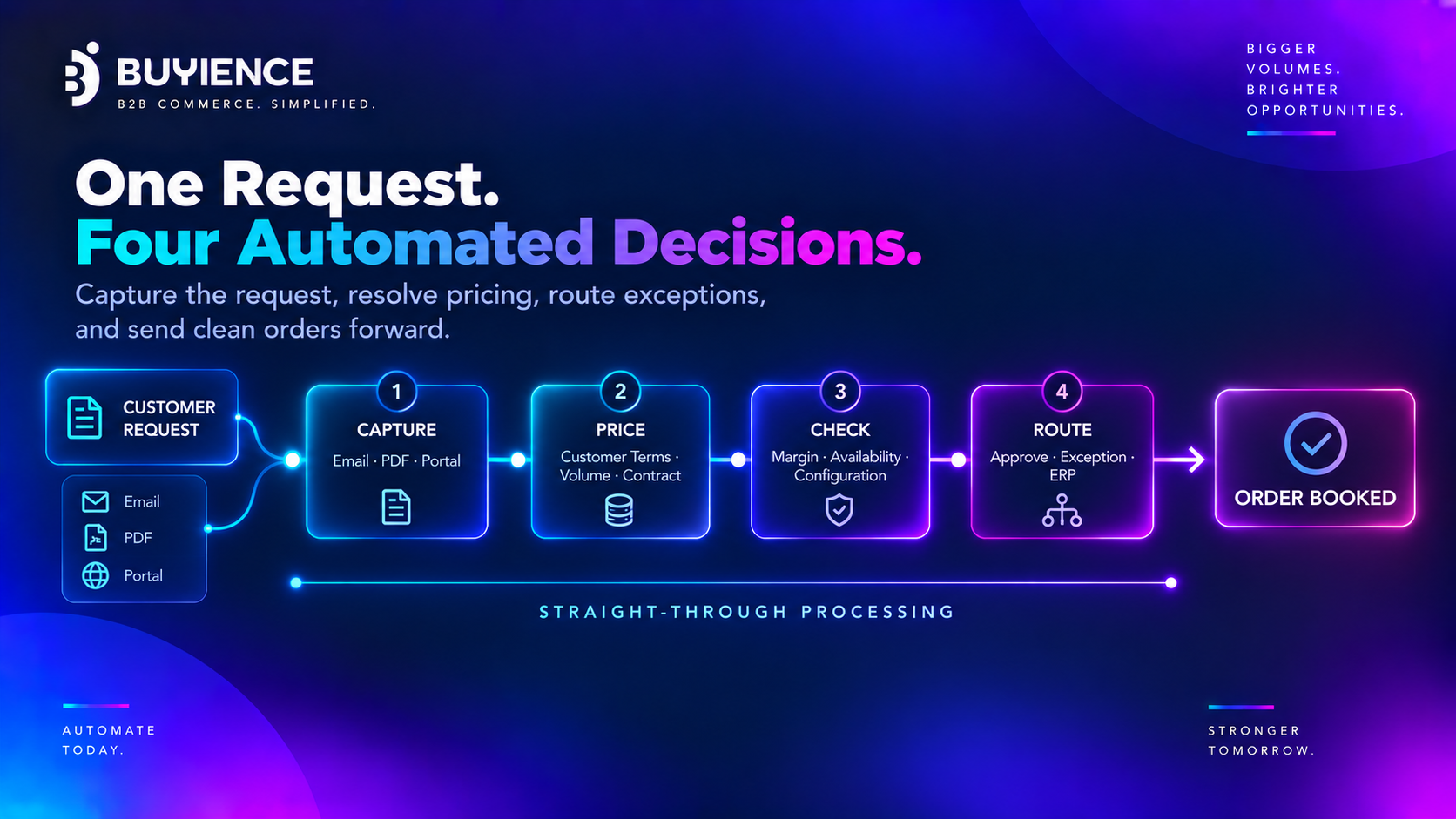
- Instant capture from any channel. Automation extracts order and quote data from emails, PDFs, spreadsheets, and portals — any format, any channel — so your customers don't have to change how they buy. Today's AI quote generation reads intent rather than rigid templates, which is why it handles messy part numbers and unusual layouts that used to break older OCR tools.
- Automated pricing and configuration. Instead of a rep hunting through catalogs and pricing sheets, the system applies contract-specific pricing and validates product configurations automatically, catching infeasible combinations before they become production problems.
- Rules-based approval routing. Rather than chasing sign-offs through email, the workflow routes automatically on predefined thresholds — for example, escalating deep discounts to a sales director or thin margins to finance review — and logs every approval as it happens. Nothing gets forgotten, and you get a clean audit trail.
- Straight-through processing to the ERP. Orders that meet all the rules flow directly into your system with no one typing, no one reviewing, no one waiting. Staff step in only on exceptions — missing fields, mismatched prices, low-confidence lines.
The results distributors report from this shift are dramatic:
- Straight-through processing benchmarks have jumped from roughly a third of orders to 75–80% on first contact, climbing past 99% on repeat customers
- Real-world implementations have cut order processing time by 87–92% and errors by around 90%
- One complex manufacturer saw quote turnaround fall from 5–7 business days to under 24 hours, with configuration errors dropping sharply at the same time
Crucially, the best of these tools don't demand a system replacement. They sit between the inbox and the ERP, complementing EDI, portals, and e-commerce rather than competing with them — and modern implementations go live in weeks, not the six-to-nine-month project plans that scared distributors off in the past.
Buyience: Quote-to-Order Automation Built for How Distributors Actually Sell
This is precisely the problem Buyience was built to solve. If your reps are drowning in RFQs, your quotes take days, and your margins are inconsistent from one deal to the next, Buyience automates the entire quote-to-order chain — and it's designed for the small and mid-sized distributors (5 to 200 employees) who've outgrown spreadsheets but don't want an enterprise implementation nightmare.
Here's how each part of the platform attacks the friction we just walked through.
The AI Quote Engine ends the quoting bottleneck
When a customer requests a price, Buyience's AI Quote Engine instantly analyzes their history, your margins, current market conditions, and thousands of past successful deals — then recommends the optimal price. No catalog hunting, no pricing-sheet lookups, no guesswork. It even surfaces a win probability: a percentage forecast of how likely the customer is to accept, so your reps know which quotes to prioritize.
This is the difference between a quote that takes days and one that goes out in minutes. And because you set a hard margin floor — say, 20% minimum profit — the AI never prices below it, ending the margin inconsistency that comes from reps guessing. Distributors typically see quote turnaround drop from 2–3 days to under 2 hours, with average margins improving by 3 to 5 percentage points.
The Digital Sales Room replaces the email approval chain
Instead of negotiations and approvals scattered across inboxes, buyers and sellers work in a shared online space where both sides see the quote, make counter-offers, ask questions, and agree on terms — including Net 30/60/90 terms — in real time. Everything is logged in one place. This is what collapses a multi-day back-and-forth into a same-day close — and it's a big reason speed-driven win rates climb 15–25%.
The B2B Storefront lets clean orders place themselves
Your customers get their own login to browse products, see their negotiated prices, and place orders 24/7 — even at midnight when your office is closed. Orders placed through the storefront flow straight in with zero manual keying, which is exactly the straight-through processing that frees your CSRs from the keyboard.
Order & Inventory Management closes the loop
Once a deal is done, the order flows straight into your system, and you track what's in stock, what's shipped, and what's running low in one place. No more quoting something you can't fulfill, and no more "let me check and get back to you" when a customer calls about status.
Smart Automation handles the follow-ups
Routine work — follow-up emails, reminders on pending quotes, alerts on expiring deals — happens automatically. Your reps stop babysitting the pipeline and start re-engaging dormant accounts, upselling from purchase history, and doing the consultative work no algorithm can replace.
Handling the Objection: "This Sounds Like a Huge Project"
Let's be direct, because this is the fear that keeps capable distributors stuck. You've heard about B2B software projects that took the better part of a year, needed consultants, and cost a fortune. That reputation is real — and it's exactly why so many distributors are still keying orders by hand.
Buyience was built to break that pattern. You sign up, answer a few questions, and your store is ready in under 10 minutes. An AI setup assistant guides you through onboarding like a conversation. Import your products from a spreadsheet or connect your existing WooCommerce store, and you're selling. From signup to selling takes days, not months.
You also don't need a technical team to run it. If your CSRs can use email and a web browser, they can use Buyience. And because it complements your existing workflows rather than ripping them out, adoption tends to be natural — reps embrace it once they feel the time savings for themselves.
The Bottom Line for Distributors
The quote-to-order process is where distributor revenue goes to wait:
- Every manual quote is a chance for a competitor to respond faster
- Every re-keyed order is labor you're paying for and an error waiting to happen
- Every approval chasing through email is a deal losing momentum
- Every hour your reps spend typing is an hour they're not selling
Margins are shrinking, customer expectations are rising, and the hire-another-CSR playbook has stopped working. Automating quote-to-order isn't about replacing your people — it's about freeing them to do the work that actually creates value, while the software handles the typing, the pricing lookups, and the follow-ups. The distributors who make that shift now will serve faster, sell more proactively, and protect their margins. The ones who wait will keep losing deals to competitors who simply respond first.
Ready to Automate Your Quote-to-Order Process?
Buyience offers a 14-day free trial with full access to every feature — no credit card required to start. The AI setup assistant will have your storefront and quote engine live in minutes, so you can see automated quoting and ordering working with your own catalog before you commit to anything.
If your reps are stuck in the order-entry business instead of the customer-service business, it's time to change that.
Visit buyience.com to start your free trial — or contact our team for a personalized demo.
From Signup to Selling in Days, Not Months.
Related articles
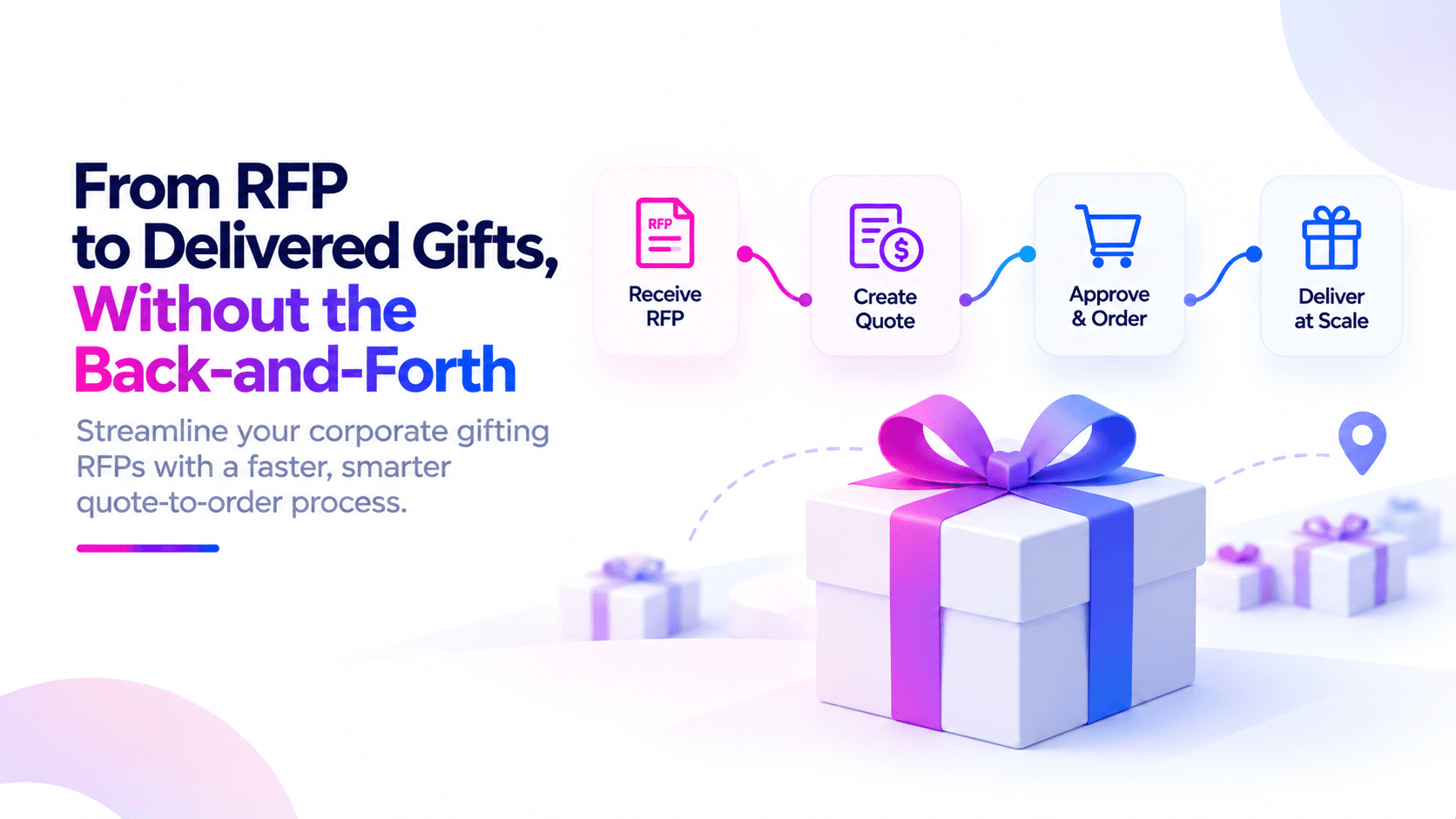
Corporate Gifting RFPs: Streamlining the Quote-to-Order Process
Corporate gifting RFPs are expensive to respond to and easy to lose for reasons unrelated to your actual capability — a missed compliance requirement, a slow response, or pricing that couldn't be revised fast enough during evaluation. The businesses that win consistently qualify hard before responding, build responses from reusable components rather than from scratch, and treat the gap between award and first order as a defined process rather than an improvisation.
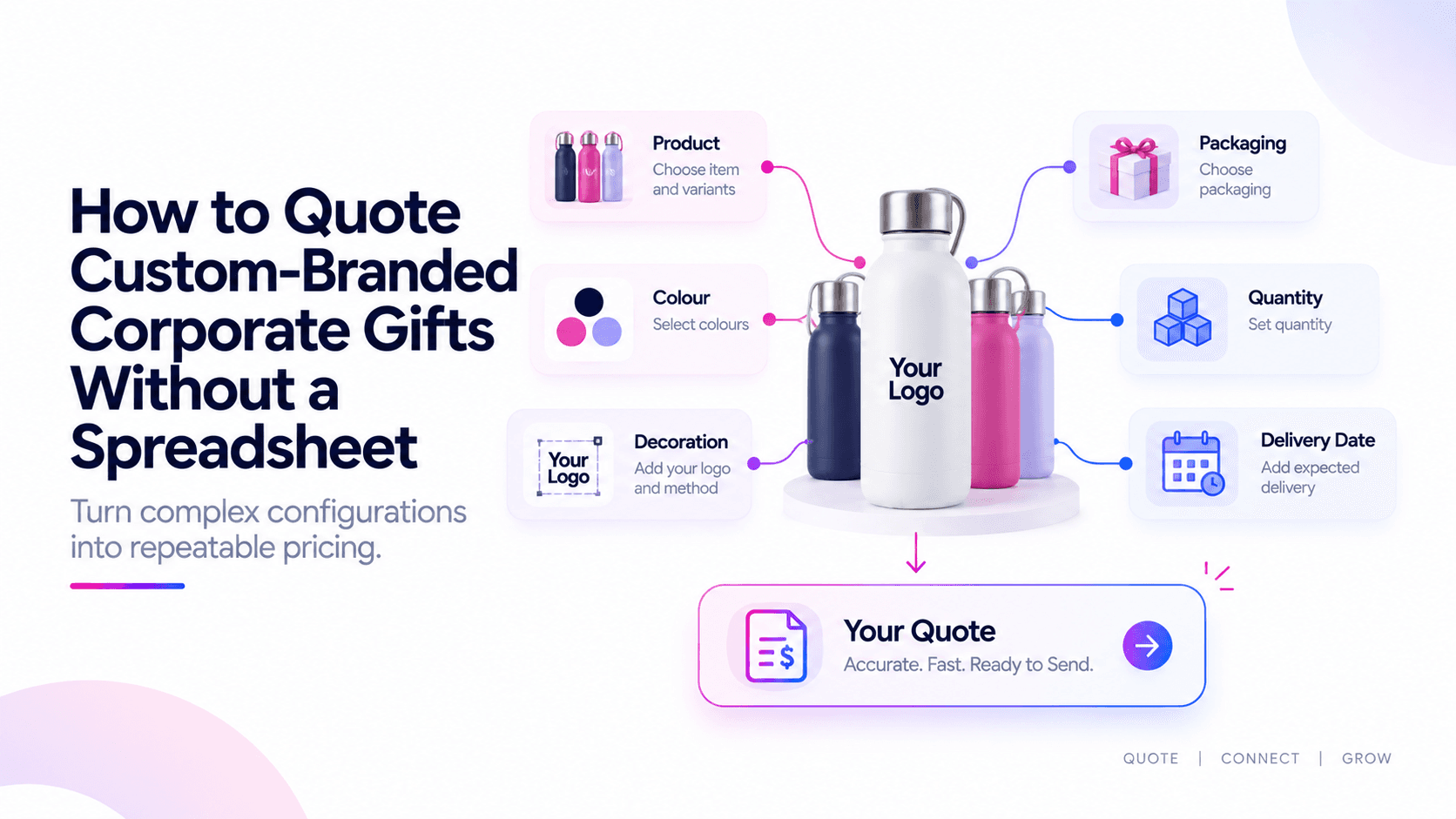
How to Quote Custom-Branded Corporate Gifts Without a Spreadsheet
Quoting a custom-branded gift order is a configuration problem, not a pricing lookup. Decoration method, setup fees, colour counts, placement counts, and variant splits all interact — and a spreadsheet forces you to rebuild that logic by hand for every quote. The fix is defining your cost components as rules once, so any combination prices itself. This guide covers how to break down a custom gift quote into its actual components and structure them so they're reusable.

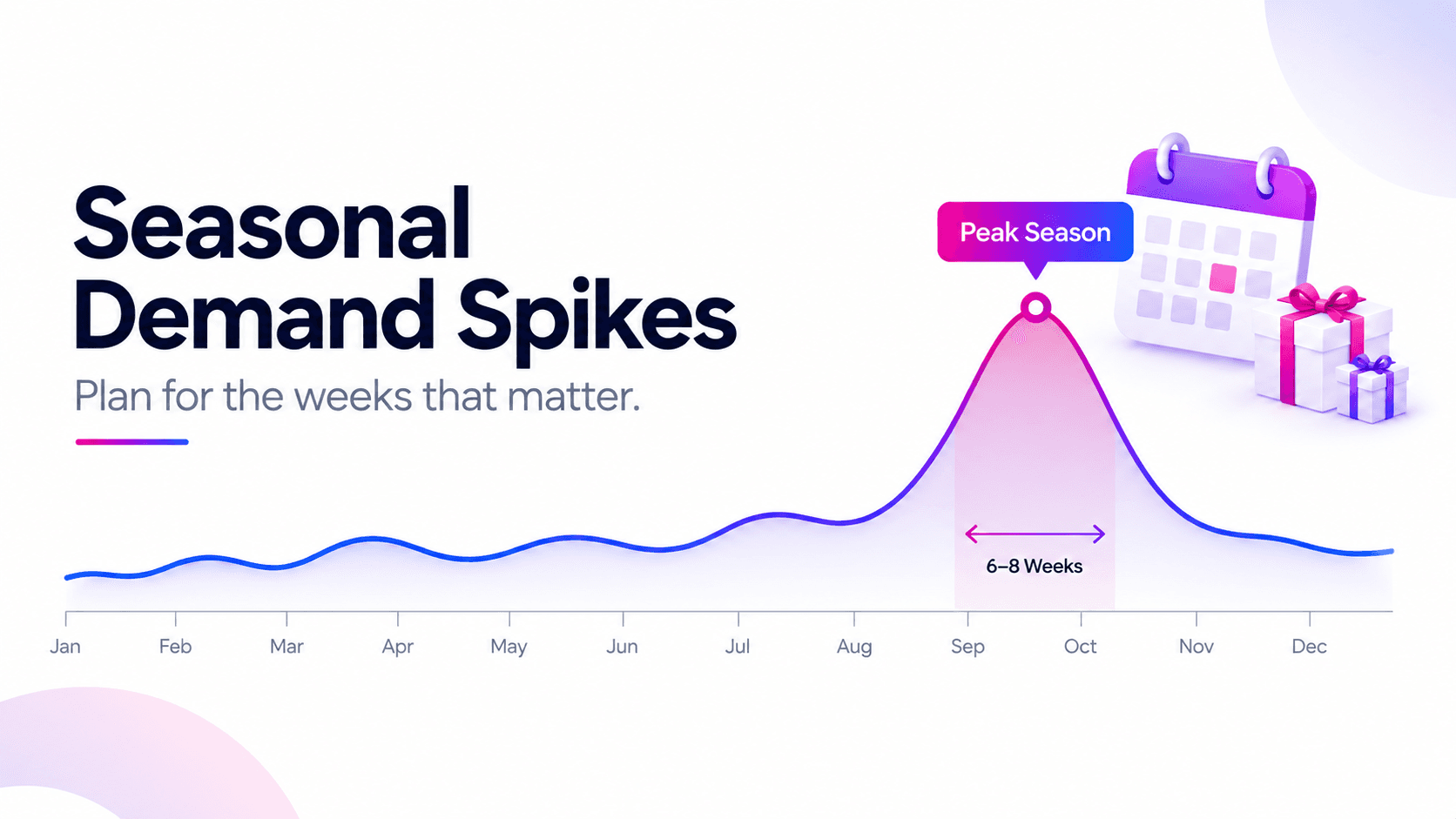
Seasonal Demand Spikes: Inventory Planning for Corporate Gifting Brands
Corporate gifting demand doesn't spread evenly across the year — it concentrates heavily into a handful of weeks, which means annual averages are close to useless for planning. Effective planning works backward from peak-week capacity rather than forward from annual volume, commits inventory early enough to clear supplier lead times, and separates what genuinely must be pre-committed from what can stay flexible. This guide covers how to build that plan.