
AI Quote Generation in B2B — What's Real vs Marketing
Every B2B quoting vendor now claims AI capabilities. Most are automating the wrong layer. Until your pricing data is structured, governed, and real-time, AI quoting is just faster guessing.

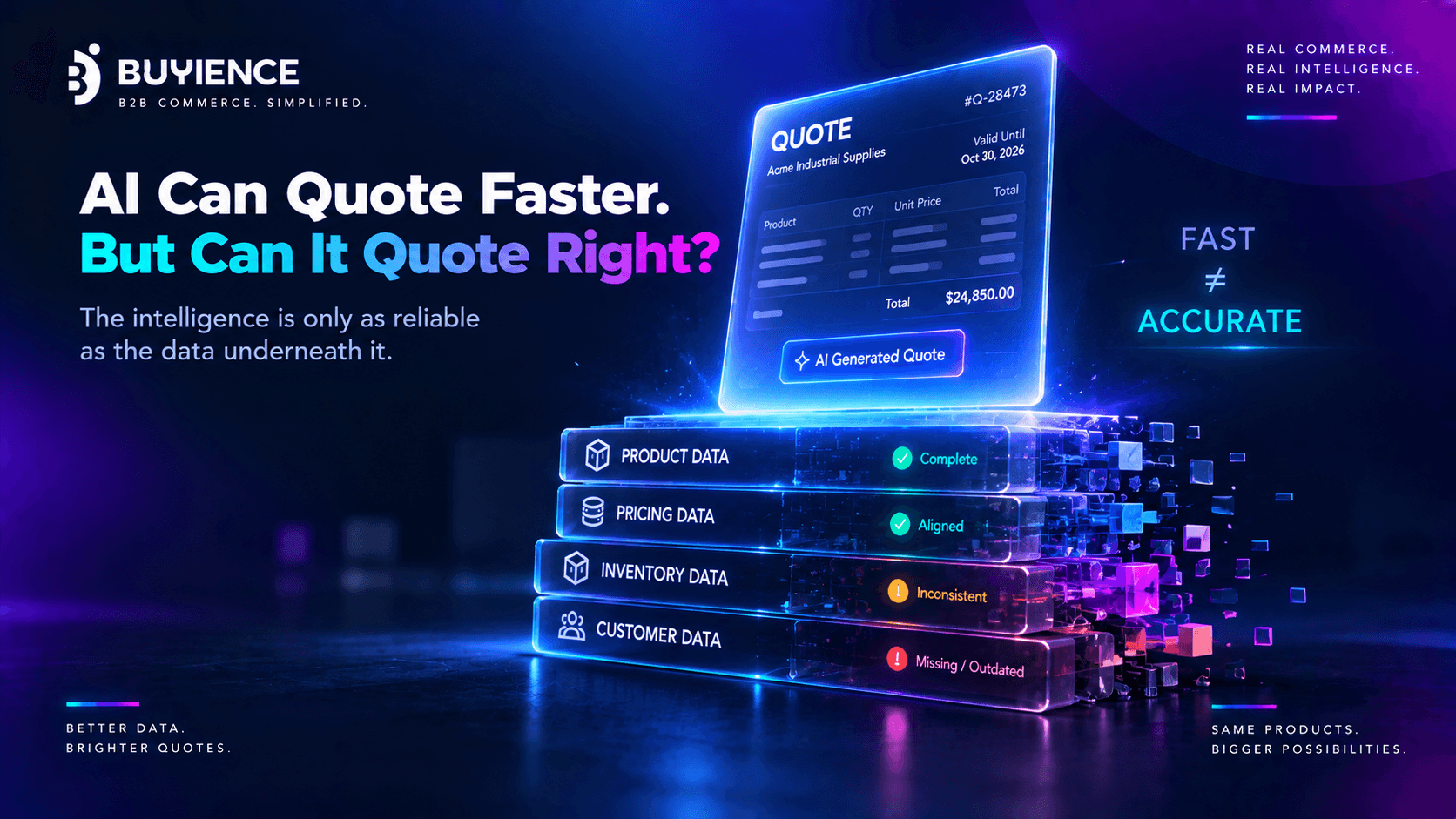
The AI Quoting Gold Rush
AI-powered quoting has become the most overused claim in B2B commerce. Open any CPQ vendor's website and AI is mentioned on the homepage — sometimes before the product is even described. The promise is consistent: faster quotes, smarter pricing, fewer errors, shorter sales cycles.
Some of these claims are real. But the gap between the marketing narrative and operational reality is significant, and B2B teams evaluating AI quoting software in 2026 need a framework for separating what works from what's still aspirational.
The core issue isn't whether AI can improve quoting. It can. The issue is that AI is being applied to a data problem most organisations haven't solved yet. When you apply intelligence to unreliable data, you don't get smart quotes. You get confidently wrong ones.
What AI Actually Does in B2B Quoting Today
Strip away the marketing language and the current state of AI in B2B quoting falls into four functional categories. Each delivers different levels of real value.
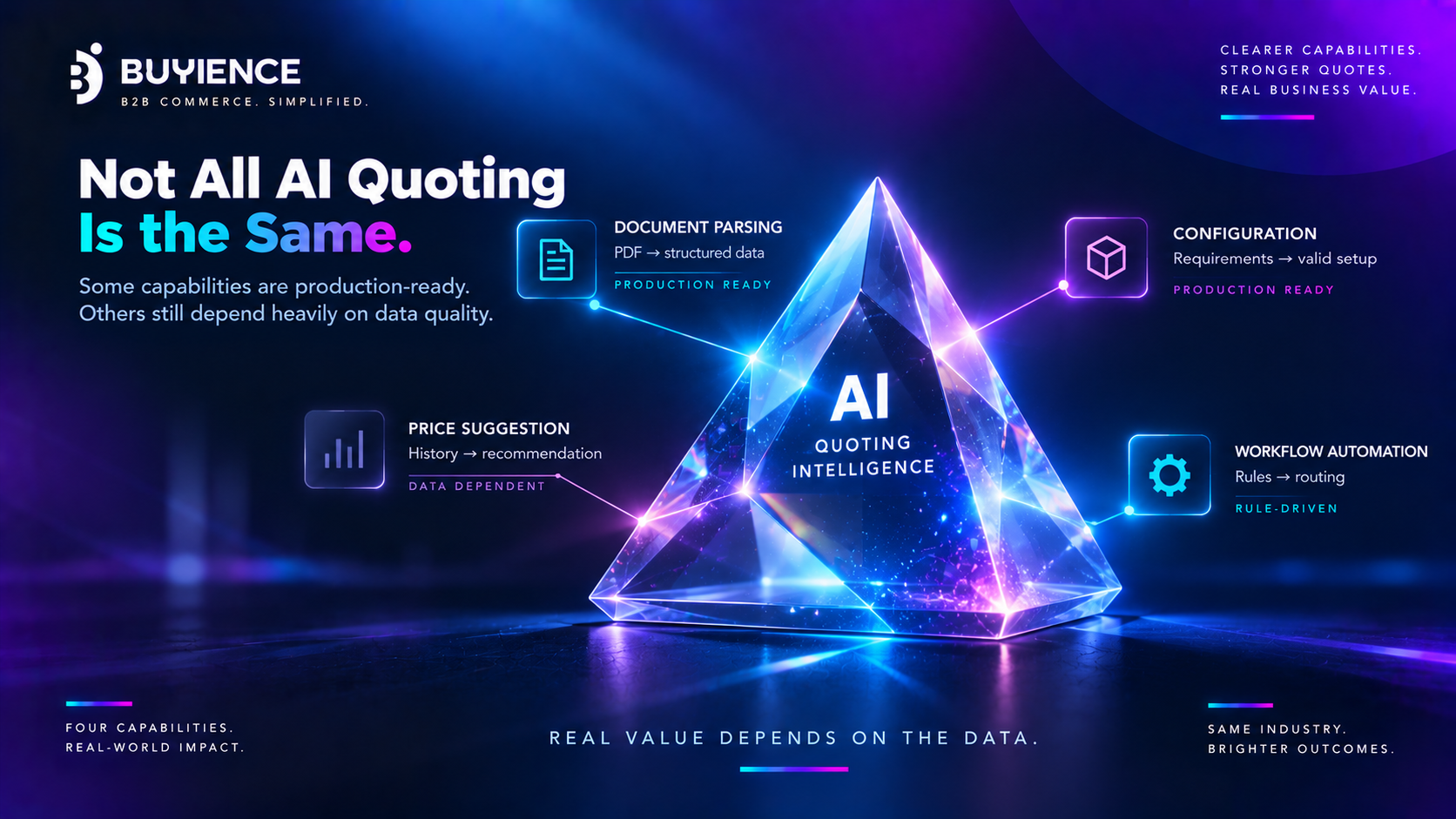
- Document parsing and data extraction — This is where AI delivers the most immediate, proven value. NLP that reads inbound RFQs — PDFs, emails, spreadsheets, forwarded purchase orders — and extracts product identifiers, quantities, delivery requirements, and customer details into structured data. This eliminates hours of manual data entry per quote request and is genuinely production-ready across multiple platforms today.
- Configuration assistance — For businesses selling configurable products, AI can guide product selection by interpreting buyer requirements and suggesting valid configurations. This is valuable when catalogs are large, configurations have complex dependency rules, and reps lack deep technical knowledge across every product line. It works well when product data and configuration rules are well-structured. It fails when they aren't.
- Price suggestion and optimisation — This is where marketing outpaces reality. Some vendors claim AI that "optimises" pricing by analysing historical win/loss data, competitor signals, and market conditions to recommend the ideal price point. In practice, it requires clean, comprehensive historical data that most B2B operations don't have. Win/loss data in most CRMs is incomplete, inconsistently coded, and rarely connected to the pricing variables that influenced outcomes. AI pricing optimisation is real in industries with high transaction volumes and clean data. In mid-market B2B with negotiated pricing, it's mostly aspirational.
- Workflow automation — AI-powered routing — cutting the cost of manual quote approvals by determining which approval path a quote should follow, predicting whether a quote will need revision, flagging quotes that deviate from historical patterns. This is a legitimate application, but calling it "AI" is generous in most implementations. Rule-based routing with statistical pattern matching is more accurate. Useful, but not transformative.
The Data Problem Nobody Wants to Talk About
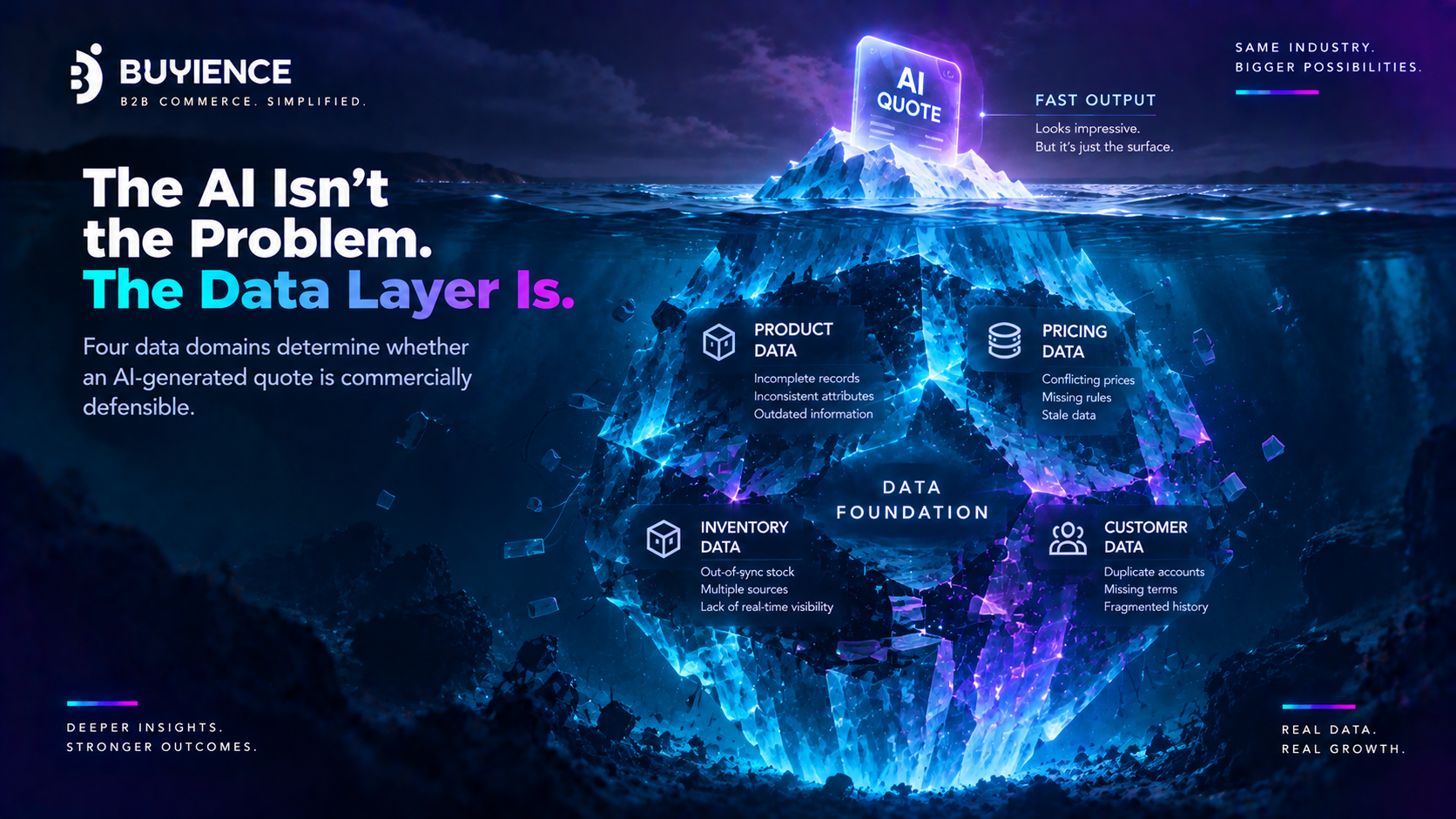
Here's the uncomfortable truth about AI quoting: the intelligence layer is the easy part. The hard part — the part that determines whether AI quoting actually works in production — is the data layer underneath it.
AI quoting software needs four data domains to generate an accurate, commercially defensible quote:
- Product data — what's being sold and how it's configured
- Pricing data — what it costs for this specific customer, inclusive of contracted rates, volume tiers, and payment terms
- Inventory data — what's available, in which warehouse, at what lead time
- Customer data — who's buying, what terms they've negotiated, what approval rules apply
In most B2B operations, these four domains live in different systems, updated at different frequencies, governed by different teams, and connected through manual processes, fragile ERP integrations, or nightly batch syncs. The product catalog is in the PIM or ERP. The pricing rules are split across the ERP, spreadsheets, and rep memory. Inventory is in the WMS, queried through syncs that might be hours old. Customer terms live across the CRM, ERP, and a contract management system — or more commonly, in an email thread.
When AI quoting software queries these fragmented sources, it assembles a quote from data that may be stale, inconsistent, or incomplete. The AI doesn't know the pricing spreadsheet was updated yesterday but the ERP sync hasn't run. It doesn't know the customer's payment terms were renegotiated last week but the CRM hasn't been updated. The result is a quote generated fast — and potentially wrong in ways that aren't visible until the order hits fulfilment.
Research confirms this is widespread. Industry data suggests the majority of organisations rate their data quality as average or worse, and poor data quality is the primary reason many AI initiatives never reach production. In quoting, that cost manifests as margin leakage, order errors, and the operational overhead of correcting quotes that should have been right the first time.
The Three Levels of AI Quoting Maturity
Not all AI quoting implementations are equal. The maturity of the implementation depends less on the AI model and more on the data infrastructure supporting it. Three distinct levels emerge.
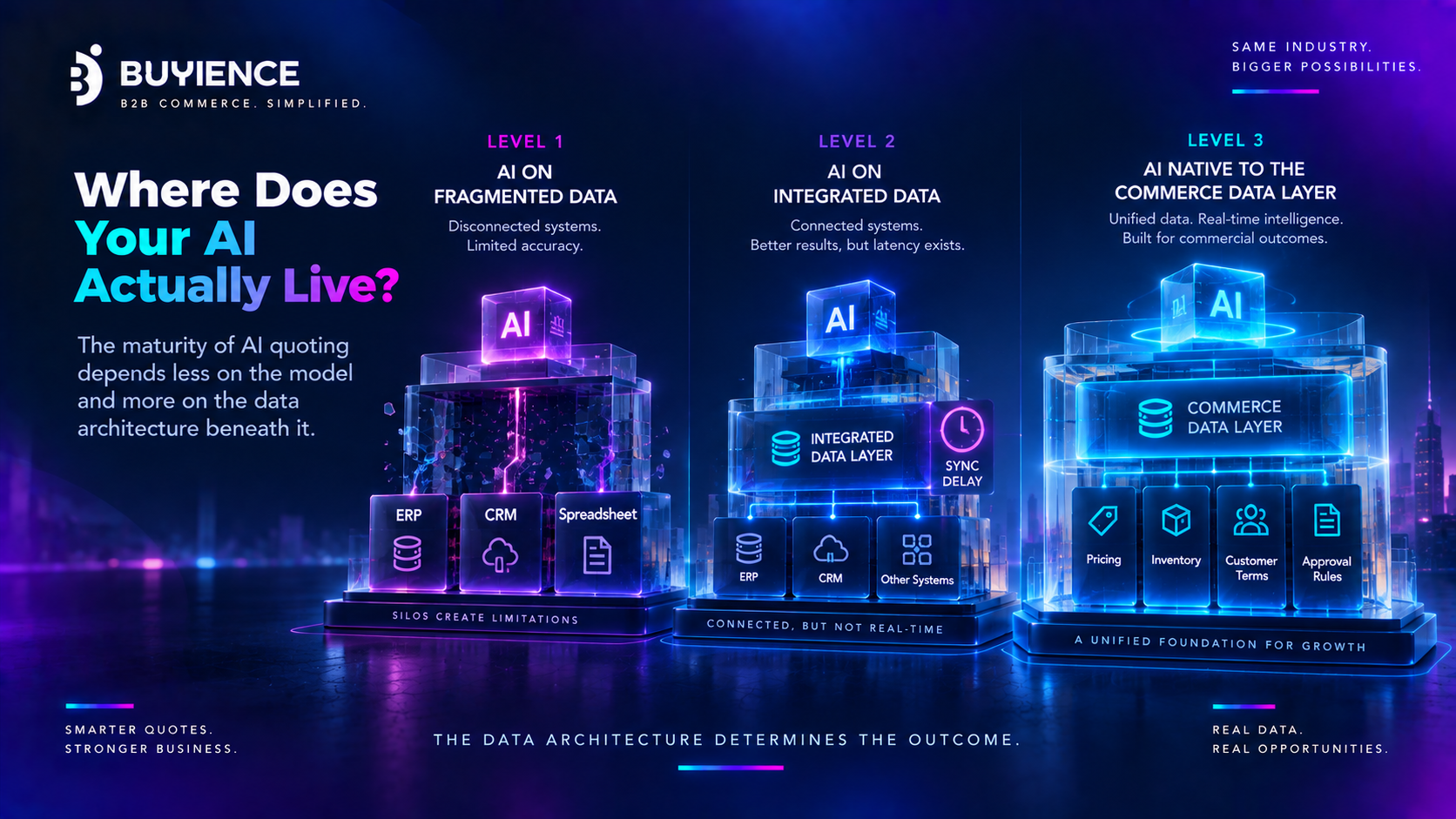
- Level 1: AI on top of fragmented data — The most common implementation. An AI layer sits on top of existing systems — ERP, CRM, spreadsheets — and queries them at the moment of quote creation. The AI is genuinely intelligent, but it's working with data that's inconsistent, stale, or incomplete. Quotes are generated faster, but error rates don't meaningfully improve because the underlying data problems are unchanged. This is the "faster guessing" scenario: you're automating the assembly of a quote from unreliable inputs.
- Level 2: AI on top of integrated data — A meaningful step up. Data from the ERP, PIM, CRM, and WMS is integrated into a unified layer — typically through middleware or an integration platform. The AI queries a single source of truth rather than assembling from multiple systems. Quotes are more consistent, but the limitation is latency: integrated data is only as current as the last sync, and in B2B environments where pricing and inventory change within the same day, batch integration creates a window of inaccuracy.
- Level 3: AI native to the commerce data layer — The highest-maturity implementation. AI doesn't query external systems or integrated data warehouses — it operates within the same platform that owns the pricing logic, inventory state, customer terms, and approval rules. There's no sync lag because the data isn't being synchronised from somewhere else. The AI resolves the quote against live data, in real time, at the moment of creation. This is where AI quoting delivers its full potential: speed, accuracy, and commercial defensibility across the quote-to-order process.
The marketing narrative from most vendors describes Level 3 outcomes. The technical reality of most implementations is Level 1. The gap between the promise and the delivery is the data layer.
What to Actually Evaluate When Buying AI Quoting Software
If your team is evaluating AI quoting solutions, the questions that matter most aren't about the AI model. They're about the data architecture.
- Where does the pricing data live, and how current is it? — If the AI queries an ERP or spreadsheet for pricing, ask how frequently that data is synchronised. If the answer is "nightly batch" or "weekly export," the AI is generating quotes from data that may be hours or days old. For customer-specific pricing, the question is sharper: when a contract is renegotiated, how quickly does the new rate appear in the quoting system? If the answer involves manual updates, the AI doesn't solve the pricing accuracy problem — it just generates inaccurate quotes faster.
- Does the AI resolve pricing, inventory, and customer terms simultaneously? — A quote that shows the right price but can't confirm delivery is incomplete. A quote that confirms inventory but uses yesterday's pricing is commercially risky. The evaluation question is whether the AI resolves all four data domains — product, price, inventory, customer terms — in a single transaction or in sequential queries that may return inconsistent snapshots.
- What happens when the AI encounters data it can't resolve? — This is the reliability question most buyers forget to ask. When the AI can't find a customer's contracted rate, does it fall back to list price (potentially underquoting or overquoting), flag the gap for human review, or block the quote until the data is resolved? The fallback behaviour determines whether AI quoting is a productivity tool or a margin risk.
- Can you audit the AI's pricing decisions? — In B2B, every quote is a commercial commitment. Finance, commercial operations, and leadership need to understand why a specific price was quoted — which pricing rule was applied, which customer tier was referenced, whether the discount fell within approved parameters. If the AI generates a price without a traceable decision path, you've traded one opacity problem (rep-driven pricing with no audit trail) for another (AI-driven pricing with no audit trail).
- What's the data infrastructure prerequisite? — The most honest AI quoting vendors will tell you what data quality and structure they require before their product delivers value. If the answer is "just connect your ERP and CRM and we'll handle the rest," be skeptical. AI quoting works when the data is clean, structured, real-time, and governed. Vendors who don't acknowledge that prerequisite are selling the intelligence layer without accounting for the foundation it needs.
Where This Connects to Platform Architecture
The reason AI quoting maturity correlates with data architecture — not AI model sophistication — is that quoting is fundamentally a data resolution problem. The intelligence layer determines how efficiently resolution happens. The data layer determines whether it's accurate.
This is why AI quoting delivers the most value when it operates within a commerce platform that natively owns the data it needs. Nova Core's AI quoting engine, for example, doesn't query external systems for pricing, inventory, or customer terms. These data domains are native to the platform — API-addressable, real-time, and structured. When the AI generates a quote, it resolves against live customer-specific pricing, current multi-warehouse inventory, active contract parameters, and workflow-based approval rules within a single transaction. The AI doesn't assemble — it resolves. That distinction is the difference between faster quoting and accurate quoting.
The Readiness Assessment: Is Your Data Ready for AI Quoting?
Before investing in AI quoting software, assess whether your data infrastructure can support it. The AI is only as reliable as the data it resolves against.
These signals indicate your data is ready:
- Customer-specific pricing exists as queryable structured data in real time
- Inventory reflects current state across all warehouses, not a periodic sync
- Product configuration rules are codified in a system, not in sales playbooks
- Customer contract terms are maintained as structured records with audit trails
- Your quoting process already produces consistent outputs regardless of which rep generates the quote
These signals indicate you need data infrastructure work first:
- Pricing lives primarily in spreadsheets
- Customer-specific rates require manual lookup across multiple systems
- Inventory is confirmed after quotes are sent
- Configuration depends on senior rep knowledge
- You've had quotes generated at prices that couldn't be fulfilled
If the first set describes your operation, AI quoting will likely deliver measurable value. If the second set is more accurate, the prerequisite investment is data infrastructure — structuring, governing, and centralising the pricing, inventory, and customer data that AI needs to operate reliably.
Moving Forward
AI quoting in B2B is real — but it's not magic, and it's not a shortcut past data infrastructure work. The vendors delivering genuine value build AI on top of structured, real-time, governed data layers. The vendors delivering marketing value deploy AI on top of the same fragmented data that made manual quoting unreliable in the first place.
The question for B2B teams isn't "how smart is the AI?" It's "how clean is the data the AI will use?" The answer to the second question determines the value of the first.
Want to assess your AI quoting readiness? [Download the B2B AI Quoting Readiness Diagnostic] — a structured assessment covering the four data domains that determine whether AI quoting will deliver accuracy or just speed.
Questions, answered
What is AI quoting software in B2B?
AI quoting software uses machine learning and natural language processing to automate parts of B2B quote generation — including parsing inbound RFQs, extracting product and quantity data, applying pricing rules, suggesting configurations, and routing quotes for approval. The range of "AI" spans from document parsing (proven, production-ready) to pricing optimisation based on historical win/loss data (emerging, highly data-dependent). The value any AI quoting tool delivers depends primarily on the quality and currency of the pricing and product data it operates on.
Why does data quality matter more than AI model quality for B2B quoting?
A quote is a data resolution problem: it assembles product configuration, customer-specific pricing, inventory availability, and contract terms into a single commercial commitment. If any of those data domains is stale, incomplete, or inconsistent, the AI resolves the quote from unreliable inputs — generating quotes faster but not more accurately. Research suggests the majority of organisations rate their data quality as average or worse, and poor data quality is the leading reason AI initiatives fail to reach production.
What are the levels of AI quoting maturity?
Three levels define AI quoting maturity.
Level 1: AI layered on top of fragmented data sources (faster but not more accurate).
Level 2: AI operating on integrated data through middleware or data warehousing (more consistent but limited by sync latency).
Level 3: AI native to the commerce platform that owns pricing, inventory, and customer data (real-time resolution, highest accuracy). Most vendor marketing describes Level 3 outcomes; most implementations deliver Level 1 or Level 2.
How do I evaluate AI quoting software for B2B?
Focus on five areas: where pricing data lives and how current it is at quote creation; whether the AI resolves pricing, inventory, and customer terms simultaneously or sequentially; how the system handles data gaps (fallback behaviour); whether pricing decisions are auditable and traceable; and what data infrastructure prerequisites the vendor acknowledges. The data architecture matters more than the AI model.
Can AI quoting work without clean pricing data?
AI can deliver value in specific functions — particularly document parsing and RFQ data extraction — without fully clean pricing data. But for the core function of generating commercially defensible quotes with accurate prices, confirmed availability, and correct customer terms, clean, structured, real-time data is a prerequisite. Deploying AI quoting on fragmented or stale pricing data produces quotes faster without improving accuracy, which can increase margin leakage rather than reduce it.
Related articles

Corporate Gifting RFPs: Streamlining the Quote-to-Order Process
Corporate gifting RFPs are expensive to respond to and easy to lose for reasons unrelated to your actual capability — a missed compliance requirement, a slow response, or pricing that couldn't be revised fast enough during evaluation. The businesses that win consistently qualify hard before responding, build responses from reusable components rather than from scratch, and treat the gap between award and first order as a defined process rather than an improvisation.
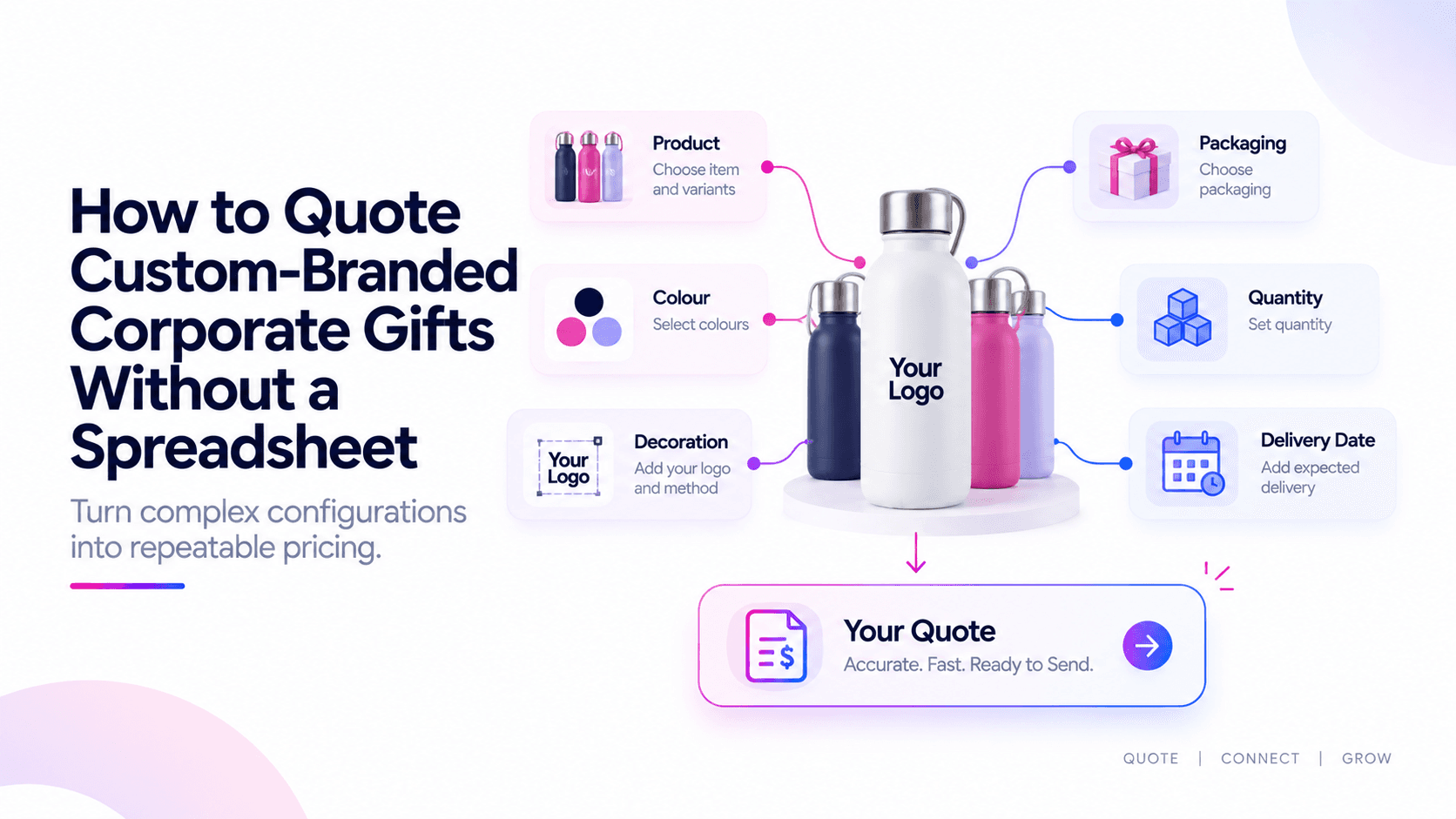
How to Quote Custom-Branded Corporate Gifts Without a Spreadsheet
Quoting a custom-branded gift order is a configuration problem, not a pricing lookup. Decoration method, setup fees, colour counts, placement counts, and variant splits all interact — and a spreadsheet forces you to rebuild that logic by hand for every quote. The fix is defining your cost components as rules once, so any combination prices itself. This guide covers how to break down a custom gift quote into its actual components and structure them so they're reusable.

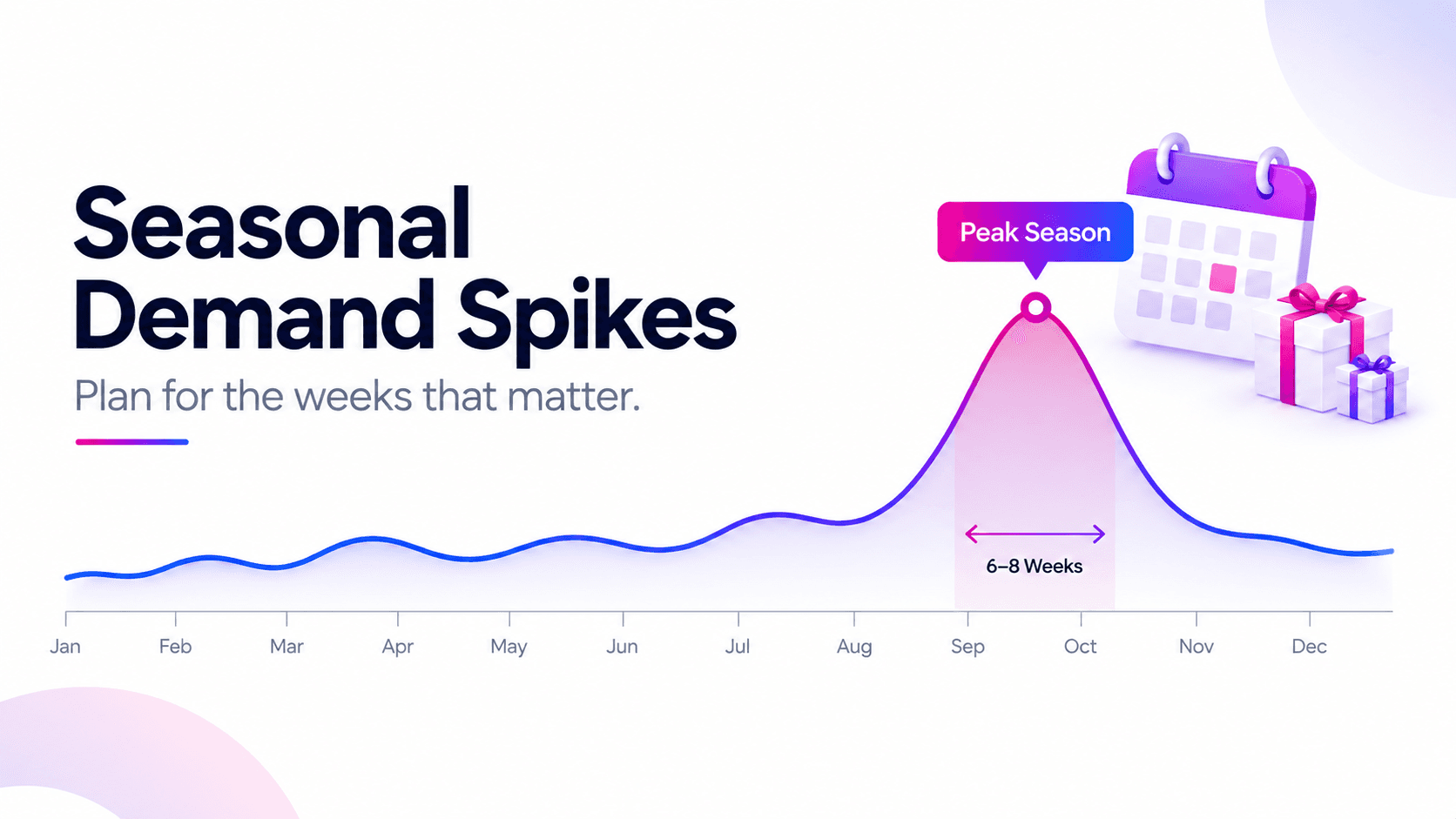
Seasonal Demand Spikes: Inventory Planning for Corporate Gifting Brands
Corporate gifting demand doesn't spread evenly across the year — it concentrates heavily into a handful of weeks, which means annual averages are close to useless for planning. Effective planning works backward from peak-week capacity rather than forward from annual volume, commits inventory early enough to clear supplier lead times, and separates what genuinely must be pre-committed from what can stay flexible. This guide covers how to build that plan.