
Industrial Supply Distributors: Moving From Phone/Email Orders to Self-Service
Phone and email ordering has been the default in fastener and industrial distribution for decades, and it works — until order volume grows past what a team can handle personally without delay or error. Moving to self-service doesn't mean removing the relationship or the phone line; it means giving customers who want to reorder a known SKU in thirty seconds the ability to do that, while keeping people available for the orders that genuinely need a conversation. This guide covers how to make that transition without disrupting the accounts that value the personal touch.

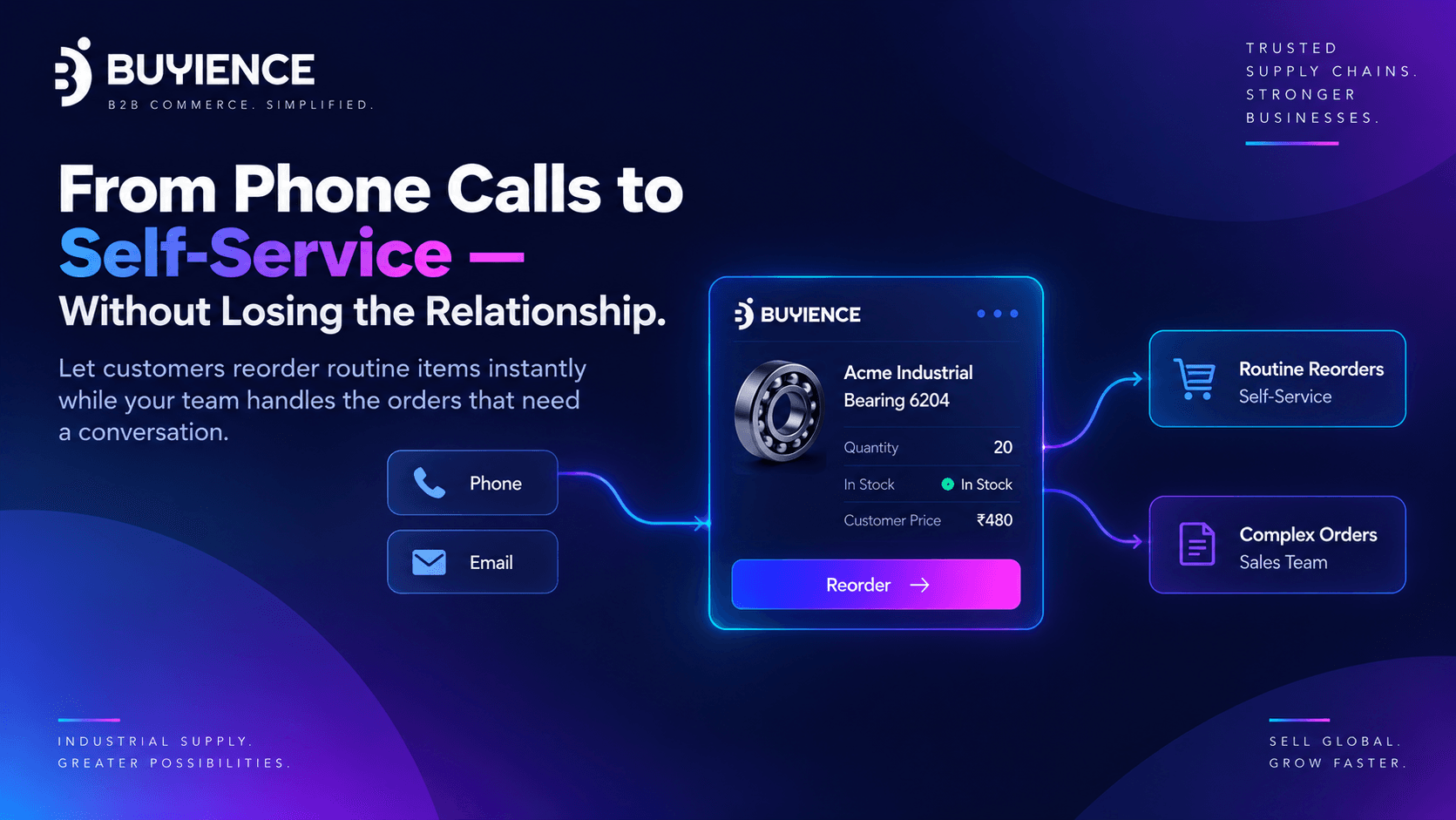
Most fastener and industrial supply distributors built their business on relationships — a customer calls, talks to someone who knows their account, and places an order. That model has real value, and moving to self-service ordering isn't about replacing it. It's about recognizing that not every order needs a phone call, and that forcing every reorder through a person creates a bottleneck that gets worse as the business grows.
A maintenance manager reordering the same bearing they've ordered fifty times before doesn't need a conversation. They need to log in, confirm the SKU and quantity, and check out — the same way they'd expect to interact with almost any other business they buy from repeatedly. Making them call or email for that isn't a sign of good service; increasingly, it's friction that a competitor without that friction can win on.
Why phone/email ordering becomes a bottleneck
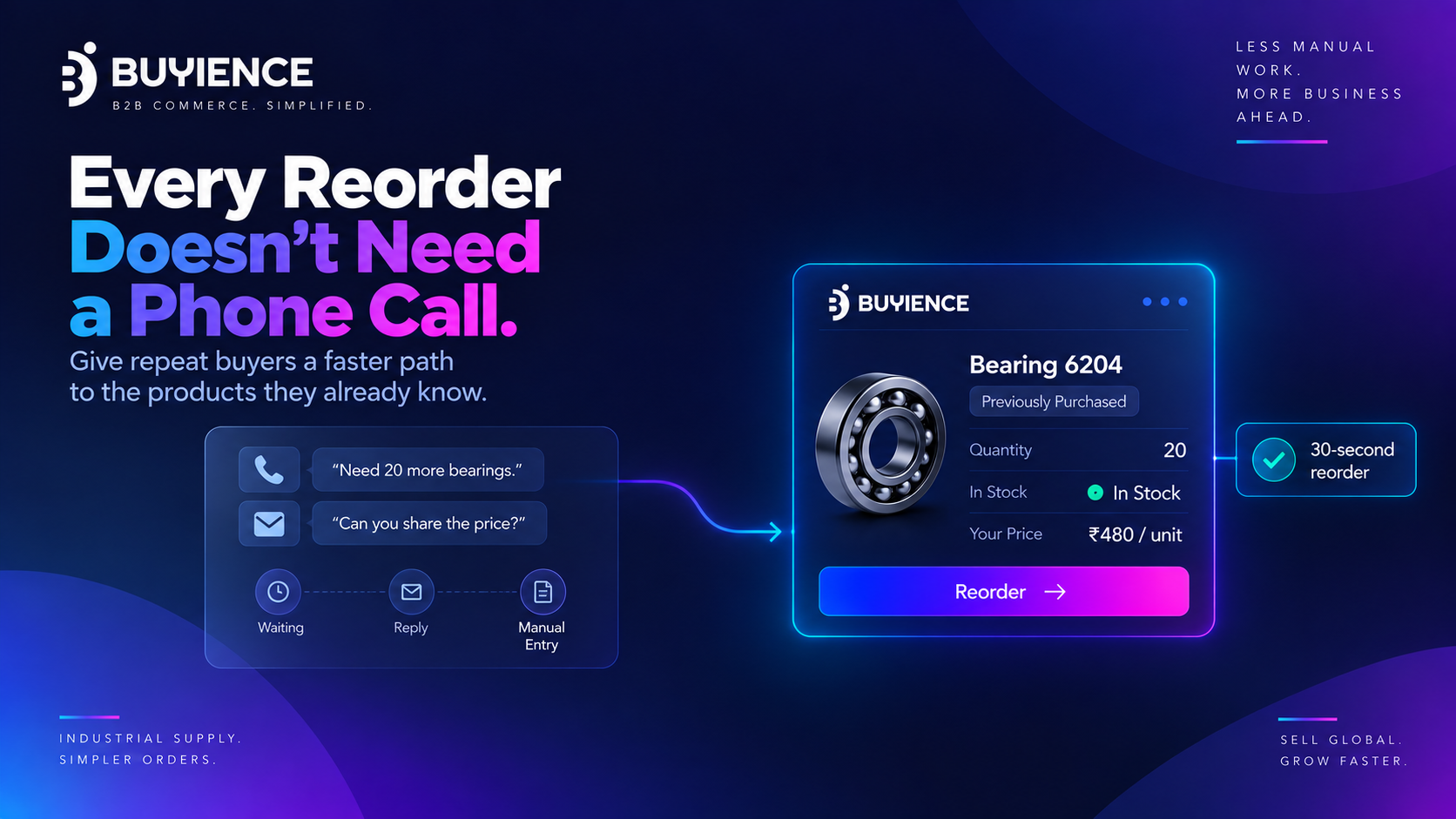
- It doesn't scale with headcount — Every order, regardless of complexity, requires a person's time: checking availability, confirming pricing, entering the order into whatever system tracks it. As order volume grows, this scales roughly linearly with staff time, which means growth requires proportional hiring rather than the efficiency gains that come from a self-service option handling the routine share of volume.
- It's slower for the customer, even when the team is responsive — A phone call or email requires the customer's time too — waiting for someone to answer, waiting for a reply, playing phone tag if the first attempt doesn't connect. A self-service reorder for a known SKU can happen in the time it takes to have that first phone conversation start.
- It concentrates knowledge in specific people — If pricing, availability, and account history live primarily in a rep's memory or a personal spreadsheet, the business becomes dependent on specific individuals being available — a real operational risk if someone is out sick, on vacation, or leaves the company.
- It makes off-hours ordering impossible — A maintenance team that discovers a part shortage at 9pm can't place an order until someone answers a phone the next business day, even if the part is in stock and could ship immediately.
- Errors compound with manual entry — Every manual step — hearing an order over the phone, transcribing it, re-entering it into an order system — is a chance for a transcription error, a wrong quantity, or a missed detail, in a way that a customer entering their own order directly isn't exposed to.
What self-service should — and shouldn't — replace
The goal isn't to eliminate the phone line or push every customer toward self-service regardless of preference. Some orders genuinely benefit from a conversation: a first-time customer who needs guidance, a complex custom specification, a large order that warrants a relationship touchpoint, or simply a long-standing customer who prefers calling and represents enough business that accommodating that preference makes sense.
The realistic goal is giving customers a choice, and making the self-service option good enough that customers who'd genuinely prefer it — often a larger share than distributors initially expect — actually use it, freeing up phone and email capacity for the orders and customers that need personal attention.
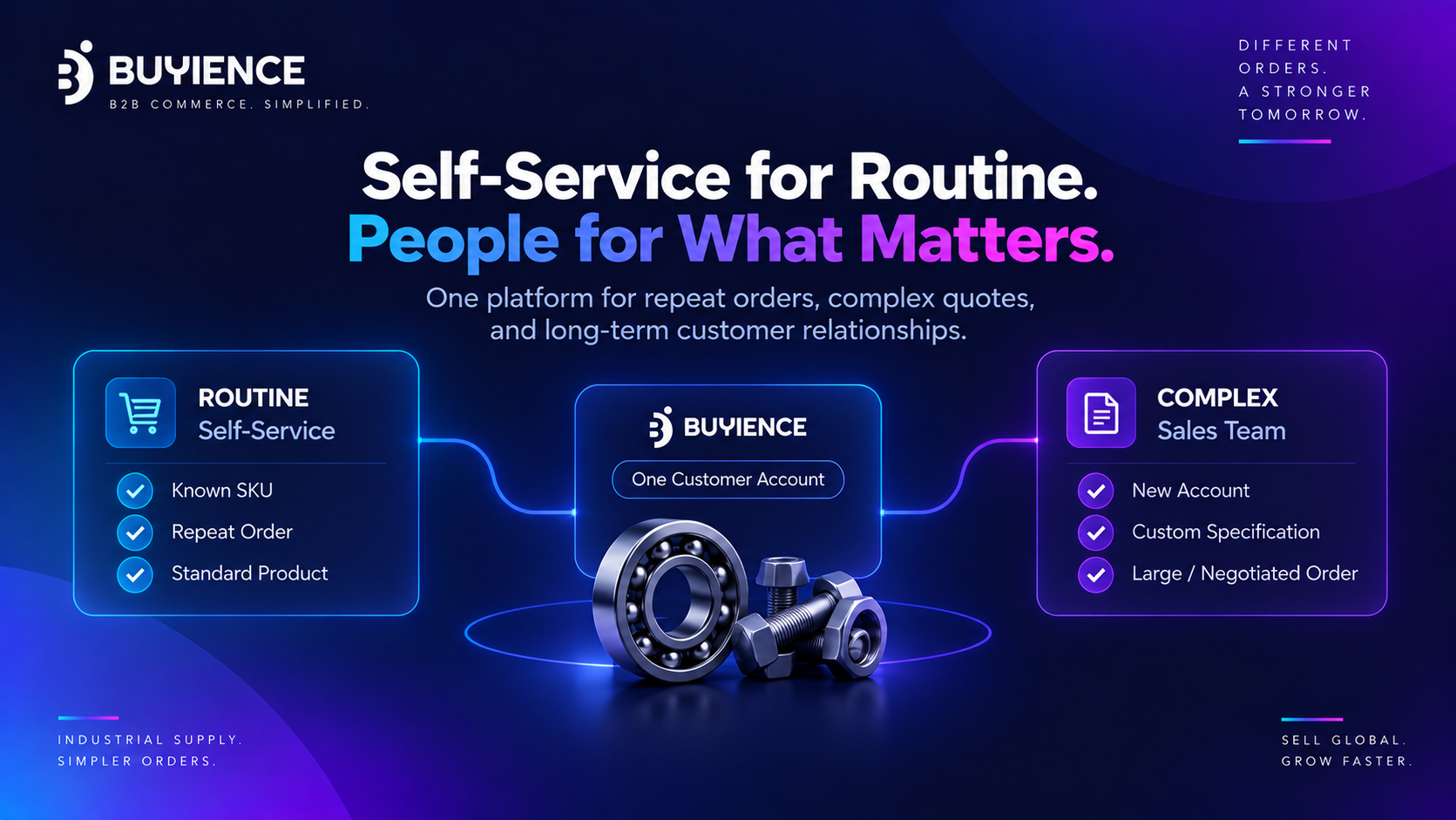
Step 1: Identify which order types are good self-service candidates
Not all orders are equally suited to self-service, and starting with the wrong ones can create a poor first impression. Good candidates typically include:
- Repeat orders of known SKUs — a customer reordering something they've bought before, where the main variables are just quantity and timing
- Standard-catalog items without customization — no special specifications, no negotiation, just a straightforward purchase at an established price
- Orders from established customers with existing pricing agreements — since their tier and volume pricing should already be defined and ready to apply automatically
Complex first-time orders, heavily customized requests, and anything requiring real negotiation are reasonable to keep on a assisted or phone-based path, at least initially — self-service can expand to cover more order types over time as the system and customer comfort both mature.
Step 2: Make current pricing and availability visible without a phone call
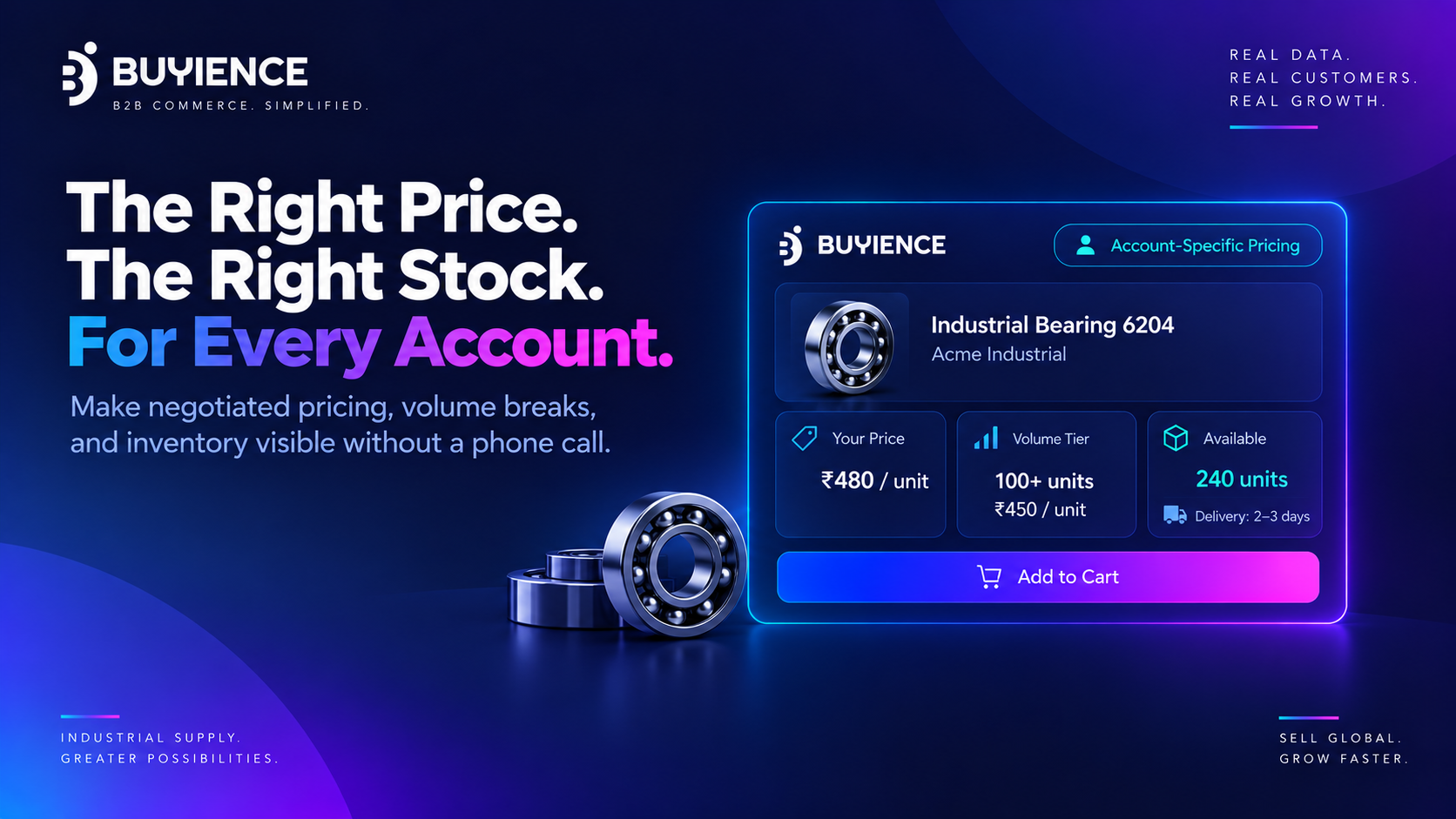
The core value proposition of self-service is that a customer can see what they need to see — current price, quantity available, expected lead time — without asking someone else to look it up for them. This requires the same underlying pricing and inventory infrastructure that supports accurate quoting generally: tiered and volume pricing resolved automatically per customer, and real-time multi-warehouse inventory visibility rather than a static, periodically updated catalog.
A self-service portal that shows outdated pricing or inaccurate stock levels is worse than no self-service option at all — it creates a bad experience and pushes the customer back to the phone anyway, except now with reduced trust in the online option.
Step 3: Preserve account-specific pricing and terms in the self-service experience
A customer with negotiated pricing, a specific tier, or established payment terms should see exactly that when they log in — not a generic public price list that doesn't reflect their actual relationship. This is where generic ecommerce checkout tools often fall short for B2B: they weren't built around the idea that different logged-in customers should see fundamentally different prices and terms for the same product, which is standard in industrial distribution but unusual in consumer retail.
Step 4: Roll out gradually, starting with your most self-service-ready customers
A full switch that forces every customer onto a new ordering method at once risks real disruption, especially for accounts who value the relationship-based process. A gradual approach works better:
- Identify customers with high-frequency, low-complexity reorder patterns first — They have the most to gain from self-service and the least reason to resist it.
- Offer it as an addition, not a replacement, at least initially — Let customers discover the value of self-service for routine reorders while knowing the phone and email options haven't gone anywhere.
- Use adoption data to guide expansion — If self-service usage grows naturally among customers who've tried it, that's a signal to expand the order types and customer segments it's offered to. If it doesn't, that's worth understanding before pushing further.
Step 5: Keep the personal relationship available for what actually needs it
Self-service succeeding doesn't mean phone and email disappear — it means the team's time on those channels shifts toward orders and customers that genuinely benefit from a conversation: new accounts building trust, complex specifications, large strategic orders, and customers who simply prefer that channel. Freeing up capacity from routine reorders is what makes it possible to give those higher-value interactions the attention they deserve, rather than splitting limited rep time evenly across every order regardless of complexity.
How Nova Core supports this transition
Nova Core's self-service customer portal gives repeat buyers real-time pricing — reflecting their actual tier, volume breaks, and negotiated terms — along with live inventory visibility, so routine reorders can happen without a phone call while preserving exactly the account-specific pricing a customer expects. It sits alongside the same AI Quote Engine and Digital Sales Room used for complex or negotiated orders, so distributors can offer both paths from one platform with shared order management rather than running self-service and assisted ordering as separate systems.
Buyience offers a 14-day free trial with full access to every feature — no credit card required to start. Visit buyience.com to start your free trial — or request a demo.
Questions, answered
Will moving to self-service ordering hurt customer relationships?
Not if it's offered as an addition rather than a forced replacement. Most distributors find that self-service works well for routine reorders while customers who value the relationship-based process for complex or first orders continue to use the phone or email as before.
Which orders should move to self-service first?
Repeat orders of known SKUs, standard-catalog items without customization, and orders from established customers with existing pricing agreements are typically the strongest early candidates.
How do I make sure self-service pricing matches what a customer would get on the phone?
The self-service portal needs to pull from the same underlying pricing and tier logic used for phone and quote-based orders — a customer's negotiated rate, volume breaks, and terms should apply automatically and identically, regardless of which channel they order through.
What's the risk of showing outdated pricing or stock levels in a self-service portal?
It creates a worse experience than no self-service option at all — it erodes trust in the online channel and pushes the customer back to calling, but now with lower confidence in the self-service option for future orders.
Should self-service replace the phone line entirely?
No. Complex, first-time, or heavily customized orders often still benefit from a conversation. The goal is giving customers a choice and freeing up phone and email capacity for the orders that genuinely need it.
How should a distributor roll out self-service ordering?
Gradually — starting with customers who have high-frequency, low-complexity reorder patterns, offering it as an addition rather than a replacement, and expanding based on actual adoption data rather than switching everyone at once.
Related articles
Spreadsheet-to-Quote: Why Manual B2B Quoting Is Costing You Deals
Manual quoting rarely loses a deal in a way anyone records. It loses deals through delay — the quote that arrives after the buyer decided — and it loses margin through inconsistency nobody traces back. The cost is invisible precisely because the failures look like normal business: a slow week, a competitive loss, a thin month. This post maps the five stages where a spreadsheet quote leaks, and which one to fix first.

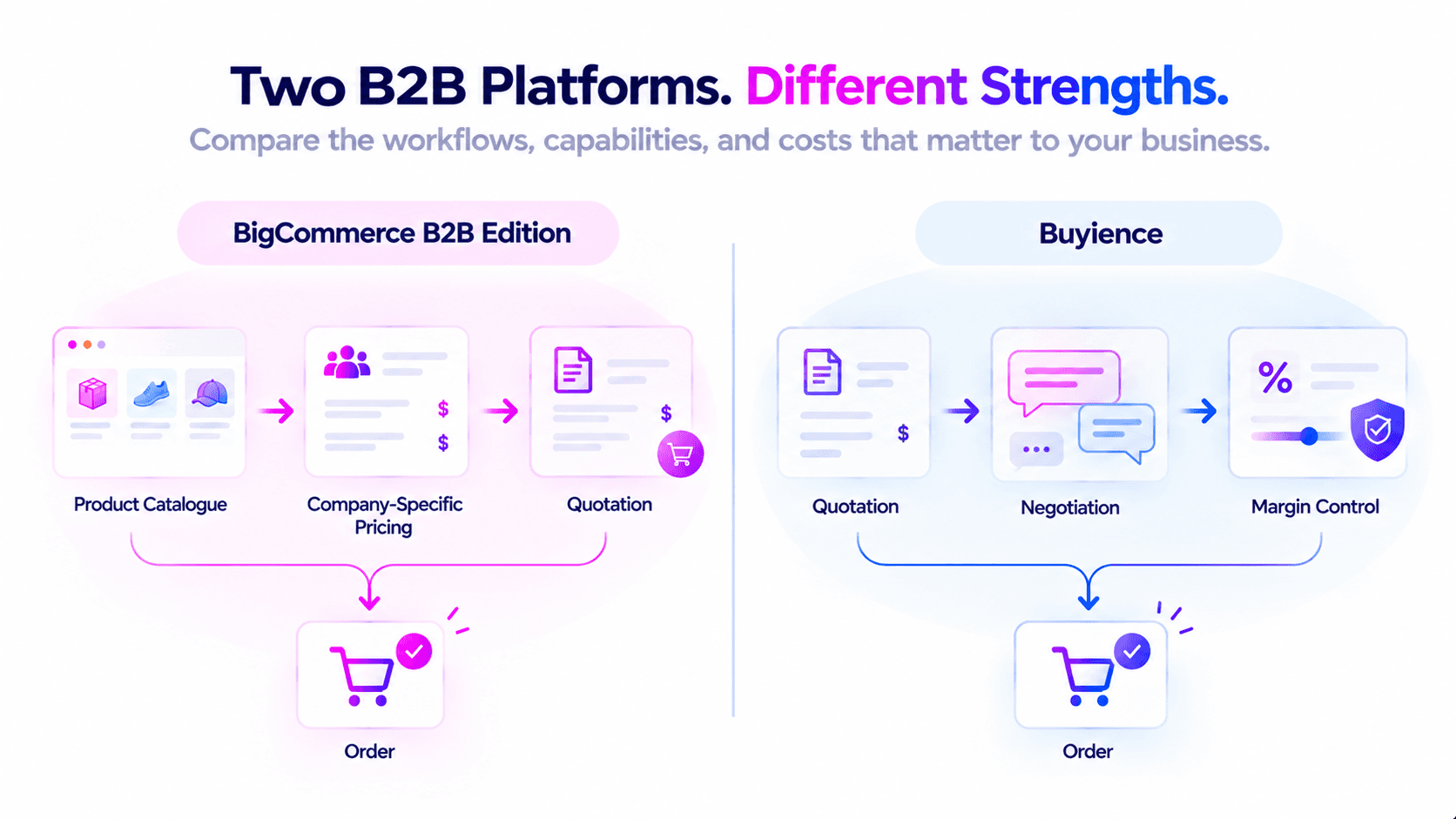
Buyience vs BigCommerce B2B Edition: A Side-by-Side Comparison
BigCommerce B2B Edition is a genuinely capable B2B platform with native quoting, company accounts, price lists and purchase order workflows — it is not a consumer cart with wholesale bolted on. The honest comparison with Buyience comes down to two things: cost tier, since B2B Edition is Enterprise-only with custom pricing, and what happens during negotiation rather than during quoting. If you have the budget and your quoting is structured rather than negotiated, B2B Edition is a strong choice.
The Best B2B Commerce Platforms for SMB Distributors in 2026
Most "best B2B platform" lists are published by vendors who rank themselves first. This one is too — we build Buyience — so the useful thing we can offer is published pricing where it exists, honest placement of where each platform actually fits, and a clear statement of which distributors should rule us out. For SMB distributors the real shortlist is short: BigCommerce B2B or Shopify for catalogue-led wholesale, Sana or an ERP-led option if your ERP governs pricing, OroCommerce if you have genuine enterprise complexity and the budget, and quoting-led platforms including ours if your revenue arrives through negotiated quotes.