
How to Price Fasteners and MRO Parts for Repeat B2B Buyers
Repeat buyers are the backbone of fastener and MRO distribution, and most distributors intuitively price them differently than new accounts — usually just not consistently or deliberately. The fix isn't a single "loyal customer discount." It's a structured approach that separates what a repeat relationship is actually worth from what a single large order is worth, and prices each factor on its own terms rather than blending them into a gut-feel number.

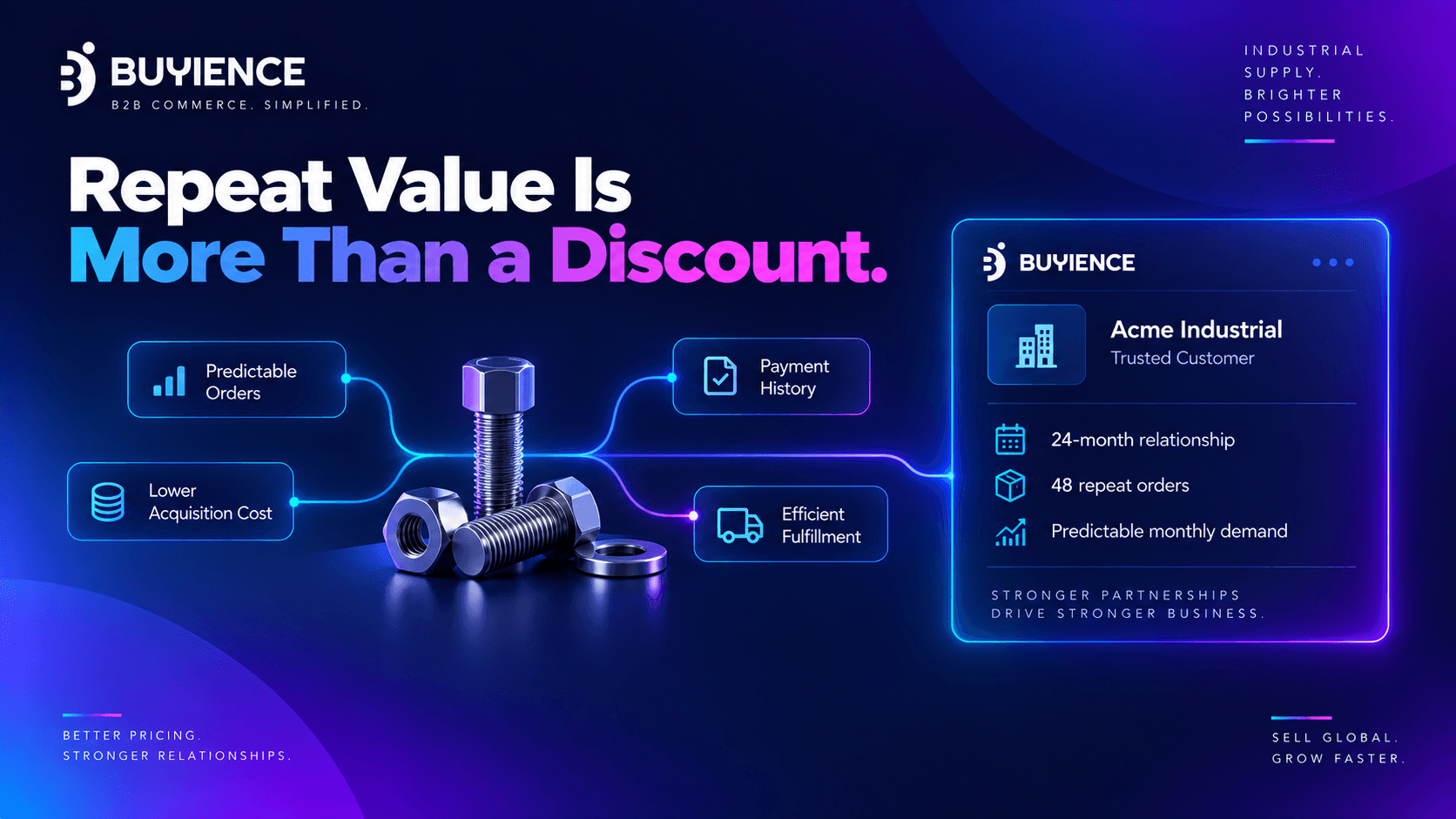
Fastener and MRO distribution runs on repeat business. A maintenance team ordering the same bearings every month, a manufacturer restocking the same fasteners on a predictable cycle — this is the steady core of most distributors' revenue, far more than one-off large orders. And yet pricing for these repeat relationships is often the least formalized part of the whole pricing structure, handled through accumulated habit and individual rep memory rather than a defined policy.
That gap matters because repeat pricing done well is a genuine retention and margin tool. Done inconsistently, it becomes a source of the exact problems distributors are usually trying to avoid: customers who don't know what to expect from one order to the next, reps who don't have a clear basis for what to offer, and pricing that drifts downward over time simply because nobody is actively managing it.
Separate what a repeat relationship is actually worth
The starting mistake is treating "repeat customer" as one undifferentiated category deserving one flat discount. In practice, a repeat relationship carries several distinct kinds of value to a distributor, and each one justifies pricing consideration on its own terms:
- Reduced acquisition and onboarding cost — A new customer requires sales time, credit setup, and onboarding effort that a repeat customer doesn't. This is a real, quantifiable cost saving, not just a relationship nicety.
- Predictability — A customer with a known, recurring order pattern lets a distributor forecast demand and plan inventory more accurately than an unpredictable one-off buyer — which has real value in reduced carrying cost and stockout risk.
- Lower credit risk, once a payment history exists — A customer with two years of on-time payments carries meaningfully less risk than a new account, which is part of why terms and pricing decisions are often linked in practice, even when they're formally separate policies.
- Order consolidation — A repeat customer ordering the same parts regularly, rather than sporadically, often means more efficient fulfillment — fewer isolated small shipments, more predictable picking and packing patterns.
None of these are the same thing as "this customer has been with us a while, so they deserve a discount." They're specific, measurable factors — which means a repeat-buyer pricing structure built around them will be more defensible, more consistent, and less prone to drifting into an arbitrary loyalty discount that erodes margin without a clear justification.
Build repeat pricing as tiers, not a single flat discount
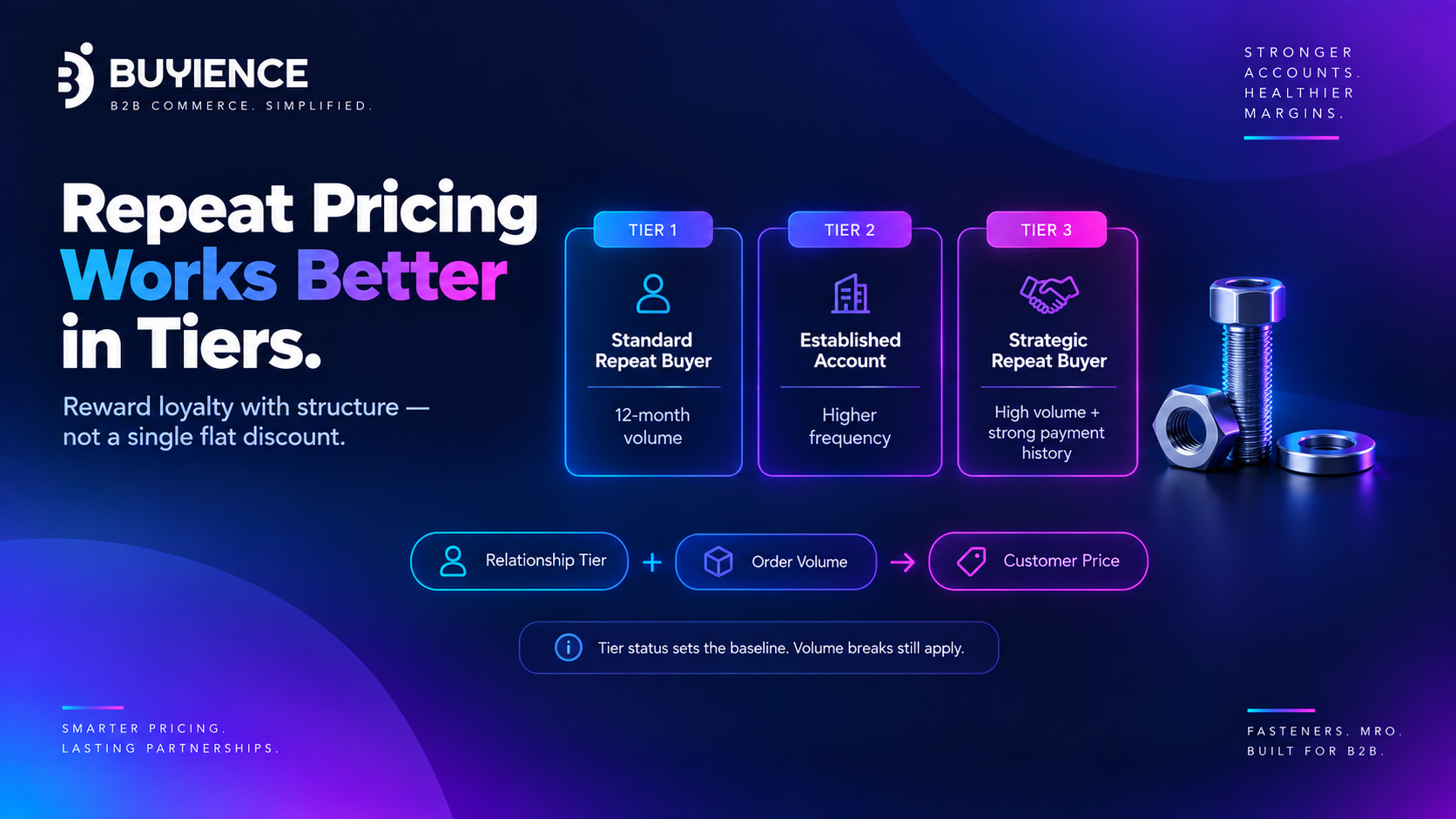
The most workable structure treats repeat buyer status as one input into a broader tiered pricing system (the same tiered structure covered in our tiered pricing setup guide), rather than a separate, one-off discount layered on top of everything else.
A practical approach:
Define tiers around measurable relationship criteria — trailing 12-month order volume, order frequency, payment history, and relationship length. A customer moves between tiers as these criteria change, not based on subjective judgment about how the relationship "feels."
Set the pricing difference between tiers deliberately, based on the actual cost savings and risk reduction repeat status provides — not an arbitrary round number. A tier structure with unclear or inconsistent gaps between levels is hard for reps to apply and hard for customers to understand.
Combine tier pricing with volume breaks, not instead of them. A repeat customer ordering a small quantity and a repeat customer ordering a large quantity shouldn't necessarily pay the same price — tier status should adjust the baseline, and volume breaks should still apply on top, consistent with how the two pricing layers interact more generally.
Handle predictable, recurring orders differently from ad hoc ones
Repeat buyers often place genuinely recurring orders — the same parts, roughly the same quantity, on a predictable cycle. This is a distinct case from a repeat customer placing a one-off large or unusual order, and it's worth pricing accordingly.
Consider standing pricing agreements for genuinely recurring SKUs and quantities. If a customer reliably orders the same bearing in the same quantity every month, a pre-agreed price for that specific pattern reduces friction for both sides and removes the need to re-quote the same thing repeatedly.
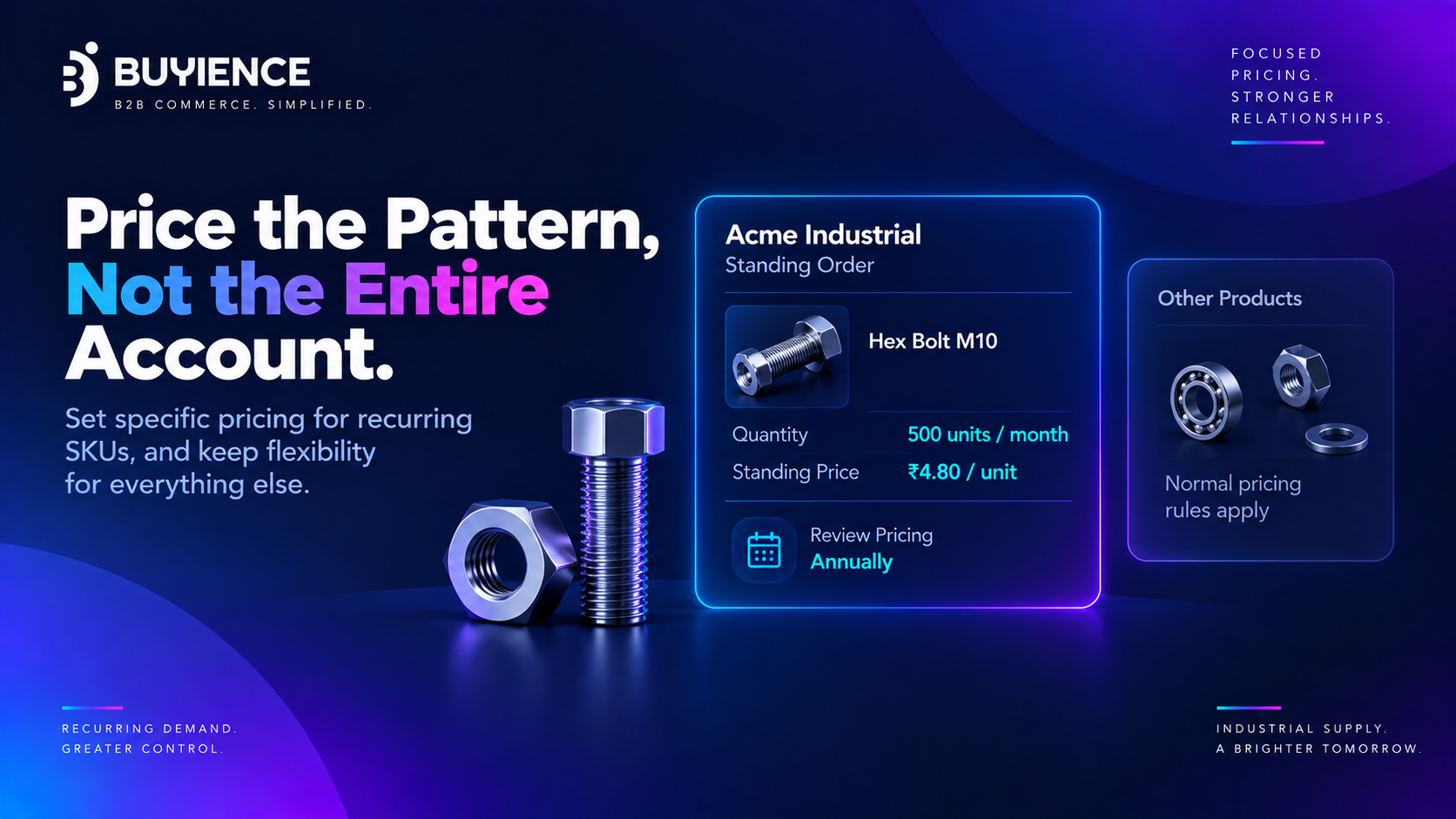
Keep standing agreements scoped, not blanket. A standing price for a specific SKU and quantity range shouldn't automatically extend to every other product the customer might order — that's a different pricing decision and should go through the normal tier and volume logic rather than inheriting a rate meant for a different situation.
Build in a review mechanism for standing agreements, since costs and market conditions change. A price locked in a year ago without review can end up well below current cost, especially for categories where input costs (steel, zinc, other raw materials) have moved.
Avoid the drift that erodes margin over time
Repeat-buyer pricing has a specific failure mode that's worth naming directly: gradual, unintentional erosion. It doesn't happen through one bad pricing decision — it happens through an accumulation of small, individually reasonable-seeming exceptions.
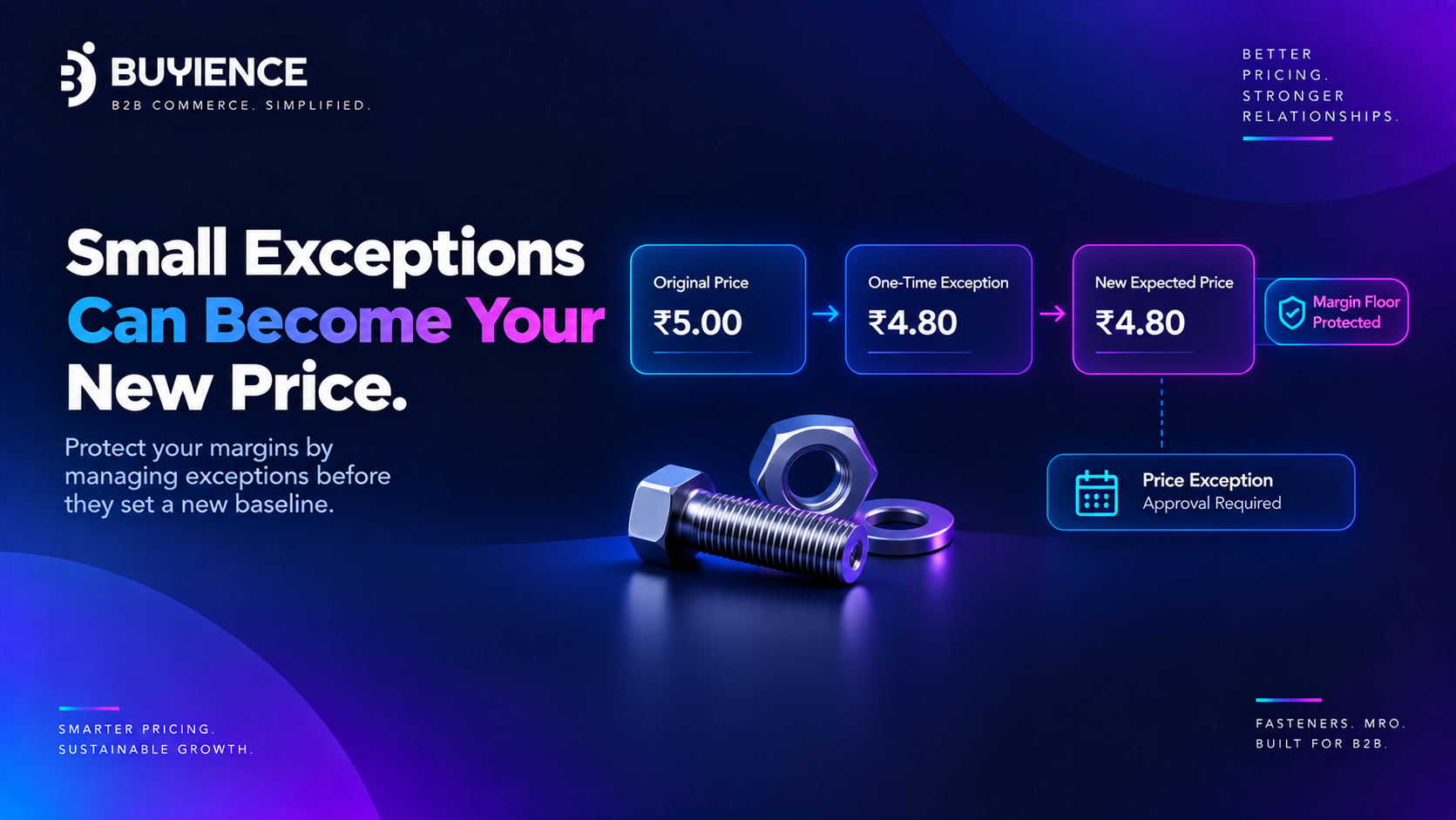
A rep grants a slightly better price to smooth over a minor service issue. Another rep matches that price on the next order because the customer mentions what they got last time. A few months later, that "one-time" adjustment has become the customer's effective baseline price, without anyone deciding that as a matter of policy.
Guarding against this requires the same discipline covered in volume discount management: a defined margin floor that any exception has to clear, an approval process for anything below standard tier pricing, and a periodic review of actual effective pricing per customer — not just the pricing on paper, but what customers are actually being charged in practice, which can quietly diverge from the stated policy over time.
Renewing and reviewing repeat-buyer pricing
Repeat pricing shouldn't be a one-time assignment that stays fixed indefinitely. A structured review — annually, at minimum, or whenever cost structure shifts meaningfully — keeps pricing aligned with actual current conditions rather than reflecting decisions made under circumstances that no longer apply.
This review is also the right moment to reassess tier assignments themselves. A customer who's grown their order volume substantially may merit moving to a better tier; a customer whose ordering has become less predictable or whose payment reliability has slipped may need reassessment in the other direction. Treating tier assignment as periodically reviewed, rather than permanent, keeps the whole structure honest.
How Nova Core supports repeat-buyer pricing
Nova Core resolves customer-tier pricing, volume breaks, and any standing or contract-specific rates automatically at the line-item level, so repeat customers get consistent, current pricing on every quote without a rep needing to manually recall or recalculate what applies. Margin floors are enforced system-wide, and every price a customer actually receives is tracked — making it straightforward to spot pricing drift before it becomes a pattern, rather than discovering it during an annual review months later.
Buyience offers a 14-day free trial with full access to every feature — no credit card required to start. Visit buyience.com to start your free trial — or request a demo.
Questions, answered
Should repeat customers automatically get a discount?
Not automatically or arbitrarily. Repeat status is best treated as one measurable input into a broader tiered pricing structure — based on order volume, frequency, and payment history — rather than a flat, undifferentiated loyalty discount.
What's the difference between tier pricing and a standing price agreement?
Tier pricing sets a baseline rate based on overall relationship criteria across a customer's full range of purchases. A standing agreement is a pre-agreed price for a specific, genuinely recurring SKU and quantity pattern, and should stay scoped to that pattern rather than extending automatically to other products.
How often should standing price agreements be reviewed?
At least annually, and sooner if there's a meaningful shift in cost structure. A price that was fair when set can fall below current cost if raw material or supplier pricing has moved since.
What causes repeat-buyer pricing to erode over time?
Usually an accumulation of small, individually reasonable exceptions — a one-time adjustment for a service issue that becomes an unofficial new baseline once a customer expects it on future orders. A defined margin floor and periodic review of actual effective pricing help catch this before it compounds.
Should repeat-buyer pricing tiers ever change for an existing customer?
Yes. Tier assignment should be reviewed periodically, not treated as permanent — a customer whose volume has grown may merit a better tier, and one whose reliability has slipped may need reassessment in the other direction.
How does repeat-buyer pricing interact with volume discounts?
The two should layer, not substitute for each other. Tier status adjusts the baseline price for a repeat relationship, and volume breaks still apply on top based on the size of each individual order.
Related articles
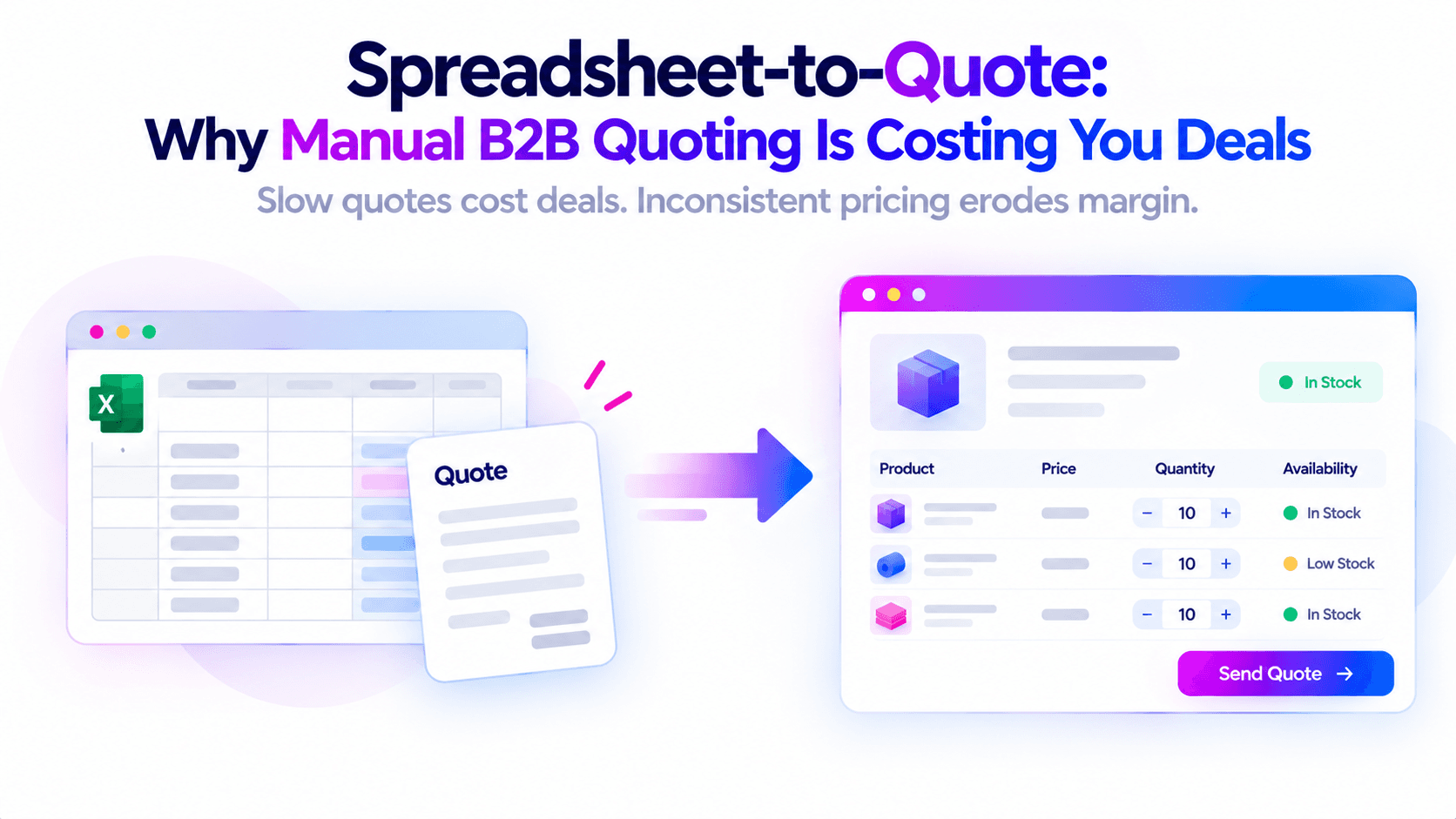
Spreadsheet-to-Quote: Why Manual B2B Quoting Is Costing You Deals
Manual quoting rarely loses a deal in a way anyone records. It loses deals through delay — the quote that arrives after the buyer decided — and it loses margin through inconsistency nobody traces back. The cost is invisible precisely because the failures look like normal business: a slow week, a competitive loss, a thin month. This post maps the five stages where a spreadsheet quote leaks, and which one to fix first.

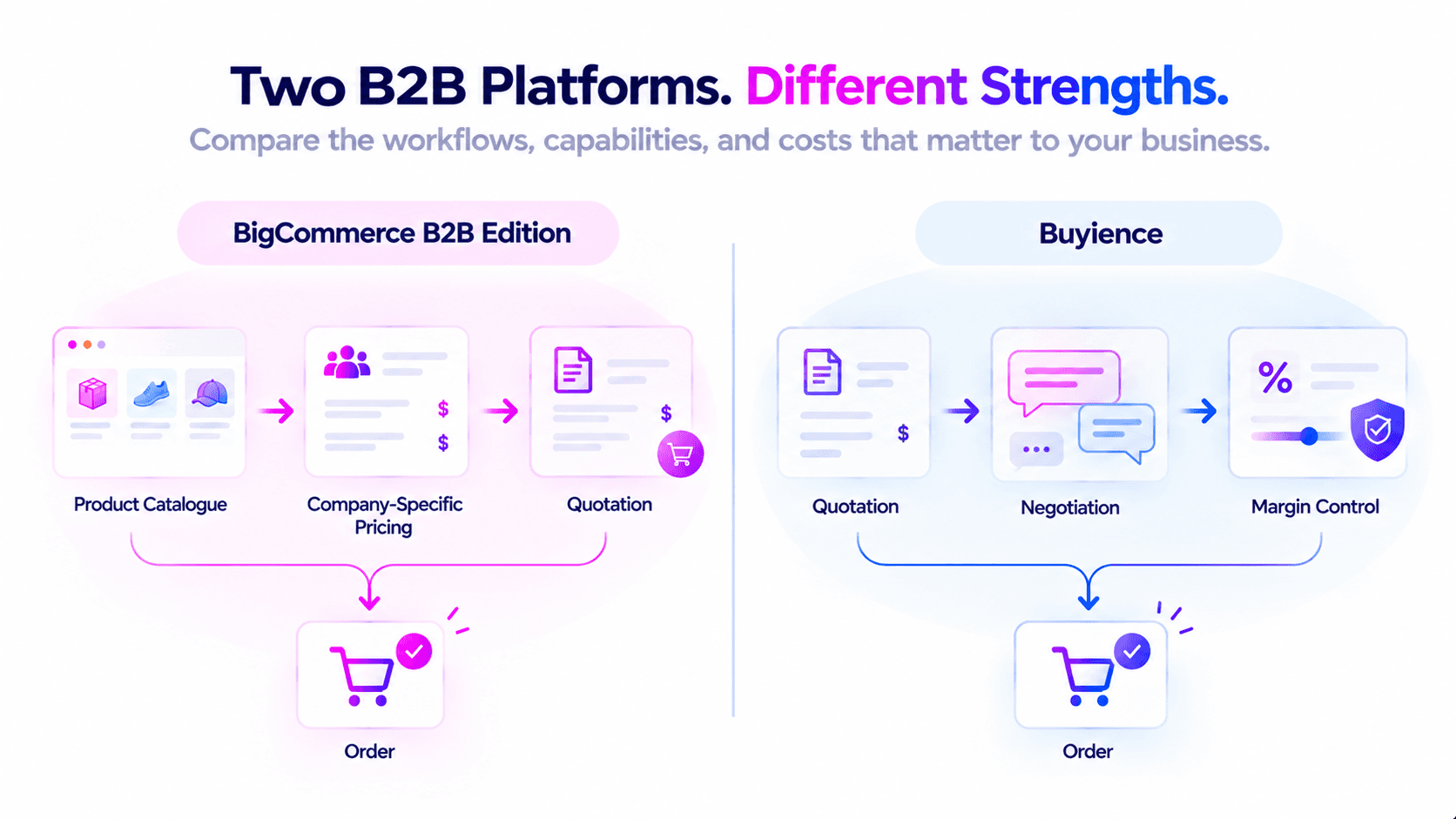
Buyience vs BigCommerce B2B Edition: A Side-by-Side Comparison
BigCommerce B2B Edition is a genuinely capable B2B platform with native quoting, company accounts, price lists and purchase order workflows — it is not a consumer cart with wholesale bolted on. The honest comparison with Buyience comes down to two things: cost tier, since B2B Edition is Enterprise-only with custom pricing, and what happens during negotiation rather than during quoting. If you have the budget and your quoting is structured rather than negotiated, B2B Edition is a strong choice.
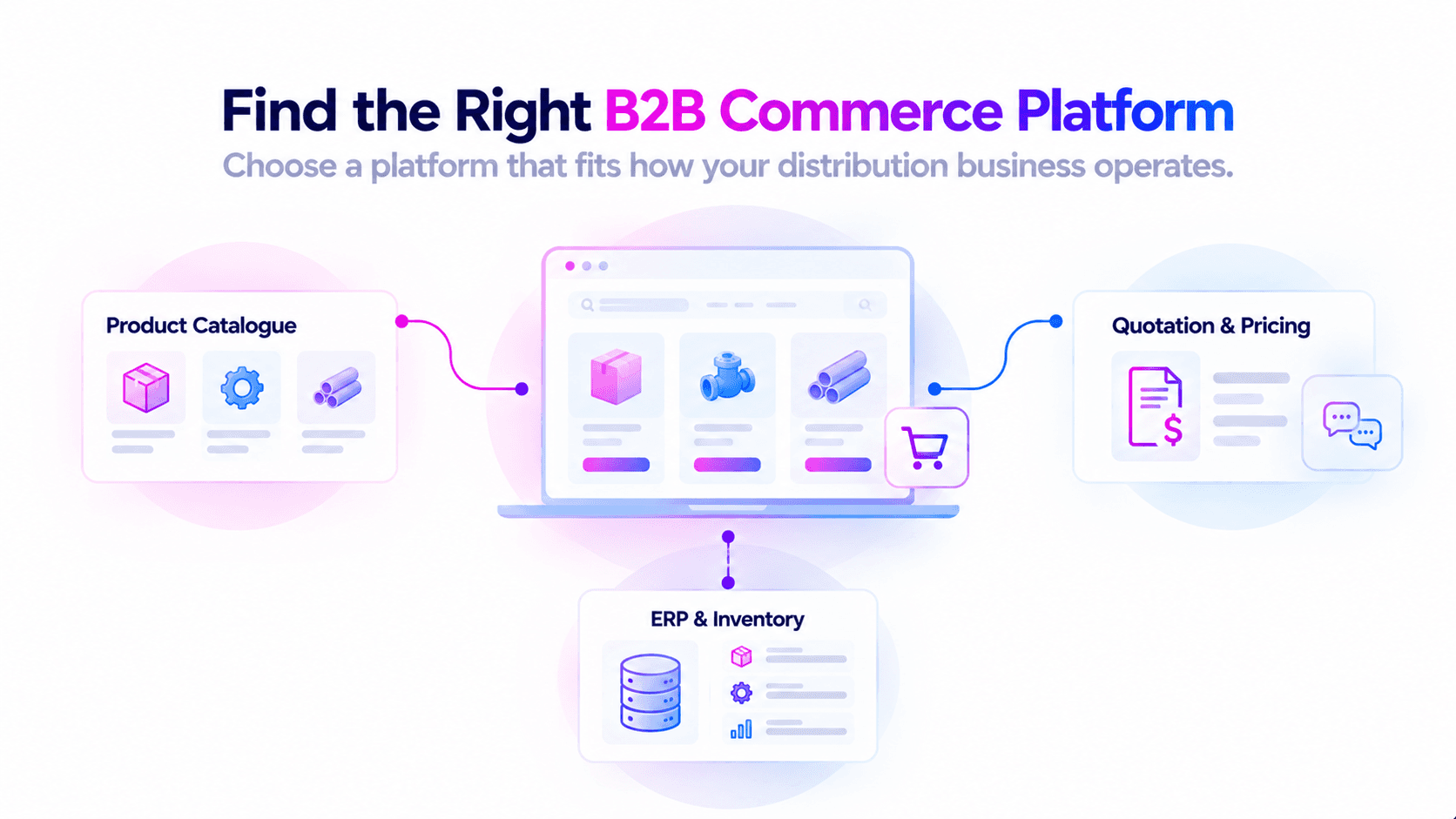
The Best B2B Commerce Platforms for SMB Distributors in 2026
Most "best B2B platform" lists are published by vendors who rank themselves first. This one is too — we build Buyience — so the useful thing we can offer is published pricing where it exists, honest placement of where each platform actually fits, and a clear statement of which distributors should rule us out. For SMB distributors the real shortlist is short: BigCommerce B2B or Shopify for catalogue-led wholesale, Sana or an ERP-led option if your ERP governs pricing, OroCommerce if you have genuine enterprise complexity and the budget, and quoting-led platforms including ours if your revenue arrives through negotiated quotes.