
Why Manual B2B Quoting Is Costing You Deals
And why your “faster quoting” initiative is probably solving the wrong problem.


If your average B2B deal involves customer-specific pricing, non-standard terms, or more than one approver, manual quoting isn’t just slowing you down — it’s quietly disqualifying you.
Every quarter, the same story shows up in pipeline reviews. Deals stall. Others slip. Some disappear without a clear reason. On paper, they’re marked as “competitive loss” or “no decision.” In reality, many of them died somewhere between “Can you send a quote?” and “We’ll get back to you.”
Leadership looks at quoting. Someone says, “We need to speed this up.” A project kicks off to redesign the quote template, bolt a quote builder onto the CRM, or roll out a tool that generates PDFs faster. Six months later, the same deals are dying for the same reasons.
Because the problem was never the quote screen.
The problem is everything that happens after someone clicks “Create Quote.”
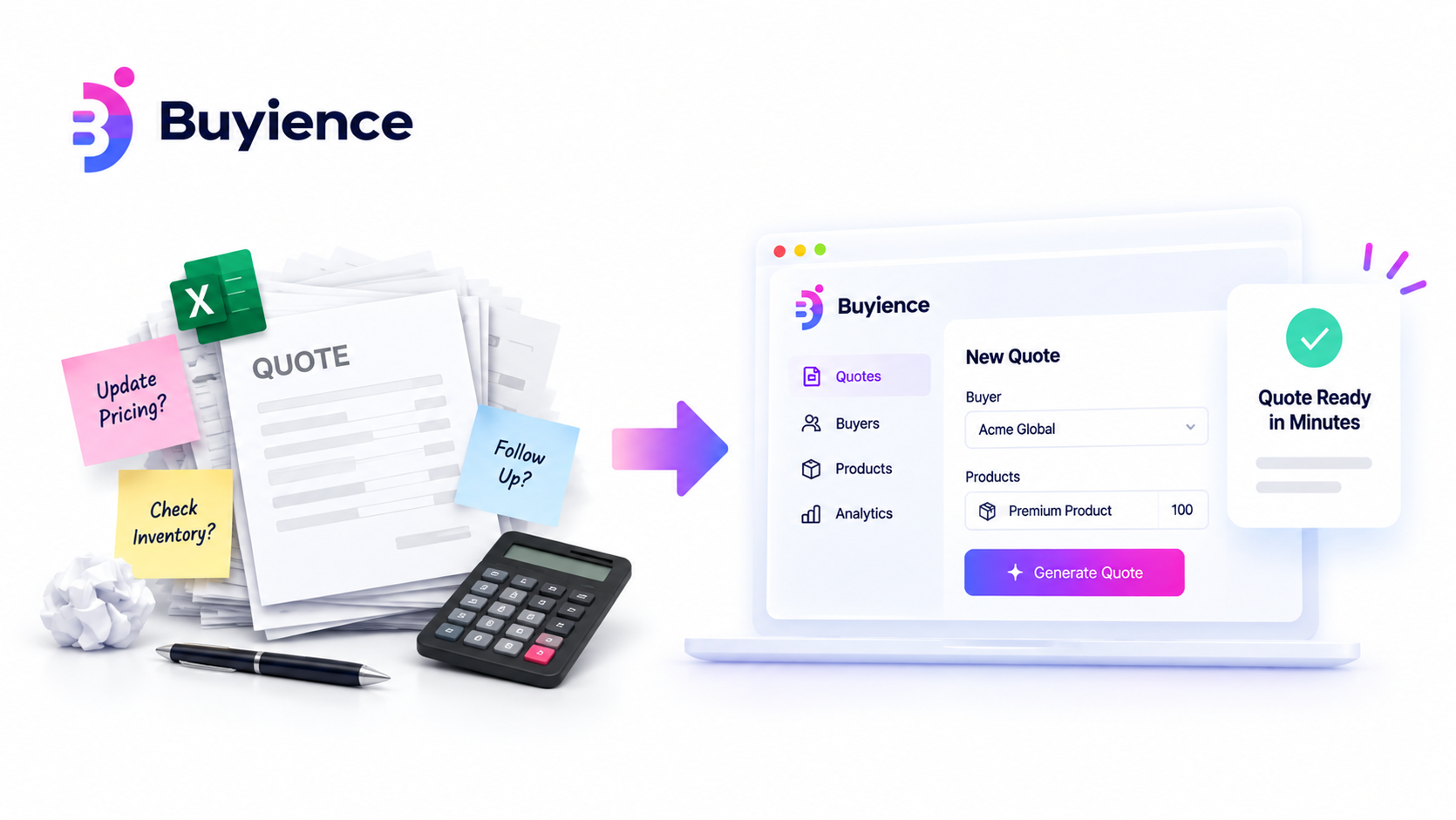
The Hidden Cost of Manual Quoting (Beyond Time)
Time-to-quote gets all the attention, but it’s the least interesting cost of broken quote-to-order workflows. The real damage compounds quietly across revenue, margin, and team behavior.
- Deal leakage is the most expensive failure. Not deals you clearly lose — deals that leak out of the funnel. A buyer is ready, pricing is close, but a small exception requires approval. The approver is traveling. The approval sits. The buyer goes with a competitor who responded in 48 hours. In the CRM, it’s logged as a competitive loss. In reality, it was a quoting workflow failure.
- Manual quoting also rewrites your revenue mix. When reps know certain deals will trigger approval hell — custom price books, volume tiers, contract terms — they unconsciously avoid them. They focus on easy, standard deals they can quote quickly. Over time, this biases your pipeline toward lower-complexity, often lower-margin business. The deals that should move the needle become operationally unattractive.
- Discount creep becomes the path of least resistance. When approvals are slow and opaque, reps push for discounts simply to get deals unstuck. Managers approve them to keep deals moving. Finance discovers margin erosion later, when it’s too late to intervene. Manual quoting doesn’t just slow deals — it systematically weakens pricing discipline.
- Customer trust erodes one revision at a time. A buyer who receives a PDF quote, spots an error, replies-all, waits for a correction, then gets a revised attachment is forming an opinion about how hard your company is to do business with. Each revision signals internal friction. By the third correction, confidence drops — even if the price is right.
- Internal escalation fatigue burns real capacity. Ops teams answering Slack questions about price tiers. Finance reviewing routine discounts. Sales managers approving deals they don’t actually need to review. Highly paid people become human middleware because the quoting process has no system-level logic.
Why Most Teams Misdiagnose the Problem
When quoting becomes a bottleneck, most organizations reach for interface fixes.
- A faster quote builder.
- A better template.
- A CPQ evaluation that focuses on how quickly a rep can generate a document.
This is a category error.
Manual quoting fails not because it’s slow to create quotes, but because it’s slow to decide them.
Over-indexing on UI speed misses where time is actually lost. In most B2B organizations, reps spend a small fraction of the quote lifecycle in the tool itself. The majority of time is spent waiting — for pricing confirmation, approvals, ERP validation, or manual checks. A faster screen doesn’t touch any of that.
“We just need a better quote template” treats the document as the product. It isn’t. The quote is an output. If pricing inputs are wrong or approvals are unclear, a polished PDF just makes a bad quote look professional.
Treating quoting as a document instead of a process is the root failure. A quote represents a chain of decisions:
- Which price applies?
- What authority does this rep have?
- What requires approval, and from whom?
- Do the terms align with the ERP?
Manual quoting optimizes the last step. Effective B2B quoting software optimizes every decision upstream.
Where Manual Quoting Breaks in Real B2B Scenarios
Manual processes hold together until complexity shows up. In B2B, complexity always shows up.
Customer-specific pricing is usually the first breaking point. Negotiated price books scattered across ERPs, spreadsheets, and inboxes force reps to ask humans instead of systems. Every lookup becomes a bottleneck. If pricing data isn’t accessible in real time, faster quoting just means faster mistakes.
Volume tiers and historical exceptions amplify errors. One customer qualifies for different tiers across products. Another has a legacy exception from a renewal two years ago. The rep knows. The system doesn’t. Manual quoting relies on memory and email threads — which fail the moment someone leaves or a deal gets audited.
Approval chains destroy velocity when logic is implicit. Who approves what should be deterministic. In practice, approvals live in Slack, email, or hallway conversations. Deals stall invisibly. Approvers lack context. Quotes get rebuilt after approval instead of before.
ERP dependencies create lag and rework. The ERP holds pricing truth but isn’t designed to orchestrate quoting. Workarounds emerge: exports, nightly syncs, spreadsheets. Quotes go out using stale data. Errors surface only when orders hit the ERP — after the buyer has already agreed.
Ownership conflicts finish the job. Sales wants flexibility. Finance wants control. Ops wants data integrity. Without a shared quoting workflow, every deal becomes a negotiation between teams instead of a governed process. This is the same failure pattern that later causes many B2B ERP integrations to collapse under real-world usage.
Quoting Is a Workflow Problem (Not a Tool Problem)
Reframing quoting as a workflow problem exposes four layers most organizations underdesign.
- Data access — Reps should never be the integration layer. Quotes should pull from governed, live data sources — customers, pricing, contracts — without manual aggregation.
- Decision logic — Which price applies? What discount is allowed? When is approval required? In manual quoting, this logic lives in people’s heads or policy docs. In scalable B2B quoting software, it lives in a rules layer the business owns and can change.
- Approval orchestration — Approvals should be contextual, automatic, and auditable. Deals within policy shouldn’t require human review. Exceptions should route instantly with full context and clear escalation paths.
- Auditability and control — Every price change, approval, and version should be traceable. If reconstructing a quote requires digging through email threads, the process is already broken.
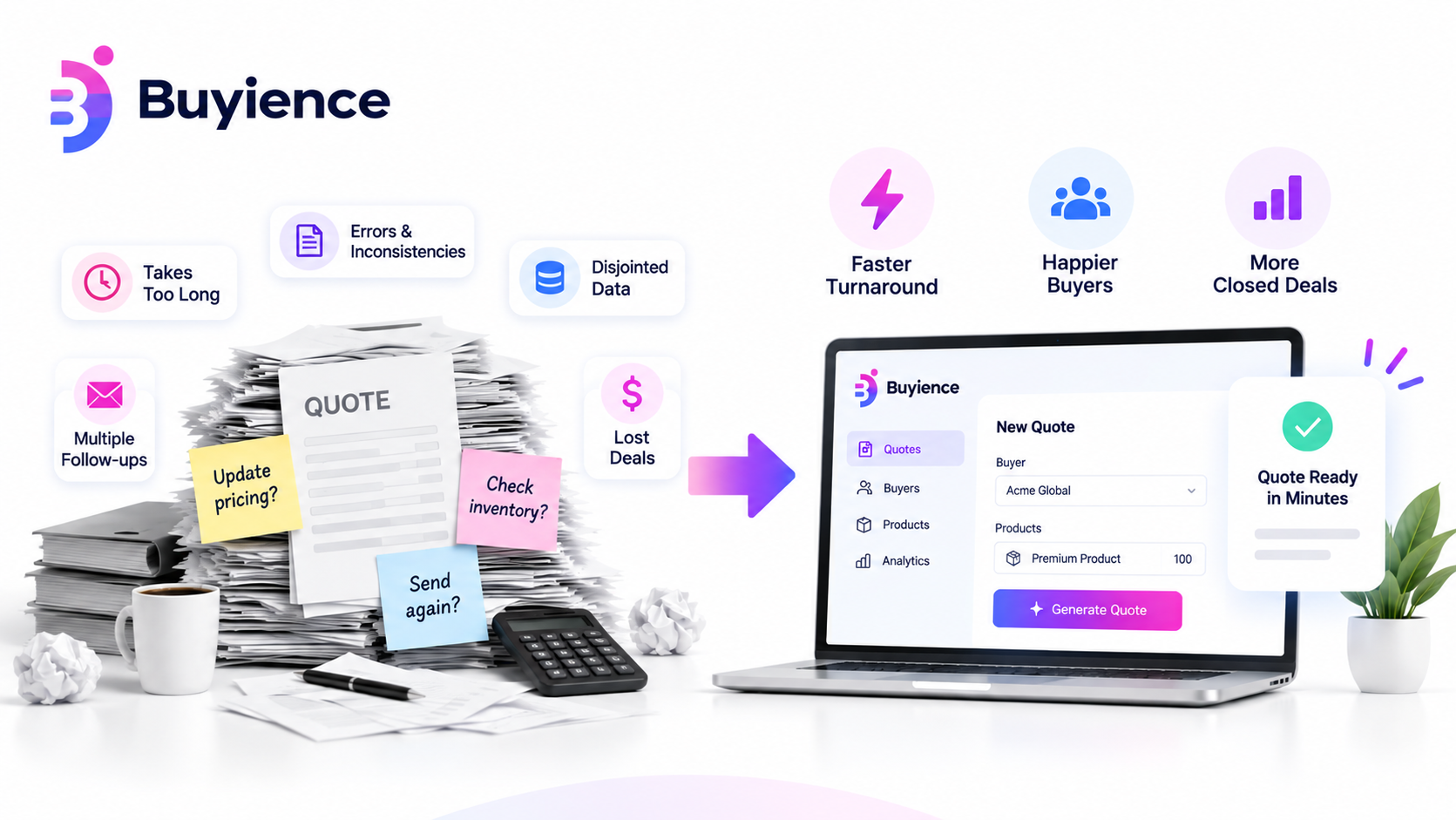
What Modern B2B Quoting Software Should Actually Solve
These aren’t features — they’re architectural outcomes.
- Workflow ownership — Commercial teams must be able to define and evolve quoting rules without dev cycles or vendor intervention.
- Pricing logic separation — Pricing rules should not be hardcoded into ERPs or buried in tool configurations. They should live in a business-controlled logic layer.
- Approvals without bottlenecks — Policy enforcement should eliminate unnecessary approvals, not route everything to a manager “just in case.”
- ERP alignment without ERP dependency — The ERP remains the system of record. Quoting remains the system of execution. Confusing the two is how manual workarounds are born.
Is Your Team Showing the Signs?
Manual quoting rarely breaks overnight. It degrades. Common signals include:
- Reps routinely asking ops or finance to verify pricing
- Quote revisions taking nearly as long as original quotes
- Approval cycles exceeding 48 hours due to missing context
- Pricing errors discovered after deals close
- Signed quotes your ERP can’t process
- Different reps producing different quotes for the same customer
If several of these are true, you don’t have a UI problem.
You have a quoting workflow problem.
Take the Next Step
Download the B2B Quote Workflow Readiness Checklist — a structured assessment covering data access, pricing logic, approvals, and system dependencies. It helps commercial and ops leaders pinpoint where quoting breaks and what to fix first.
No vendor evaluation. Just clarity.
Questions, answered
What is manual B2B quoting?
Manual B2B quoting relies on spreadsheets, email approvals, PDFs, and human lookups to assemble and approve quotes. It typically breaks down when pricing is customer-specific or approvals are required.
Why does manual quoting cause deal delays?
Because decisions are implicit instead of system-enforced. Pricing verification, approvals, and ERP checks all depend on human availability, creating unpredictable bottlenecks.
Isn’t CPQ software supposed to fix this?
Only if it addresses workflow ownership, pricing logic, and approvals — not just quote creation. Many CPQ tools optimize document generation without fixing decision orchestration.
How does manual quoting impact margins?
It encourages discounting to bypass delays, reduces policy enforcement, and biases reps toward simpler, lower-margin deals.
When should a company invest in B2B quoting software?
When quoting requires human verification, approvals exceed 24–48 hours, or pricing errors surface after deals close. These are workflow failures, not scale issues.
Can ERPs handle B2B quoting on their own?
ERPs are systems of record, not systems of execution. Using them to run quoting workflows usually creates spreadsheets, sync delays, and approval chaos.
Related articles
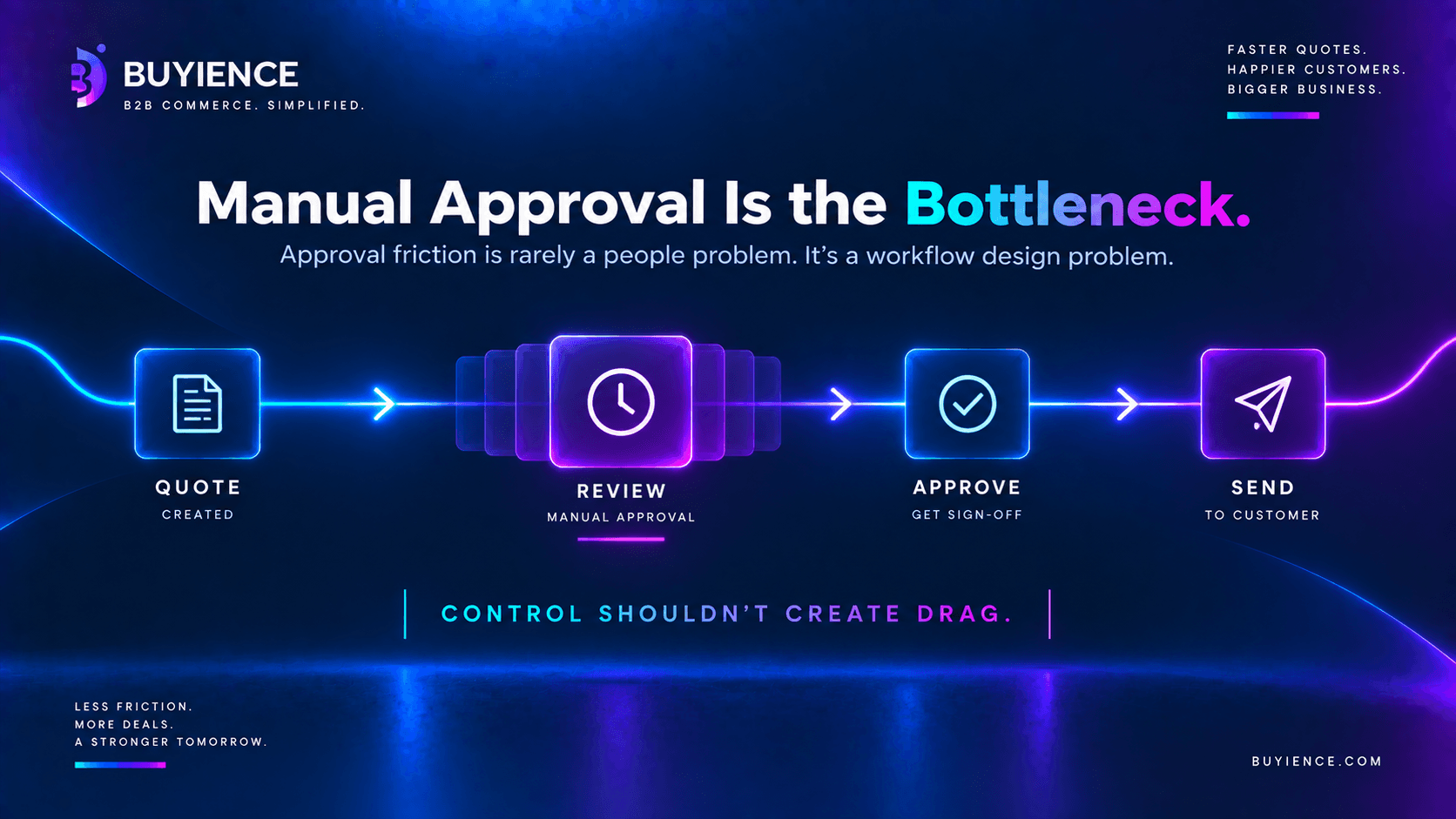
The Real Cost of Manual Quote Approvals in B2B
Most B2B leaders think approval delays are a discipline issue. They're usually wrong. When discounts fluctuate, when deals stall waiting for sign-off, when managers complain about review fatigue — the instinct is to tighten policy.

Corporate Gifting RFPs: Streamlining the Quote-to-Order Process
Corporate gifting RFPs are expensive to respond to and easy to lose for reasons unrelated to your actual capability — a missed compliance requirement, a slow response, or pricing that couldn't be revised fast enough during evaluation. The businesses that win consistently qualify hard before responding, build responses from reusable components rather than from scratch, and treat the gap between award and first order as a defined process rather than an improvisation.
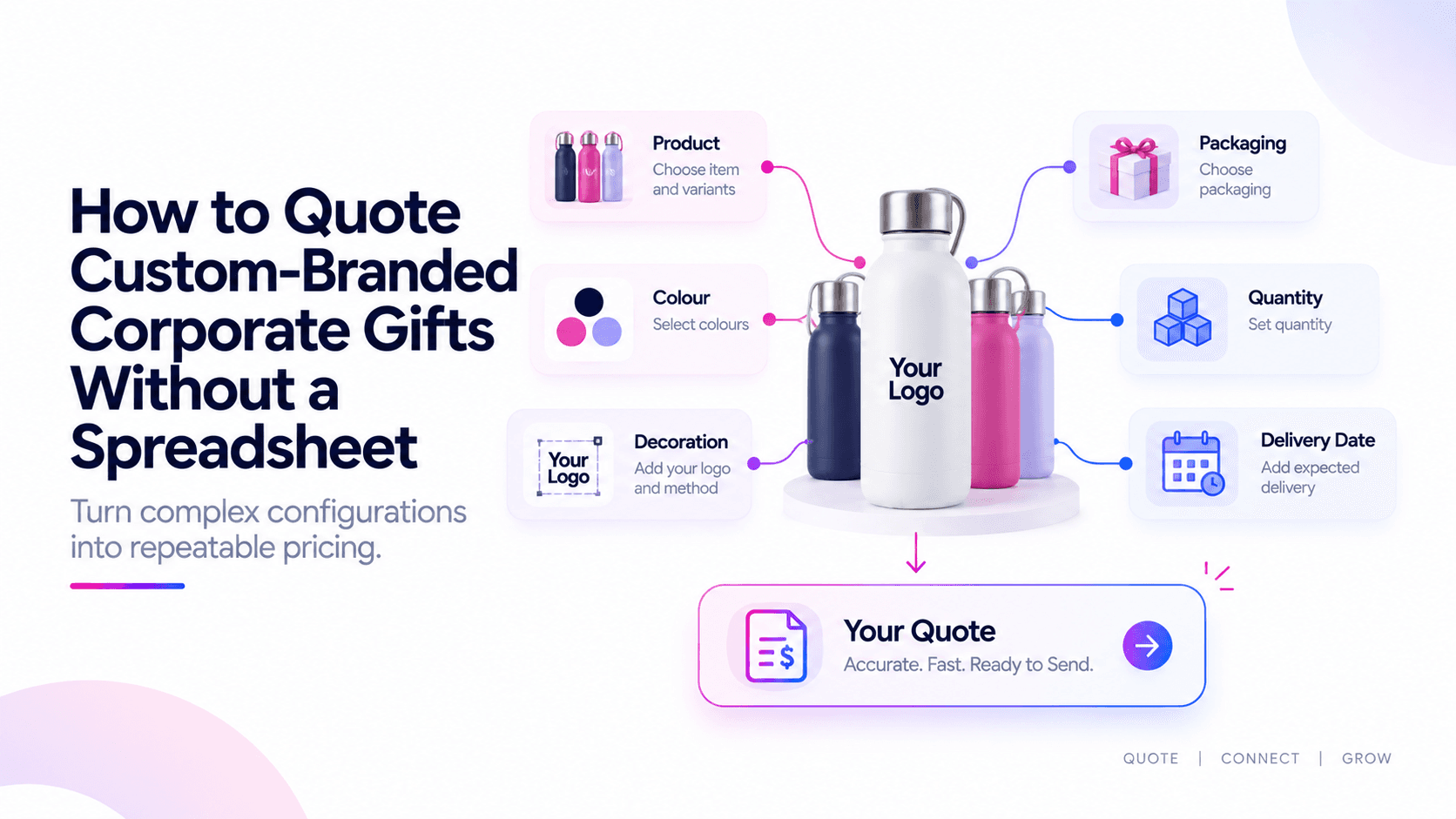
How to Quote Custom-Branded Corporate Gifts Without a Spreadsheet
Quoting a custom-branded gift order is a configuration problem, not a pricing lookup. Decoration method, setup fees, colour counts, placement counts, and variant splits all interact — and a spreadsheet forces you to rebuild that logic by hand for every quote. The fix is defining your cost components as rules once, so any combination prices itself. This guide covers how to break down a custom gift quote into its actual components and structure them so they're reusable.
