
The Universal Commerce Protocol Is Here. Most B2B Platforms Aren't Ready for It
What agent-driven commerce actually demands from your pricing, quoting, and inventory infrastructure — and why the readiness gap is wider than most operators think.


The Universal Commerce Protocol isn't a press release. It's an architectural shift.
Co-developed by Google and Shopify, endorsed by more than 20 retailers and platforms — including Etsy, Wayfair, Target, and Walmart — UCP is an open standard that defines how AI agents discover merchants, negotiate terms, build carts, and complete transactions. It launched at NRF 2026 in January, and as of mid-2026, it's already powering native shopping experiences in Google Search AI Mode and the Gemini app.
The protocol itself is technically elegant: a layered architecture with capabilities, extensions, and services that let agents interact with merchant backends through REST, JSON-RPC, MCP, or A2A connections. Merchants declare what they support. Agents discover those capabilities, negotiate what they can handle, and execute transactions.
For B2C retailers with standard catalogs and fixed pricing, UCP adoption is relatively straightforward. List your products. Expose your checkout. Let agents transact.
For B2B operators — wholesalers, distributors, manufacturers running complex pricing, negotiated contracts, multi-warehouse inventory, and approval workflows — the picture is fundamentally different. And far more consequential.
The B2B Readiness Problem No One Is Talking About
Most coverage of UCP and agentic commerce focuses on consumer scenarios: a shopper asks an AI assistant to find running shoes, the agent compares options across merchants, and checkout happens inside the chat. That's compelling. It's also the easy case.
B2B commerce doesn't work that way. And the gap between what the protocol enables and what most B2B backends can actually deliver is where the real strategic risk lives.
Consulting firm Kearney has already projected that distributors could see meaningful margin erosion as pricing transparency increases in agent-driven marketplaces. McKinsey describes the trajectory toward Level 5 agentic commerce — where personal agents negotiate directly with merchant agents, transactions are settled through shared protocols, and procurement runs continuously in the background. Deloitte reports that fewer than one in four B2B suppliers currently use agentic AI technologies, even as investment plans accelerate.
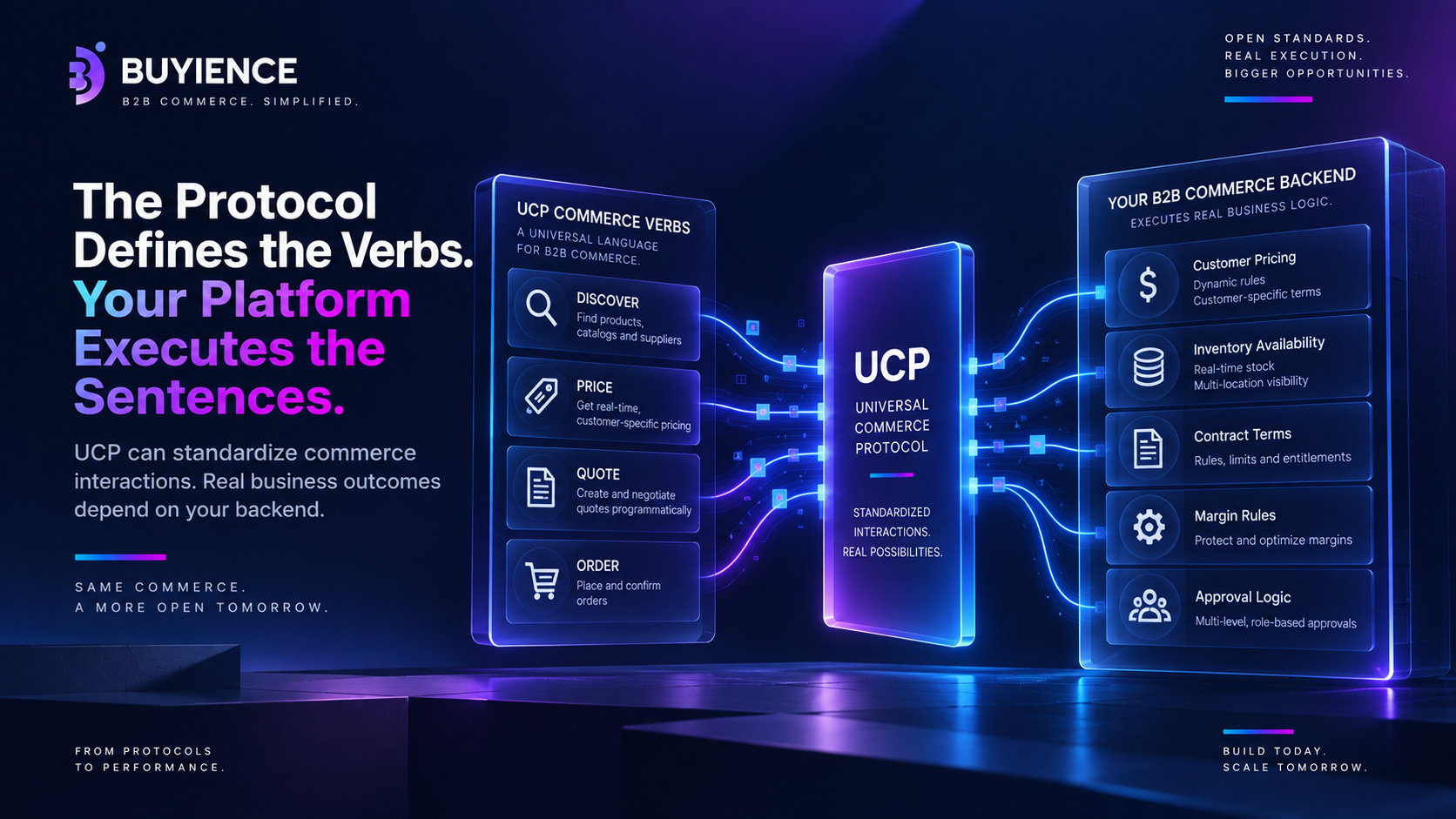
When a procurement agent — whether human-directed or autonomous — needs to place an order for industrial fasteners across three warehouses, with customer-specific pricing tiers, volume-based discounts, negotiated payment terms, and an approval chain that touches finance and operations before anything ships, the protocol's "capabilities" need something real behind them.
The protocol can define the verbs. But your platform has to execute the sentences.
This is where the readiness gap emerges. UCP assumes merchants can expose structured, machine-readable data about their products, pricing, inventory, and fulfillment in real time. It assumes your commerce backend can respond to agent queries with the same fidelity and speed that a well-trained sales rep would — except programmatically, at scale, with no manual intervention for routine transactions.
Most B2B platforms were not built for this. They were built for humans clicking through forms.
What UCP Actually Requires From a B2B Commerce Stack
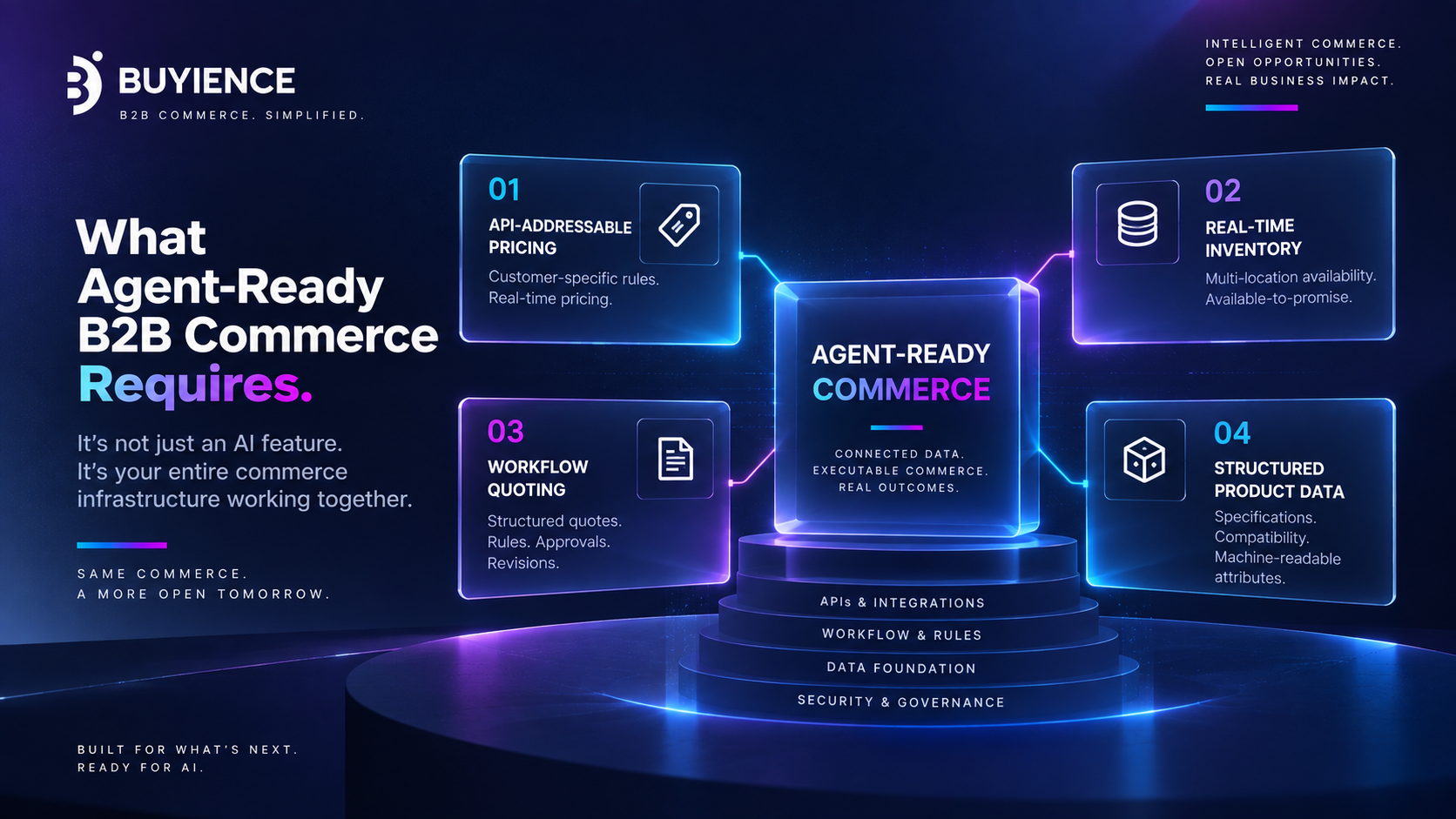
Understanding UCP's operational demands requires looking beyond the protocol spec and into what it implies for the systems underneath it.
Pricing must be API-addressable, not spreadsheet-dependent
In an agent-driven model, pricing can't live in a sales rep's head, a negotiation email thread, or a static price list that gets updated quarterly. When an AI agent queries your system for a quote, it needs to receive customer-specific pricing — including contract rates, volume tiers, promotional adjustments, and margin rules — in a structured, machine-readable response. Instantly.
This isn't about having an API endpoint that returns a number. It's about having pricing logic that can evaluate customer context, order composition, historical patterns, and business rules in real time, and return a defensible price without human involvement for standard scenarios.
If your pricing engine requires a rep to "check with finance" before responding to a volume inquiry, you are not UCP-ready. You're not even close.
Inventory must be real-time, multi-location, and queryable
UCP agents don't just ask "do you have this product?" They ask "do you have 500 units of this product available for delivery to this address from the nearest warehouse by this date, and what does that cost?"
That query hits inventory availability, warehouse allocation logic, fulfillment routing, and freight calculation simultaneously. If your inventory system updates nightly via batch sync from an ERP, the agent gets stale data. If your warehouses operate as independent silos with no unified availability view, the agent gets incomplete data. Either way, the agent moves on to the next merchant.
Real-time, multi-warehouse inventory visibility isn't a nice-to-have in the agentic model. It's the minimum threshold for participation.
Quoting must be a workflow, not a document
This is the point most B2B operators underestimate. UCP doesn't care about your PDF quote template. Agents don't read PDFs. They interact with structured data through defined capabilities.
In an agent-driven transaction, quoting becomes a programmatic workflow: the agent requests a quote, the system evaluates pricing rules, applies customer-specific terms, checks inventory constraints, calculates margins, and returns a structured response — all within the protocol's interaction model. Revisions, counter-offers, and approvals happen through the same channel, not through email threads and Slack messages.
Platforms that treat quoting as "generate a document and email it" will find themselves invisible to agent-driven procurement. The quote has to be a living, interactive object with state, rules, and machine-readable terms — not a static PDF attached to an email.
Product data must be structured for machine consumption
Agent-driven discovery works on structured attributes, not marketing copy. When a procurement agent searches for products, it's filtering on specifications, compatibility, certifications, and application context — not reading your product descriptions looking for keywords.
This means your product catalog needs rich, structured metadata: technical specifications in standardized formats, compatibility matrices, substitution logic, and enough contextual information for an agent to evaluate fit without human interpretation.
If your product data lives in unstructured descriptions that were written for SEO rather than machine interpretation, agents won't find you. They'll find the merchant whose catalog an agent can actually parse.
The Protocol Stack Is Deeper Than It Appears
UCP doesn't operate in isolation. It's designed to compose with the Agent Payments Protocol (AP2) for secure payment authorization, Agent2Agent (A2A) for multi-agent coordination, and the Model Context Protocol (MCP) for connecting agents to external tools and data sources.
For B2B operators, this composability has specific implications. A procurement agent might use MCP to access your product catalog, UCP to negotiate pricing and build a cart, A2A to coordinate with a logistics agent for delivery optimization, and AP2 to authorize payment against a purchase order with credit terms.
Each layer requires your backend to respond with structured, trustworthy data. The chain is only as strong as the weakest integration point. If your pricing is API-ready but your inventory syncs on a 24-hour delay, the transaction breaks. If your product data is machine-readable but your quoting workflow requires a manual approval for every order over $5,000, the agent escalates to a human — and your competitor's system processes the order automatically.
This is why the agentic commerce discussion is fundamentally an infrastructure discussion for B2B. Consumer-facing merchants are optimizing for product visibility and checkout speed. B2B merchants need to optimize for transactional depth: the ability to handle complex, multi-variable queries that touch pricing, inventory, configuration, credit, and fulfillment in a single interaction. The merchants who can respond to that full query programmatically win the transaction. Everyone else gets filtered out before a human ever sees the opportunity.
Where B2B Platforms Typically Fall Short
The gap between UCP's requirements and most B2B platforms' capabilities tends to concentrate in a few areas.
- Monolithic architectures that can't expose granular capabilities — UCP's model assumes merchants can declare specific capabilities — checkout, product discovery, identity linking, fulfillment — and agents can invoke them independently. Monolithic platforms that bundle everything into a single application layer can't selectively expose capabilities without significant re-architecture.
- Pricing logic locked inside ERPs — Many B2B operators run pricing through their ERP, which was designed for internal operations, not real-time external queries. When pricing rules live in ERP logic that requires synchronous database queries and multi-step calculations, response times measured in seconds become response times measured in minutes. Agents won't wait.
- Manual approval workflows with no programmatic interface — Approval chains that require a human to click "approve" in an email or internal tool are incompatible with agent-driven transaction flows. Approvals need rule-based automation with clear thresholds: auto-approve within margin bounds, escalate outside them. The approval logic needs to be as programmable as the pricing logic.
- Inventory systems that don't account for allocation — Showing aggregate stock across warehouses isn't the same as showing available-to-promise inventory that accounts for existing reservations, in-transit stock, and fulfillment constraints. Agents need ATP data, not raw stock counts.
What This Means for Operators Making Platform Decisions Now
If you're evaluating B2B commerce platforms in 2026, agent readiness should be part of the assessment — even if your buyers aren't using AI procurement agents today. The infrastructure decisions you make now will determine whether your business is discoverable, quotable, and transactable in an agent-driven marketplace 18 to 24 months from now.
The platforms that will thrive in an agentic commerce environment share specific architectural characteristics:
- API-first design — can expose capabilities independently
- Real-time data layers — serve current pricing and inventory without batch delays
- Programmable business rules — can evaluate and respond to agent queries without human intervention
- Modular architectures — can adopt new protocol capabilities as they emerge
This is why MACH architecture — Microservices, API-First, Cloud-Native, Headless — isn't just a technical preference for B2B platforms anymore. It's the structural prerequisite for participating in protocol-driven commerce. Platforms built on monolithic foundations can't selectively expose the capabilities that UCP requires. They can't respond in real time because their data layers weren't designed for it. And they can't evolve at the pace that an open, actively-developing protocol demands.
Buyience's Nova Core was built on these principles — not because of UCP specifically, but because the operational problems UCP addresses are the same problems B2B operators face every day:
- Customer-specific pricing that evaluates in real time
- Multi-warehouse inventory with unified availability
- AI-assisted quoting that operates as a workflow, not a document generator
- An API-first architecture where every capability is independently addressable
The protocol formalizes what good B2B commerce architecture already requires. Platforms that were built for real-time, structured, machine-readable commerce don't need to retrofit for agent readiness. They're already there.
The Window Is Open, but It Won't Stay Open
UCP is evolving rapidly. Multi-item cart support, identity linking for loyalty programs, and post-purchase support for tracking and returns are already on the roadmap. As the protocol matures and procurement teams adopt AI agents for routine purchasing, the merchants whose backends can respond programmatically will capture the transactions. The merchants who can't will become invisible — not because their products are inferior, but because their infrastructure can't participate in the conversation.
The competitive advantage in agent-driven commerce isn't about who adopts UCP first. It's about who already has the architectural foundation to support what the protocol demands:
- Real-time pricing
- Structured product data
- Programmable business rules
- Inventory systems that serve truth, not approximations
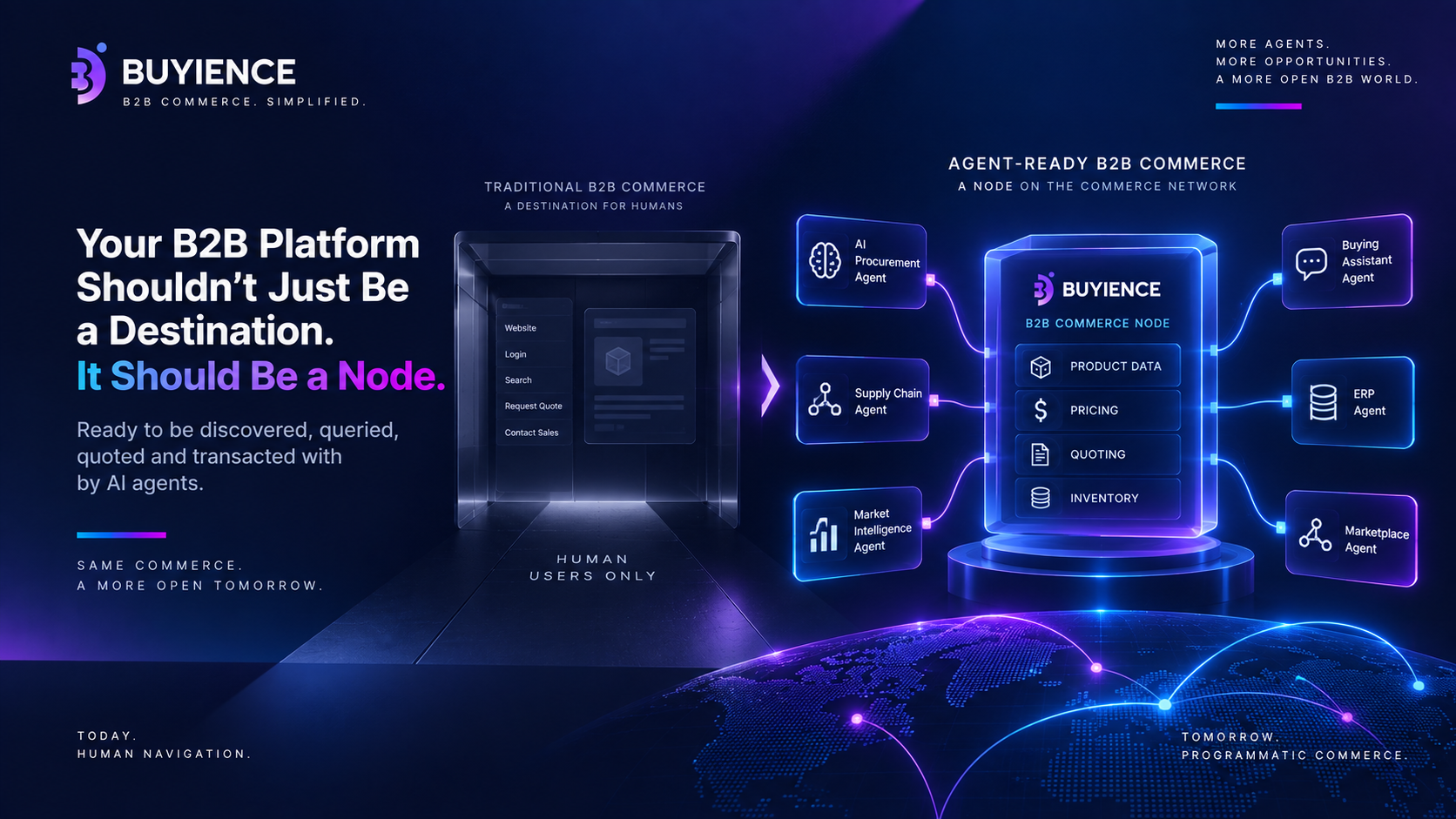
For B2B operators, the question isn't whether agent-driven commerce is relevant to your business. It's whether your platform is capable of being a node on the network, or whether it's still a destination that requires humans to navigate it manually.
The difference between those two positions isn't a feature toggle. It's an architectural decision that either enables or prevents participation in protocol-driven commerce. And by the time most operators realize they need to make that decision, the early movers will already be capturing the transactions that agents route automatically to backends that can respond.
FAQ
Questions, answered
What is the Universal Commerce Protocol (UCP)?
UCP is an open standard co-developed by Google and Shopify that defines how AI agents discover merchants, negotiate terms, build carts, and complete transactions. It launched at NRF 2026 with endorsement from more than 20 global partners — including Etsy, Wayfair, Target, Walmart, Visa, Mastercard, and Stripe. The protocol uses a layered architecture built on REST and JSON-RPC transports and composes with the Agent Payments Protocol (AP2), Agent2Agent (A2A), and Model Context Protocol (MCP) to cover the full transaction lifecycle. It's open-source under Apache License 2.0 and actively evolving on GitHub.
How is UCP different from OpenAI's Agentic Commerce Protocol (ACP)?
Both protocols aim to standardize how AI agents transact with merchants, but they differ in architecture and philosophy. UCP separates checkout from payment and composes with whichever payment protocol the merchant prefers. ACP bundles checkout and payment together through a Shared Payment Token via its collaboration with Stripe. UCP is backed by a coalition of retailers and payment networks and is designed as a cross-ecosystem standard. ACP emerged from OpenAI's shopping integrations within ChatGPT. For B2B operators, the more relevant question isn't which protocol wins — it's whether your commerce infrastructure can expose structured, machine-readable capabilities that either protocol requires.
Does UCP apply to B2B commerce, or is it only for retail?
UCP was designed with consumer retail as its initial surface — native shopping in Google Search AI Mode and the Gemini app — but the protocol's architecture is not limited to B2C. Its capability-based model, where merchants declare what they support and agents invoke those capabilities programmatically, maps directly to B2B transaction requirements. The challenge for B2B operators is that the protocol assumes real-time, structured data behind every capability. B2B commerce adds layers of complexity — customer-specific pricing, negotiated contracts, approval workflows, multi-warehouse fulfillment — that demand significantly more from the backend than a standard retail checkout.
What does "agent-ready" mean for a B2B commerce platform?
Agent readiness means your platform can respond to programmatic queries from AI agents without human intervention for routine transactions. Specifically, it requires API-addressable pricing that evaluates customer-specific rules in real time, multi-location inventory with available-to-promise accuracy, quoting workflows that operate as structured data exchanges rather than document generators, product catalogs with machine-readable attributes and specifications, and approval logic that can auto-resolve within defined business rules. If any of these layers requires manual intervention, email-based handoffs, or batch-synced data, the platform isn't agent-ready — regardless of how modern the storefront looks.
My buyers aren't using AI procurement agents yet. Why should I care now?
Because the infrastructure decisions you make today determine whether you can participate in agent-driven commerce 18 to 24 months from now. Retrofitting a monolithic platform for real-time, API-first, capability-based commerce is a re-architecture project, not a configuration change. Operators who build on the right architectural foundation now — MACH architecture, real-time data layers, programmable business rules — will be ready when procurement teams adopt AI agents for routine purchasing. Operators who wait until agent adoption is mainstream will face the cost and timeline of catching up while competitors are already capturing transactions automatically.
How does MACH architecture relate to UCP readiness?
UCP's capability model requires merchants to expose granular, independently addressable functions — checkout, product discovery, identity linking, fulfillment — that agents can invoke selectively. MACH architecture (Microservices, API-First, Cloud-Native, Headless) enables exactly this: each microservice can expose its own capability, APIs serve as the interaction layer for agents, cloud-native infrastructure supports the real-time response times agents expect, and headless design decouples the backend logic from any specific frontend — including an AI agent interface. Monolithic platforms that bundle capabilities into a single application layer can't meet these requirements without fundamental re-architecture.
What role does quoting play in agent-driven B2B commerce?
Quoting is one of the highest-stakes capabilities in B2B agent commerce because it sits at the intersection of pricing, inventory, customer context, and approval logic. In an agent-driven model, quoting shifts from a document-generation task to a real-time, programmatic workflow. The agent requests a quote, the system evaluates pricing rules against customer-specific terms and current inventory, calculates margin impact, and returns a structured response — all within the protocol's interaction model. Platforms where quoting still means "a rep builds a PDF and emails it" cannot participate in this workflow. The quote must be a stateful, machine-readable object that agents can negotiate with, revise, and act on programmatically.
Is Buyience's Nova Core compatible with UCP?
Nova Core was built on MACH architecture with API-first design, real-time pricing and inventory, AI-assisted quoting workflows, and modular capabilities — the same architectural characteristics that UCP demands from merchant backends. While UCP-specific protocol integration is an evolving landscape for all platforms, Nova Core's foundation means the structural prerequisites are already in place: customer-specific pricing that evaluates programmatically, multi-warehouse inventory with real-time availability, quoting that operates as a workflow rather than a document, and an API layer where every capability is independently addressable. The platform doesn't require re-architecture to support protocol-driven agent interactions.
Assess your agent readiness. Download our B2B Commerce Agent-Readiness Checklist — a structured framework for evaluating whether your pricing, inventory, quoting, and product data infrastructure can support protocol-driven commerce. No sales pitch. Just the operational criteria that determine whether your backend can participate in the next generation of B2B transactions.
Related articles

Seasonal Demand Spikes: Inventory Planning for Corporate Gifting Brands
Corporate gifting demand doesn't spread evenly across the year — it concentrates heavily into a handful of weeks, which means annual averages are close to useless for planning. Effective planning works backward from peak-week capacity rather than forward from annual volume, commits inventory early enough to clear supplier lead times, and separates what genuinely must be pre-committed from what can stay flexible. This guide covers how to build that plan.
Multi-Warehouse Inventory for Industrial Suppliers: A Practical Guide
Running inventory across more than one warehouse solves real problems — shorter delivery times, regional redundancy, room to grow — but it introduces a coordination problem that single-location distributors never have to solve: knowing, in real time, exactly what's available where. Distributors who get this wrong end up overselling stock that's already spoken for, or sitting on excess inventory in one location while another runs a stockout. This guide covers how to structure multi-warehouse inventory so the numbers stay trustworthy.

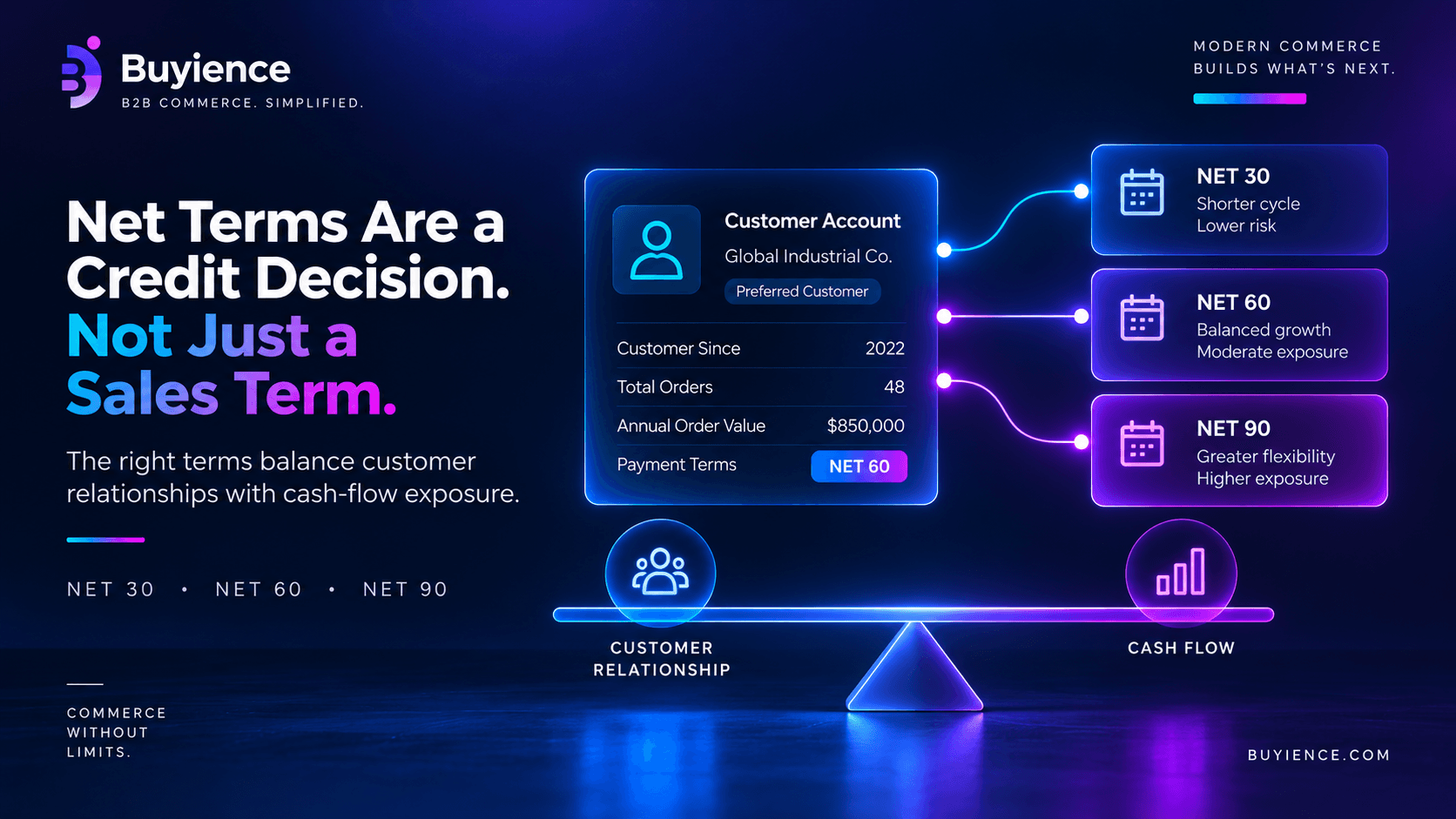
Net 30/60/90 Terms in Industrial Distribution: What Actually Works
Net terms are standard practice in industrial and fastener distribution, but "standard" doesn't mean "safe by default." The distributors who manage terms well tie them to a defined credit policy, apply them consistently rather than case-by-case, and track them in the same system that handles quoting and orders — not in a separate spreadsheet that goes stale. This guide covers how to set a terms policy, when to extend or restrict it, and what breaks when terms live disconnected from the rest of your sales process.