
How Fastener Distributors Can Stop Losing Margin on Manual Quotes
Manual quoting causes fastener and MRO distributors to lose margin through stale pricing, inconsistent discounting, and no enforced margin floor. Fixing it means automating tiered/contract pricing at the line level, enforcing a system-level margin floor, and keeping one source of truth for pricing — not asking reps to work faster inside the same broken process.

Fastener distribution runs on volume and precision. Thousands of SKUs, dozens of pricing tiers, customers who order the same bolts and washers every month but expect a fresh quote every time. It's a business built for automation — and yet most fastener distributors still price and quote by hand.
That gap is where margin quietly disappears.
Where the margin actually leaks
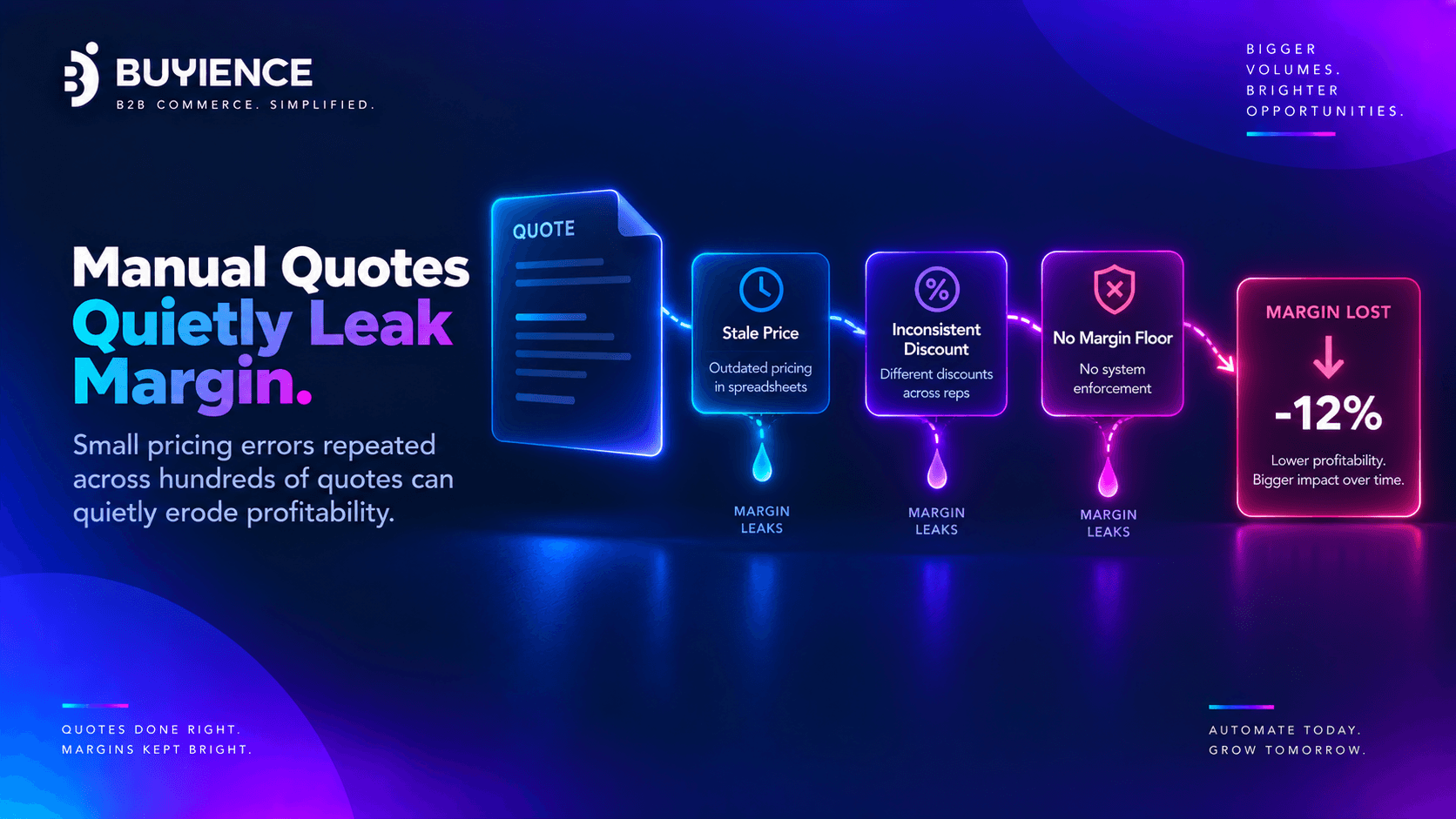
Manual quoting doesn't fail loudly. It fails in small, repeated ways that add up over a quarter:
- Stale list prices — A rep pulls up last quarter's price sheet because it's what's open on their desktop, not because it's current. Steel and zinc costs move; the quote doesn't.
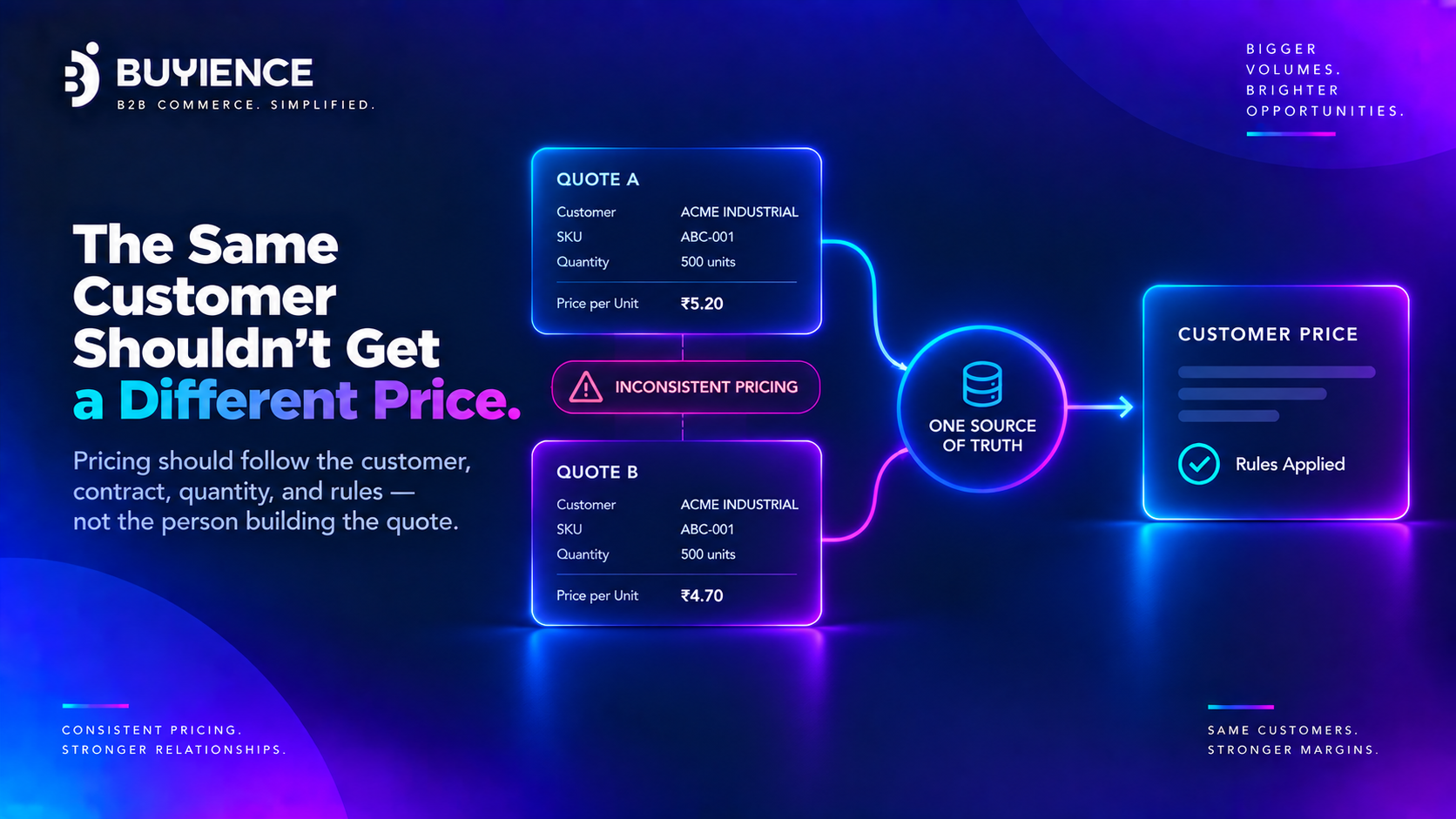
- Inconsistent discounting — Two reps quote the same customer, on the same SKU, in the same month, at different prices — because "what feels fair" isn't a pricing policy. Over hundreds of quotes, this inconsistency costs real dollars and creates awkward conversations when customers compare notes.
- No visibility into the floor — Without a hard margin floor built into the quoting process, a rep chasing a deal has no system stopping them from discounting past the point of profitability. They find out after the order ships, when it's too late to do anything but note it for next time.
- Time cost that becomes an opportunity cost — A quote built manually in a spreadsheet — checking current cost, applying the right tier, adjusting for volume, formatting it to send — can easily take 20–30 minutes per line item on a complex order. Multiply that across a sales team quoting dozens of times a week, and the real cost isn't just the hours. It's the deals that go to whichever competitor answered first.
None of these are people problems. They're process problems — and they're specific to how fastener and MRO distribution actually works: high SKU count, tiered and volume pricing, repeat buyers, and margins thin enough that a percentage point matters.
A quick self-audit: is manual quoting costing you margin?
Before assuming the answer, it helps to check. Pull up your last 20–30 quotes and ask:
- Did every quote for the same customer use the same base pricing logic? Or did the discount depend on which rep built it, or how the negotiation was going that day?
- Was the cost data current at the moment of quoting? Or was it pulled from a price sheet that was last updated weeks or months earlier?
- Is there a record of who approved any discount below standard tier pricing — and why? If the answer lives only in someone's memory or an old email thread, that's a gap.
- How long did each quote take to build, from request to send? Time it honestly, including the back-and-forth to confirm current pricing.
- Did any quote go out below your actual margin floor? Not the floor you intended to hold — the floor as it actually happened, calculated after the fact.
Most distributors running this audit for the first time find at least one of these questions uncomfortable to answer. That discomfort is usually where the margin is going.
Why fastener distribution is a hard case for generic tools
A lot of quoting software is built for simple, single-price catalogs — sell one thing, quote one price. Fastener and MRO distribution rarely looks like that. A single customer might buy the same M8 bolt in three different quantities across three different orders, each at a different unit price depending on volume breaks, contract terms, and how long they've been a customer.
Generic ecommerce platforms handle this poorly because pricing logic that complex wasn't the problem they were built to solve. The result is distributors bolting spreadsheets, email threads, and manual approval chains onto a platform that was never designed for negotiated, tiered, relationship-based B2B pricing — which is exactly how fasteners and MRO parts get sold.
It's worth being specific about what "handling complexity well" actually requires, because this is where most generic tools fall short in practice:
- Line-level pricing resolution. The same customer buying the same part in different quantities on the same order needs each line to resolve its own price independently — not one blanket discount applied to the whole quote.
- Contract awareness. If a customer has negotiated terms, the system needs to know that before a rep even opens the quote builder, not require someone to remember and manually apply it.
- SKU-count tolerance. A catalog with a few hundred products behaves very differently, technically, than one with tens of thousands of fastener variants across sizes, materials, and finishes. Tools built for the former often slow to a crawl or require workarounds at the latter.
- Approval workflows that don't bottleneck sales. A margin floor is only useful if exceptions can be routed and approved quickly when a genuinely good reason exists — not if every edge case requires a multi-day email chain to a manager.
What a structured quoting process actually looks like
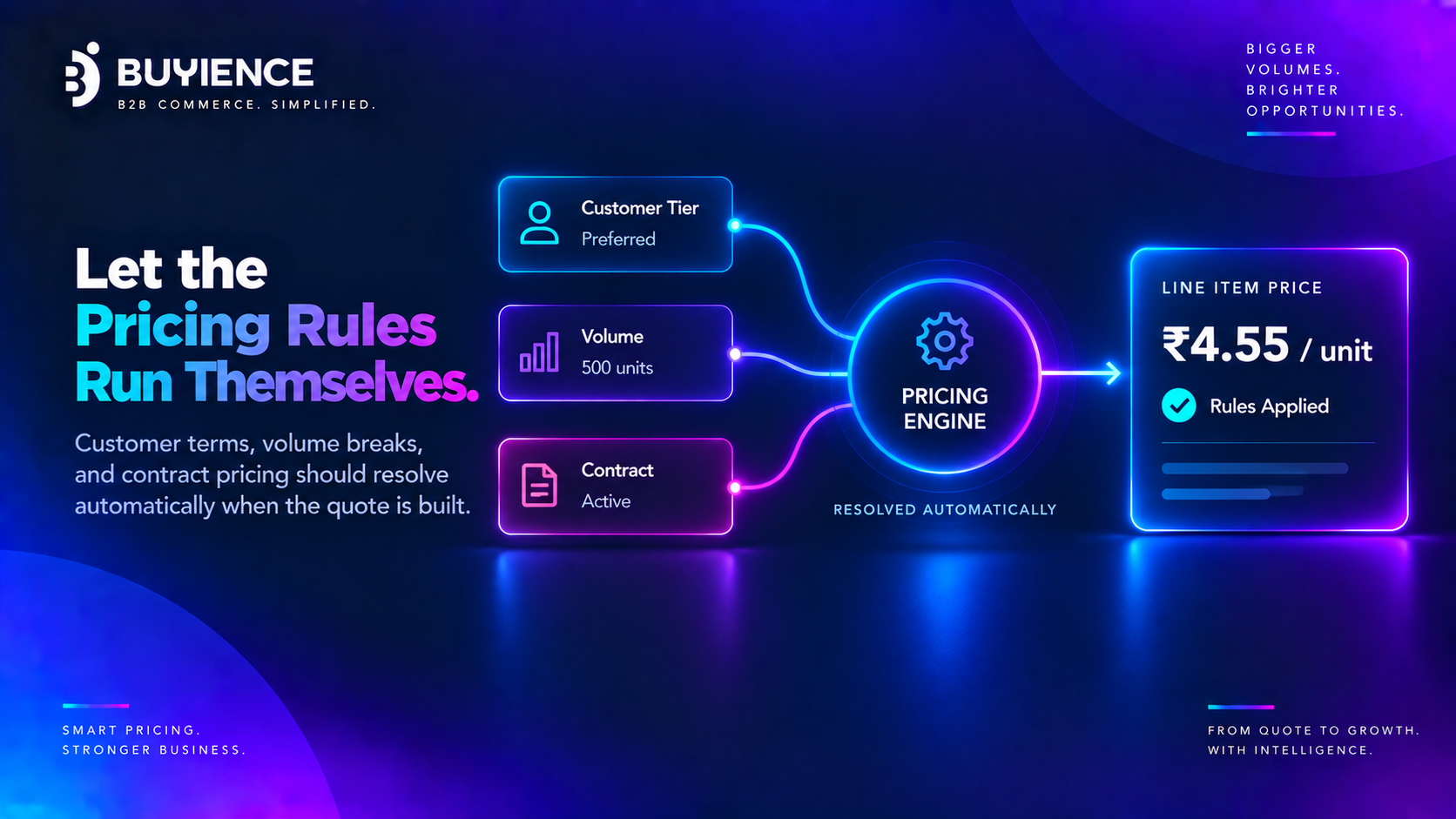
The fix isn't "work faster." It's removing the manual steps where inconsistency and error creep in. In practice, that means:
- Pricing rules that apply themselves. Customer-specific rates, volume breaks, and contract pricing should resolve automatically at the line level the moment a quote is built — not get recalculated by hand from a price sheet that may or may not be current.
- A margin floor the system enforces, not the rep. Reps should have room to negotiate — that's part of selling — but the system should know where the floor is and flag or block anything that crosses it, before the quote goes out rather than after.
- One source of truth for pricing. When cost or list price changes, it should update everywhere at once, not in whichever spreadsheet happens to be open on a given rep's laptop that week.
- A record of what was actually quoted. When a customer asks why this month's price differs from last month's, someone should be able to answer in seconds — not by digging through old email threads.
This is the difference between quoting as a manual task and quoting as a governed process. The second version scales; the first one erodes margin a little more with every quote.
What Buyience does for fastener and MRO distributors
Nova Core's AI Quote Engine was built for exactly this kind of pricing complexity — customer-specific rates, tiered and volume pricing, and contract terms that resolve automatically at the line level, with margin protection built into every quote before it goes out. According to our own product benchmarks, distributors using it generate quotes 80–90% faster than manual methods, at 95%+ pricing accuracy.
It's paired with multi-warehouse inventory, a self-service customer portal, Net 30/60/90 terms support, and a real-time Digital Sales Room where reps and buyers can negotiate live — all from one platform, without stitching together a spreadsheet, an inbox, and a separate order system.
If manual quoting is quietly costing you margin, it's worth seeing what a governed pricing process looks like in practice.
Start your free trial → — 14 days, no card required.
Have questions about how tiered pricing or margin floors work for your specific catalog? Request a demo and we'll walk through it with your actual SKUs.
Questions, answered
How much margin do fastener distributors typically lose to manual quoting?
It varies by distributor and isn't something we'd put a single industry-wide number on without a data source behind it. What's consistent across manual processes is where the loss comes from: stale list prices, inconsistent rep-to-rep discounting, and no enforced floor before a quote goes out. Fixing those three sources of leakage is the highest-leverage place to start.
What's the difference between tiered pricing and volume discounting?
Tiered pricing sets different rates by customer segment or contract level (a "Gold tier" customer pays less than a new account, regardless of order size). Volume discounting sets rates by quantity ordered, regardless of who's buying. Most fastener and MRO distributors need both running at once, resolved automatically at the line-item level.
Can a margin floor actually stop a rep from underpricing a deal?
Yes, if it's enforced at the system level rather than left as a guideline. A hard floor built into the quoting engine will flag or block a quote that crosses it before it's sent — rather than surfacing the problem after the order has already shipped.
How long should a fastener/MRO quote actually take to generate?
For a distributor quoting manually — checking current cost, applying the right tier, adjusting for volume, formatting the document — 20–30 minutes per line item is common. With automated, rule-based pricing, that same quote can generate in seconds because the pricing logic runs itself instead of being rebuilt by hand each time.
Does automated quoting work for distributors with thousands of SKUs and custom contract pricing?
That's the case it needs to handle well — a tool built for simple, single-price catalogs will struggle with the SKU count and negotiated pricing typical of fastener and MRO distribution. Look for a platform built specifically for tiered, contract, and volume pricing resolved at the line level, not a generic ecommerce cart with pricing bolted on.
What should I look for in fastener distributor software specifically?
At minimum: customer-specific and tiered pricing that applies automatically, a margin floor the system enforces, multi-warehouse inventory visibility, and a single source of truth for pricing so cost changes propagate everywhere at once. Net terms support (30/60/90) and a real-time negotiation or approval workflow are close behind for most distributors.
Related articles
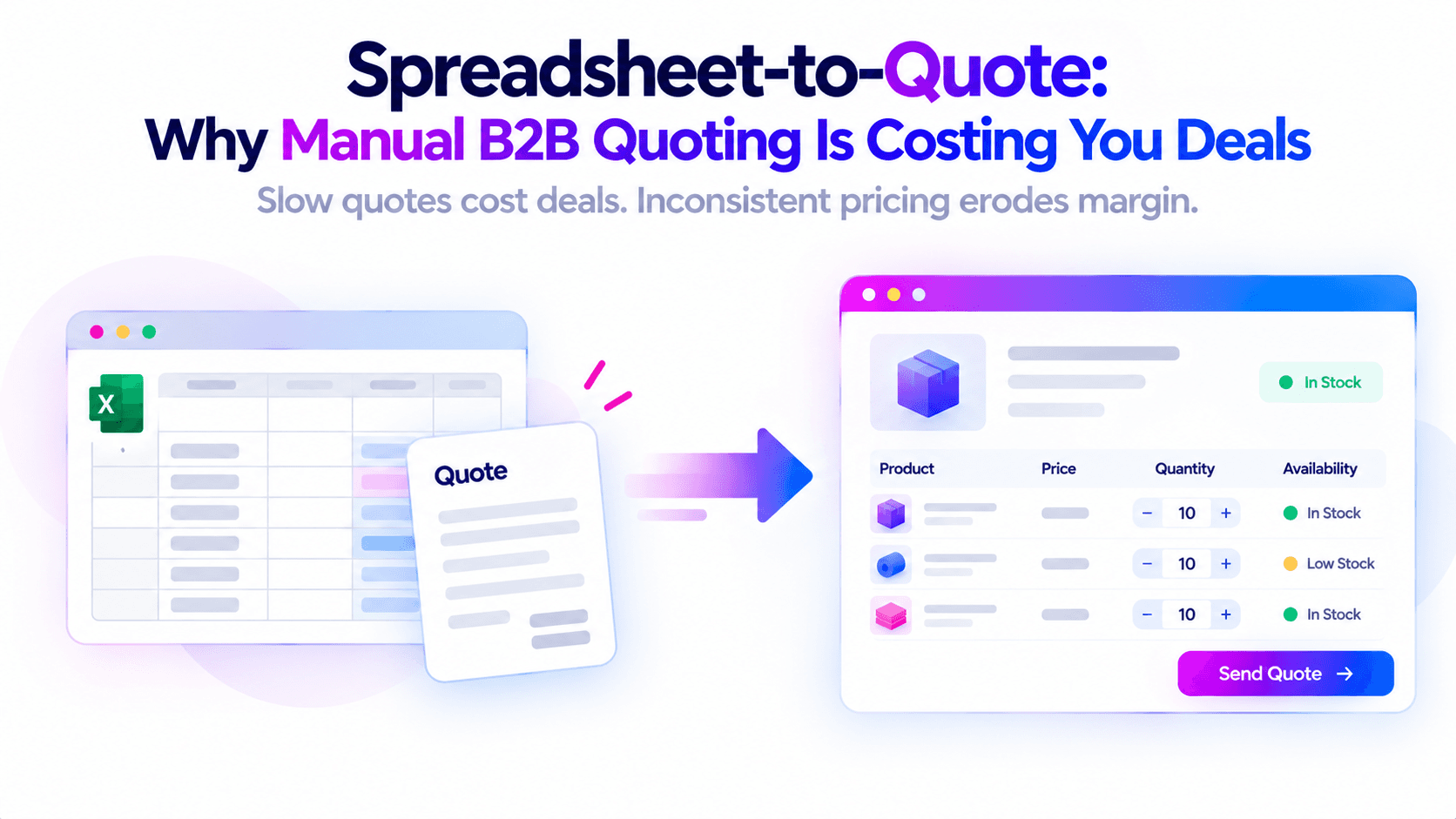
Spreadsheet-to-Quote: Why Manual B2B Quoting Is Costing You Deals
Manual quoting rarely loses a deal in a way anyone records. It loses deals through delay — the quote that arrives after the buyer decided — and it loses margin through inconsistency nobody traces back. The cost is invisible precisely because the failures look like normal business: a slow week, a competitive loss, a thin month. This post maps the five stages where a spreadsheet quote leaks, and which one to fix first.

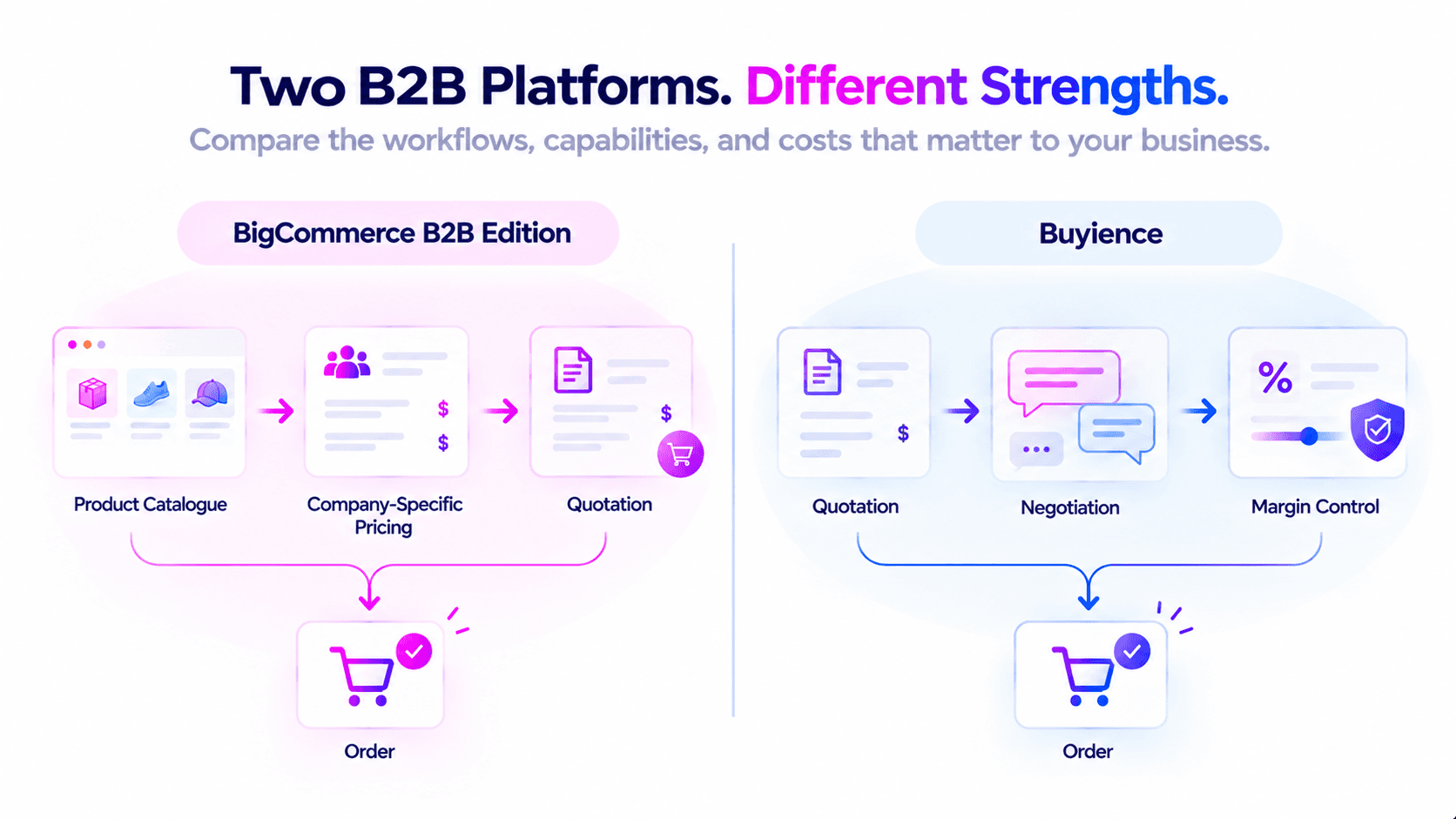
Buyience vs BigCommerce B2B Edition: A Side-by-Side Comparison
BigCommerce B2B Edition is a genuinely capable B2B platform with native quoting, company accounts, price lists and purchase order workflows — it is not a consumer cart with wholesale bolted on. The honest comparison with Buyience comes down to two things: cost tier, since B2B Edition is Enterprise-only with custom pricing, and what happens during negotiation rather than during quoting. If you have the budget and your quoting is structured rather than negotiated, B2B Edition is a strong choice.
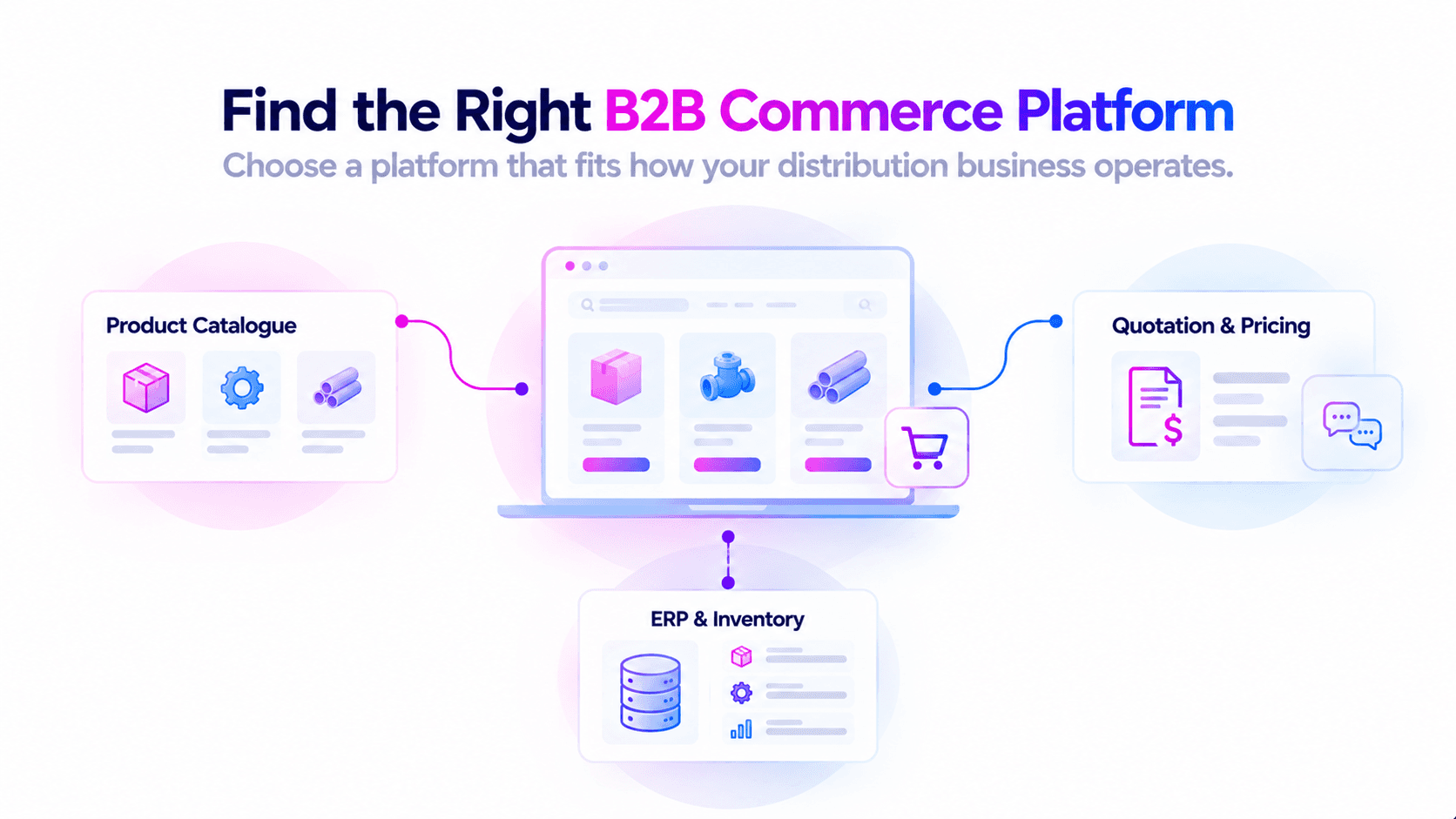
The Best B2B Commerce Platforms for SMB Distributors in 2026
Most "best B2B platform" lists are published by vendors who rank themselves first. This one is too — we build Buyience — so the useful thing we can offer is published pricing where it exists, honest placement of where each platform actually fits, and a clear statement of which distributors should rule us out. For SMB distributors the real shortlist is short: BigCommerce B2B or Shopify for catalogue-led wholesale, Sana or an ERP-led option if your ERP governs pricing, OroCommerce if you have genuine enterprise complexity and the budget, and quoting-led platforms including ours if your revenue arrives through negotiated quotes.