
Tiered Pricing for Fastener & MRO Distributors: A Practical Setup Guide
Tiered pricing for fastener and MRO distribution needs two layers working together — customer-segment tiers (who's buying) and volume breaks (how much they're buying) — resolved automatically at the line-item level. Most distributors that try to run this manually end up with pricing that's inconsistent, hard to audit, and slowly loses margin. This guide walks through defining tiers, setting volume breaks, layering contract pricing on top, and rolling it out without disrupting active sales relationships.

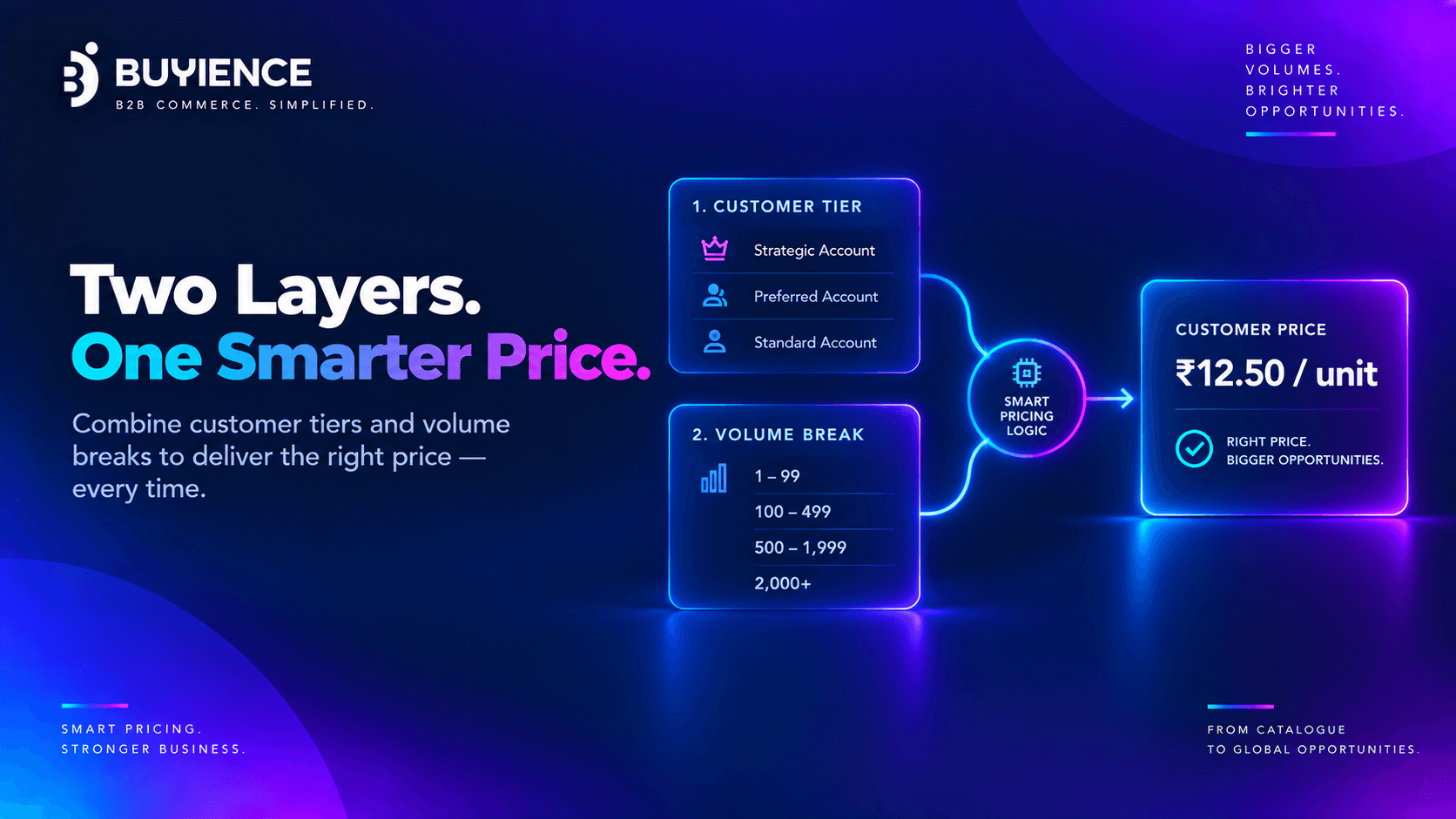
If you distribute fasteners or MRO parts, you already have tiered pricing — even if it isn't written down anywhere. Your best long-term accounts pay less than a first-time buyer. Someone ordering 10,000 units gets a better unit price than someone ordering 100. The question isn't whether you have tiers. It's whether they're consistent, documented, and actually protecting your margin — or whether they exist mostly in individual reps' heads.
This guide is a practical setup process, not a theory of pricing. It assumes you're building or rebuilding a tiered pricing structure for a catalog with real complexity: thousands of SKUs, repeat B2B buyers, and margins where a percentage point matters.
The two layers of tiered pricing
Before setting anything up, it's worth separating two things that often get blended together and cause confusion:
- Customer tiers — About who is buying. A distributor might define three or four tiers — say, New Account, Standard, Preferred, and Strategic — based on relationship length, order history, or negotiated contract status. Each tier gets a baseline discount off list price.
- Volume breaks — About how much is being bought in a single order, independent of who's buying. Order 500 units of a fastener and the unit price drops; order 5,000 and it drops further. This applies whether the buyer is a brand-new account or a ten-year customer.
The distributors who struggle with tiered pricing are usually the ones trying to manage both with one flat discount percentage per customer, applied by memory. The ones who get it right treat these as two separate rule sets that combine automatically at the line-item level, every time.
Step 1: Define your customer tiers based on real criteria
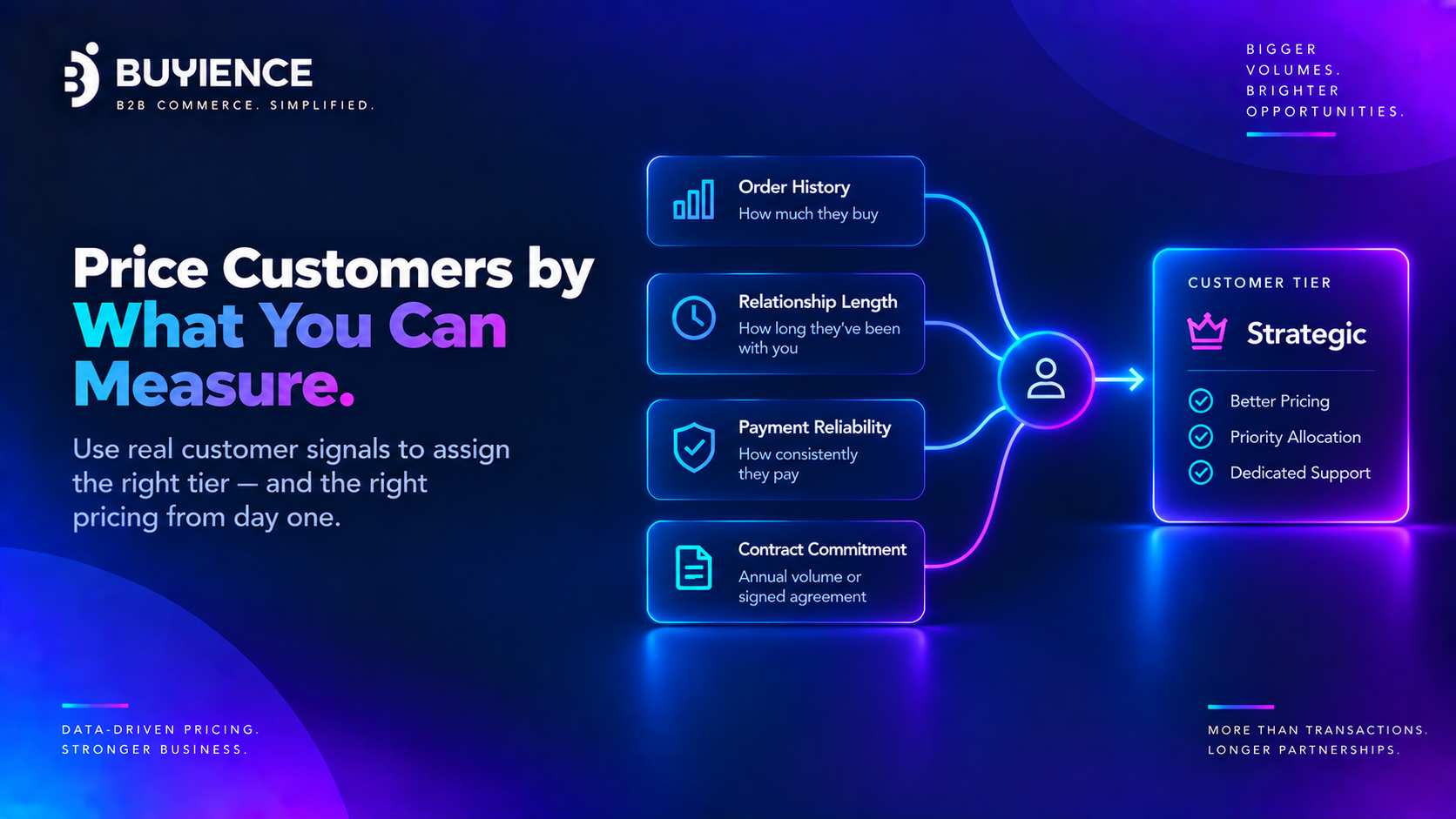
Resist the temptation to make tiers subjective ("this customer feels important"). Use criteria you can actually measure and defend:
- Order history — trailing 12-month volume or revenue
- Relationship length — how long they've been an active account
- Payment reliability — on-time payment history, especially relevant if you're offering Net 30/60/90 terms
- Contractual commitment — customers with signed volume or exclusivity agreements
Three to five tiers is usually enough. More than that, and the distinctions start to blur and become hard for reps to apply consistently. Give each tier a clear name and a clear discount range off list price — not a single fixed number, since volume breaks will still apply within the tier.
Step 2: Build your volume break structure
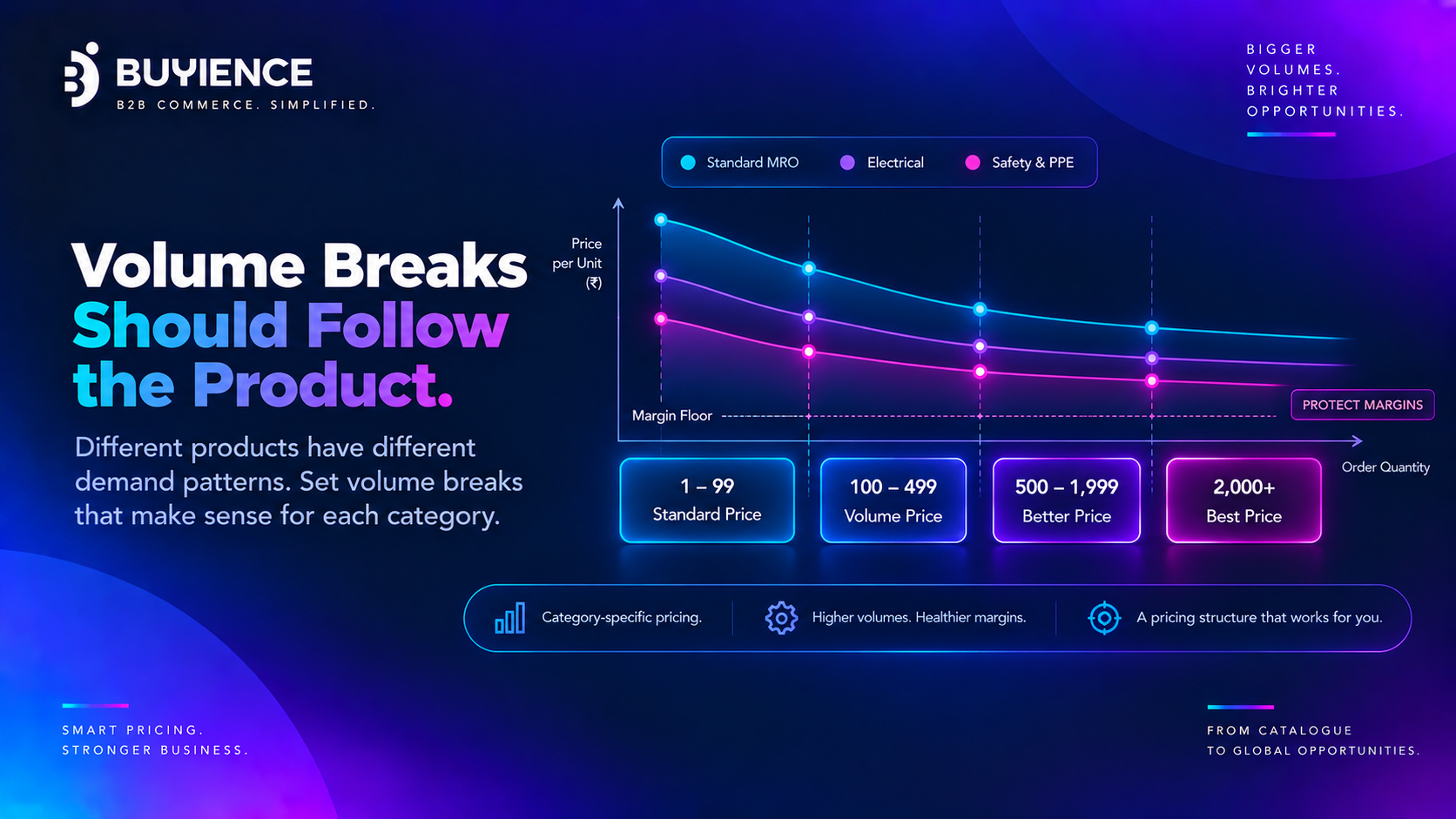
Volume breaks should be set at the SKU or product-category level, not applied as one blanket rule across your entire catalog. A high-velocity, low-margin item like a common hex bolt might need different break points than a specialty fastener with thinner volume but healthier margin per unit.
A practical approach:
- Group SKUs by category and margin profile, not just by product type. Two fasteners that look similar on a shelf can have very different cost structures.
- Set 3–4 break points per group — for example, 1–99 units, 100–499, 500–1,999, 2,000+. Fewer breaks are easier to manage; more breaks give finer control but add complexity for reps and systems alike.
- Model each break against your margin floor, not just against a "nice round discount." A 15% break that still clears your floor is safe. A 15% break chosen because it sounds competitive, without checking the floor, is how margin erodes.
- Review break points against actual order size distribution. If most orders in a category cluster around 300–400 units, a break point at 500 isn't doing much work — it's a break nobody reaches.
Step 3: Layer contract and negotiated pricing on top
Some of your accounts will have pricing that doesn't fit neatly into tiers or volume breaks — a negotiated rate as part of a larger agreement, a price lock for a fixed period, or an exception granted for a strategic reason. This layer should sit above the tier and volume logic, overriding it only where explicitly defined, not replacing the whole pricing structure for that customer.
This matters because contract pricing that isn't layered cleanly tends to "leak" into how reps think about that customer's pricing more broadly — a rep who knows Customer X gets a special rate on Product A sometimes assumes similar latitude on Product B, where no such agreement exists. Keeping contract exceptions scoped and explicit — tied to specific SKUs or categories, with an end date where relevant — prevents this drift.
Step 4: Decide how exceptions get approved
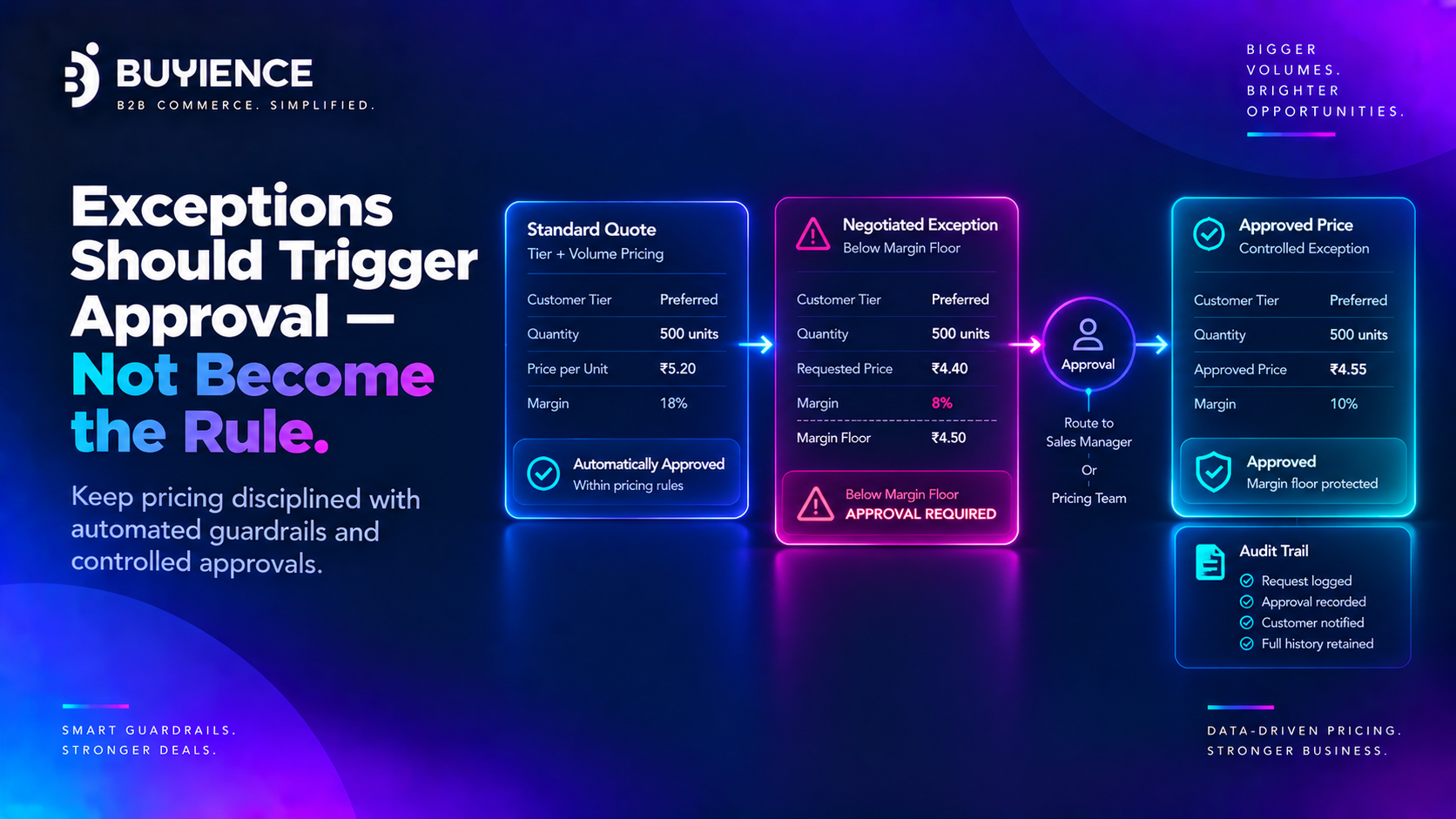
No pricing structure survives contact with real sales conversations without some mechanism for exceptions. The question is whether that mechanism is fast enough that reps use it, and controlled enough that it doesn't quietly become the default.
A workable approach:
- Set a threshold — anything within the defined tier and volume structure needs no approval.
- Anything below the margin floor requires explicit sign-off, ideally routed automatically rather than via a separate email or phone call.
- Track every exception, including who approved it and why. Over a quarter, this record tells you whether your tier structure is well-calibrated or whether exceptions are becoming the norm — a sign the tiers themselves need revisiting.
Step 5: Roll it out without disrupting active relationships
Existing customers already have pricing expectations, even if those expectations were never formally documented. A rollout that resets everyone to a new tier structure overnight risks confusing or alienating accounts who don't understand why their price changed.
A gentler approach:
- Map existing customers into the new tier structure first, before changing anything they see. In most cases, a well-designed tier system will land existing accounts close to where they already are.
- Flag and review outliers — customers whose current effective pricing doesn't cleanly match any tier. These are usually the accounts with informal, undocumented arrangements, and they need a deliberate decision, not an automatic reassignment.
- Communicate proactively with any account whose pricing will materially change, rather than letting them discover it on their next invoice.
Where this breaks down in spreadsheets
All of the above is manageable in principle with a well-built spreadsheet — for a while. The problem is that tiered pricing combined with volume breaks and contract exceptions is a multiplicative problem, not an additive one. A few dozen SKUs, a handful of tiers, and a couple of volume breaks per SKU is fine by hand. Thousands of SKUs across several tiers and multiple break points per category is not — the number of price combinations that need to stay correct and current grows far faster than the effort available to maintain them manually.
This is the point where distributors typically end up with the exact problems tiered pricing was supposed to prevent: reps applying discounts inconsistently because the "correct" price for a given combination isn't easy to look up quickly, pricing drifting out of date because updating it means editing dozens of cells across multiple sheets, and no clean audit trail when a customer asks why their price changed.
How Nova Core handles this
Nova Core's AI Quote Engine resolves customer-specific pricing, volume breaks, and contract pricing automatically at the line-item level — every quote pulls current pricing logic rather than a snapshot from whenever a spreadsheet was last updated. Margin floors are enforced at the system level, with exceptions routed for approval rather than left to individual judgment. It's built specifically for the kind of pricing complexity fastener and MRO distributors deal with: high SKU counts, multiple simultaneous pricing layers, and margins where consistency matters as much as the discount itself.
If you're building or rebuilding a tiered pricing structure and want to see how it maps onto your actual catalog, it's worth walking through with real SKUs rather than in the abstract.
Buyience offers a 14-day free trial with full access to every feature — no credit card required to start. Visit buyience.com to start your free trial — or request a demo and we'll map it against your actual catalog.
Have a specific tier or volume-break structure you're trying to model? Request a demo and we'll map it against your actual catalog.
Questions, answered
How many pricing tiers should a fastener distributor have?
Three to five is a practical range for most distributors. Fewer than that often can't distinguish meaningfully between customer types; more than that becomes hard for reps to apply consistently and hard to audit later.
What's the difference between a pricing tier and a volume break?
A pricing tier is based on who the customer is — relationship length, order history, contract status. A volume break is based on how much is being ordered in a single transaction, independent of who's buying. Most distributors need both, combined at the line-item level.
Should volume breaks be the same across my whole catalog?
No. Break points should reflect the margin profile and order-size patterns of each product category. A blanket break structure applied catalog-wide usually ends up too aggressive for some SKUs and ineffective for others.
How do I handle a customer with a special negotiated rate that doesn't fit any tier?
Layer it as a scoped exception — tied to specific SKUs or categories, with an end date if applicable — rather than moving that customer into a custom, undocumented pricing arrangement that reps have to remember by hand.
Can tiered pricing be managed in a spreadsheet?
For a small catalog with few tiers and break points, yes, for a while. Once you're combining multiple tiers, multiple volume breaks per category, and contract exceptions across thousands of SKUs, the number of price combinations grows faster than a spreadsheet can reliably track — which is usually where pricing inconsistency starts.
What happens to existing customers when I introduce a new tier structure?
Map them into the new structure first, based on their existing effective pricing, before anything changes on their end. Review outliers individually, and communicate proactively with any account whose pricing will materially change rather than letting them find out on an invoice.
Related articles
Spreadsheet-to-Quote: Why Manual B2B Quoting Is Costing You Deals
Manual quoting rarely loses a deal in a way anyone records. It loses deals through delay — the quote that arrives after the buyer decided — and it loses margin through inconsistency nobody traces back. The cost is invisible precisely because the failures look like normal business: a slow week, a competitive loss, a thin month. This post maps the five stages where a spreadsheet quote leaks, and which one to fix first.

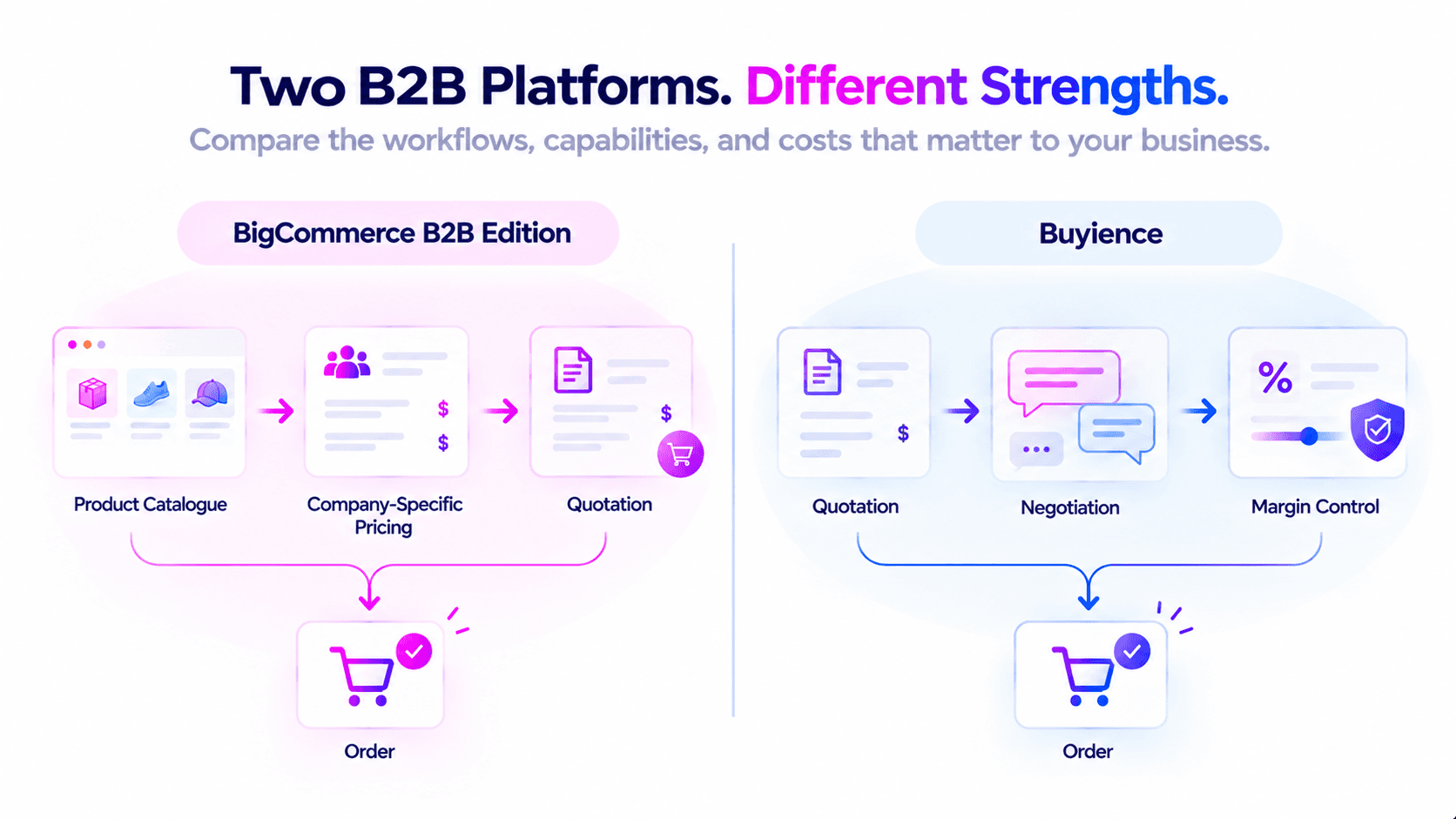
Buyience vs BigCommerce B2B Edition: A Side-by-Side Comparison
BigCommerce B2B Edition is a genuinely capable B2B platform with native quoting, company accounts, price lists and purchase order workflows — it is not a consumer cart with wholesale bolted on. The honest comparison with Buyience comes down to two things: cost tier, since B2B Edition is Enterprise-only with custom pricing, and what happens during negotiation rather than during quoting. If you have the budget and your quoting is structured rather than negotiated, B2B Edition is a strong choice.
The Best B2B Commerce Platforms for SMB Distributors in 2026
Most "best B2B platform" lists are published by vendors who rank themselves first. This one is too — we build Buyience — so the useful thing we can offer is published pricing where it exists, honest placement of where each platform actually fits, and a clear statement of which distributors should rule us out. For SMB distributors the real shortlist is short: BigCommerce B2B or Shopify for catalogue-led wholesale, Sana or an ERP-led option if your ERP governs pricing, OroCommerce if you have genuine enterprise complexity and the budget, and quoting-led platforms including ours if your revenue arrives through negotiated quotes.