
Quote Turnaround Time: The Metric Fastener Distributors Ignore
Most fastener and MRO distributors track win rate, average order value, and revenue per rep — but rarely track how long it actually takes to get a quote out the door. That's a gap, because quote turnaround time is one of the few metrics that directly predicts win rate in competitive, time-sensitive B2B buying situations. This post covers how to measure it properly, what a reasonable benchmark looks like, and where the time actually goes.

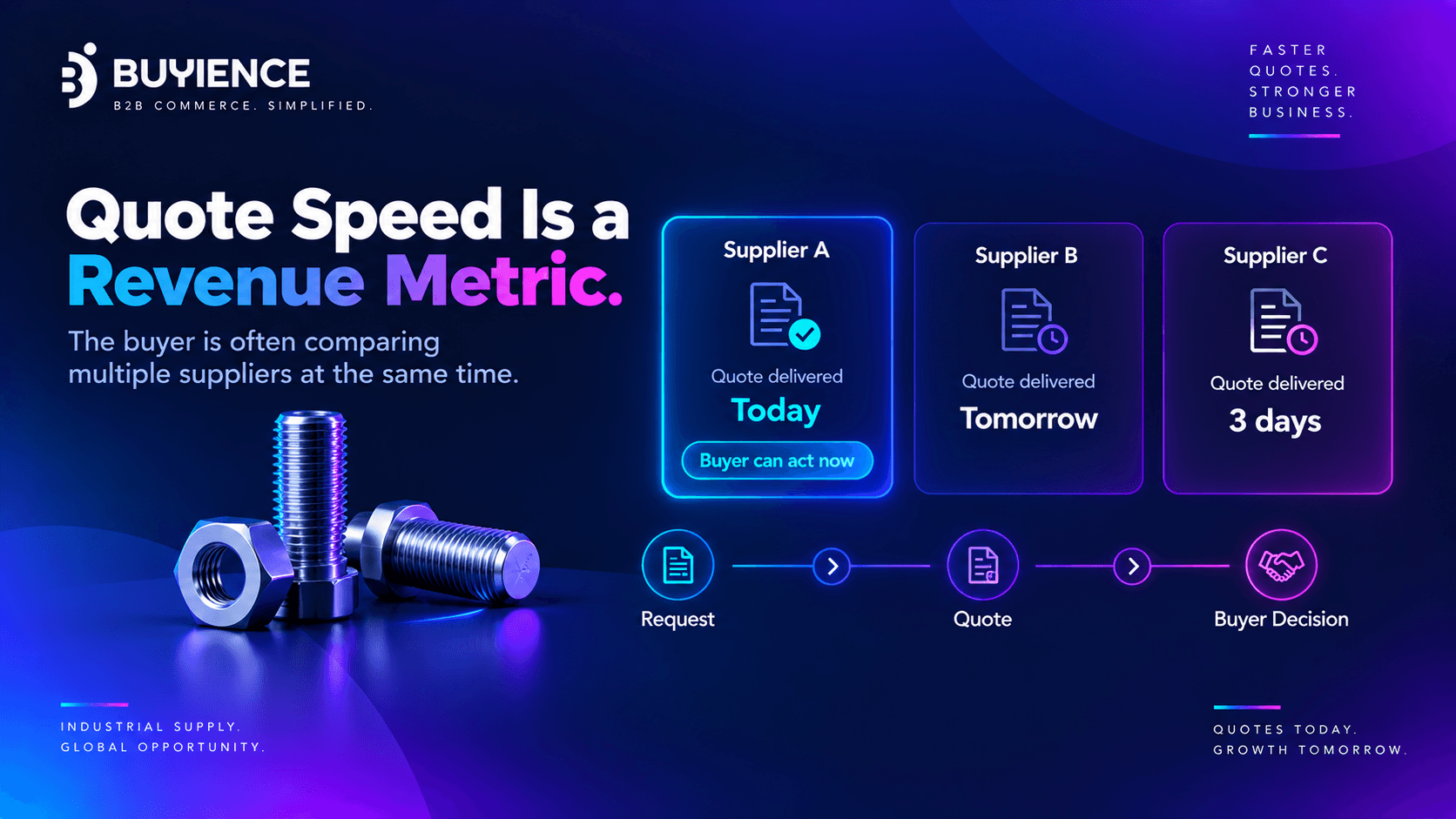
Ask a fastener or MRO distributor about their sales metrics and you'll typically hear about win rate, average deal size, and revenue targets. Ask about quote turnaround time — how long it takes from a customer's request to a quote actually landing in their inbox — and the answer is often a shrug, or a rough guess that turns out to be optimistic once someone actually measures it.
That's a real gap, because in industrial and fastener distribution, buyers frequently request quotes from more than one supplier at once and move forward with whoever responds first with a credible, accurate price. Turnaround time isn't just an internal efficiency metric — it's a direct, measurable input into win rate.
Why quote speed matters more in fastener and MRO distribution specifically
Fastener and MRO purchasing tends to be transactional and comparison-driven for a large share of orders. A buyer needs a specific part in a specific quantity, often to keep a production line or maintenance schedule running, and has limited patience for a slow response when the part itself is largely commoditized across suppliers. In that environment, price and availability matter, but so does simply being first to respond with something the buyer can act on.
This creates a specific dynamic: a distributor with slightly worse pricing but a same-day quote will often beat a distributor with slightly better pricing that takes three days to arrive — because by day three, the buyer has already ordered from someone else. Quote turnaround time functions less like a nice-to-have efficiency metric and more like a direct lever on revenue, particularly for the segment of business that's price-comparison driven rather than relationship-locked.
How to actually measure quote turnaround time
Most distributors that think they're tracking this are actually tracking something looser — a general sense of "we're usually pretty fast." A proper measurement needs a clear start and end point:
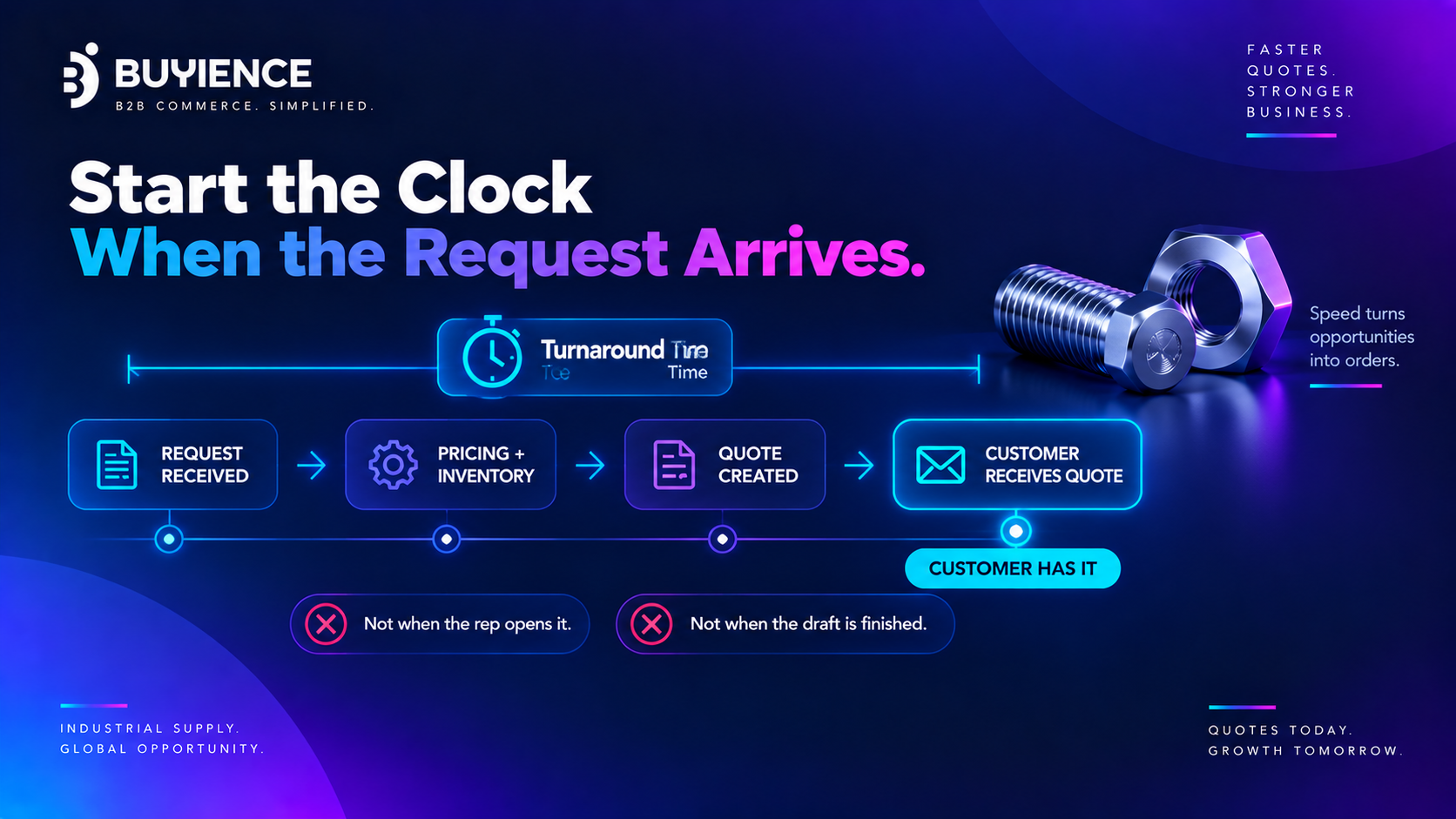
- Start the clock at the moment the request is received — not when a rep gets around to opening it, and not when internal work begins. If a request comes in via email, phone, or a web form, the clock starts there.
- Stop the clock when the quote is actually delivered to the customer — not when it's finished internally and sitting in a draft folder, not when a manager approves it, but when the customer has it in hand.
- Track this per quote, not as a vague average — A single company-wide average can hide a lot: a handful of same-day quotes can offset a long tail of multi-day ones, producing an average that looks fine while a meaningful share of customers are waiting far longer than the headline number suggests. Track the distribution, not just the mean: median turnaround, and the percentage of quotes that take longer than your target window.
- Segment by complexity — A simple, single-SKU quote for a repeat customer should turn around fast. A complex multi-line quote with custom specifications or a first-time customer will reasonably take longer. Tracking these together as one number obscures where the real bottleneck is.
What a reasonable benchmark looks like
There's no universal number that applies to every distributor's product mix and customer base, and it would be a mistake to claim an industry-wide standard without data behind it. What's more useful is setting an internal benchmark based on your own quote complexity mix, and then measuring consistently against it — a same-day target for simple, standard-catalog quotes is a reasonable starting point for most fastener and MRO distributors, with a defined, longer window for complex or custom requests.
The point of a benchmark isn't the specific number — it's having one at all, so "we're pretty fast" becomes a measurable claim rather than an assumption.
Where the time actually goes
When distributors measure this for the first time, the results are often surprising — not because any single step takes unreasonably long, but because the total adds up faster than expected once every step is accounted for:
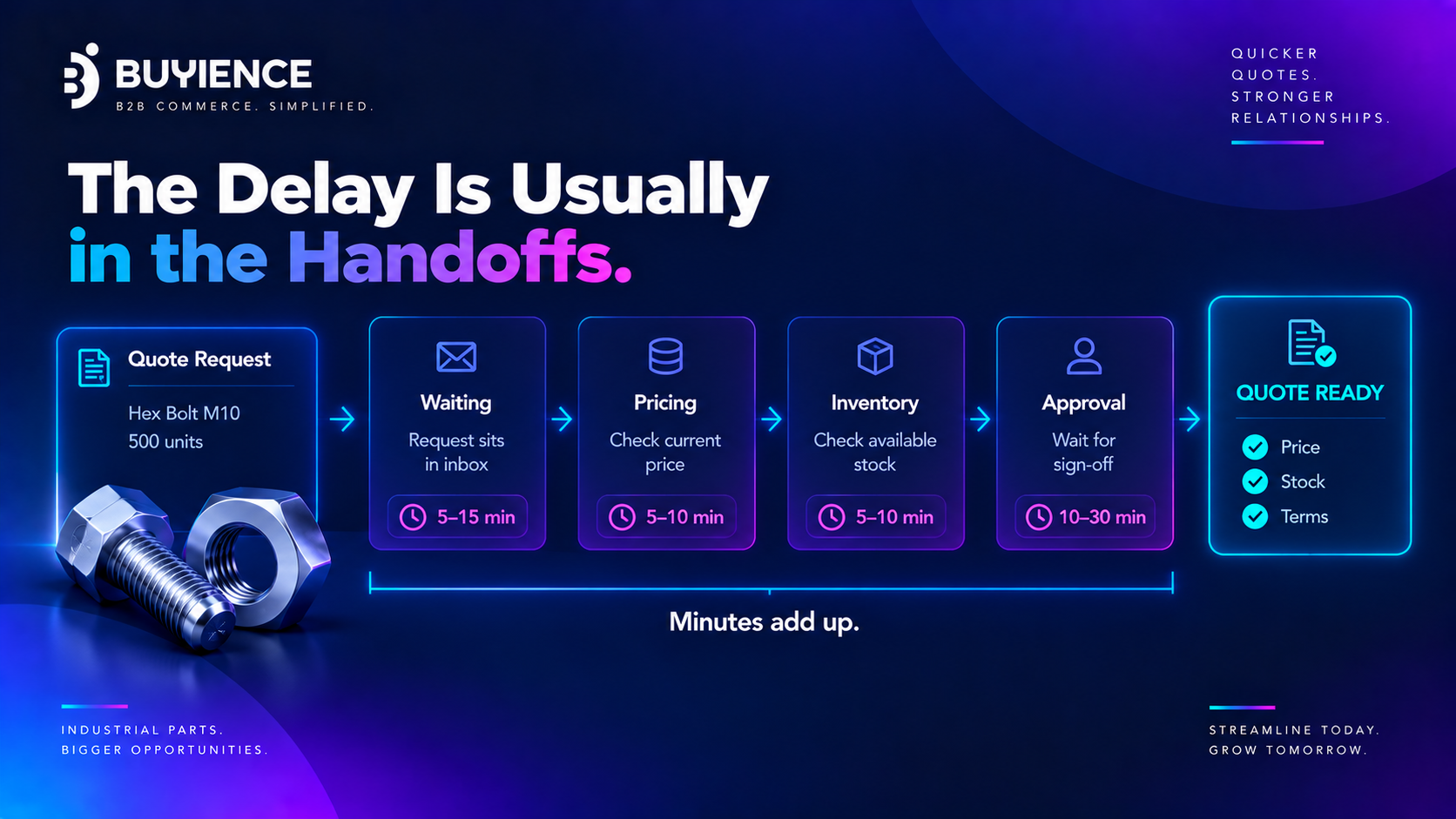
- Time before a rep even sees the request — Requests arriving via a general inbox or shared line often sit for a period before being picked up, especially if they arrive outside business hours or during a busy stretch.
- Time spent checking current pricing — If pricing isn't centrally maintained and current, a rep has to verify cost, apply the right tier and volume logic, and confirm nothing has changed since the last price sheet update — a step that consumes real time precisely because it's manual.
- Time spent checking inventory availability — Particularly for distributors managing stock across multiple warehouses without real-time visibility into what's actually available where.
- Time spent on approval, for anything outside standard pricing — If a quote needs sign-off — for a discount, a custom term, or an unusual quantity — the approval step often introduces the longest single delay, especially if it depends on a specific person's availability.
- Time spent formatting and sending — Even after all the pricing and availability work is done, turning that into a clean, professional quote document and sending it is its own step, and a surprisingly time-consuming one when done manually for every request.
Most of these steps individually take only a few minutes. Stacked together, especially with any delay waiting for a person to become available at any single step, the total routinely exceeds what either the distributor or the customer would consider "fast" — even when no individual part of the process is obviously broken.
What actually moves the needle
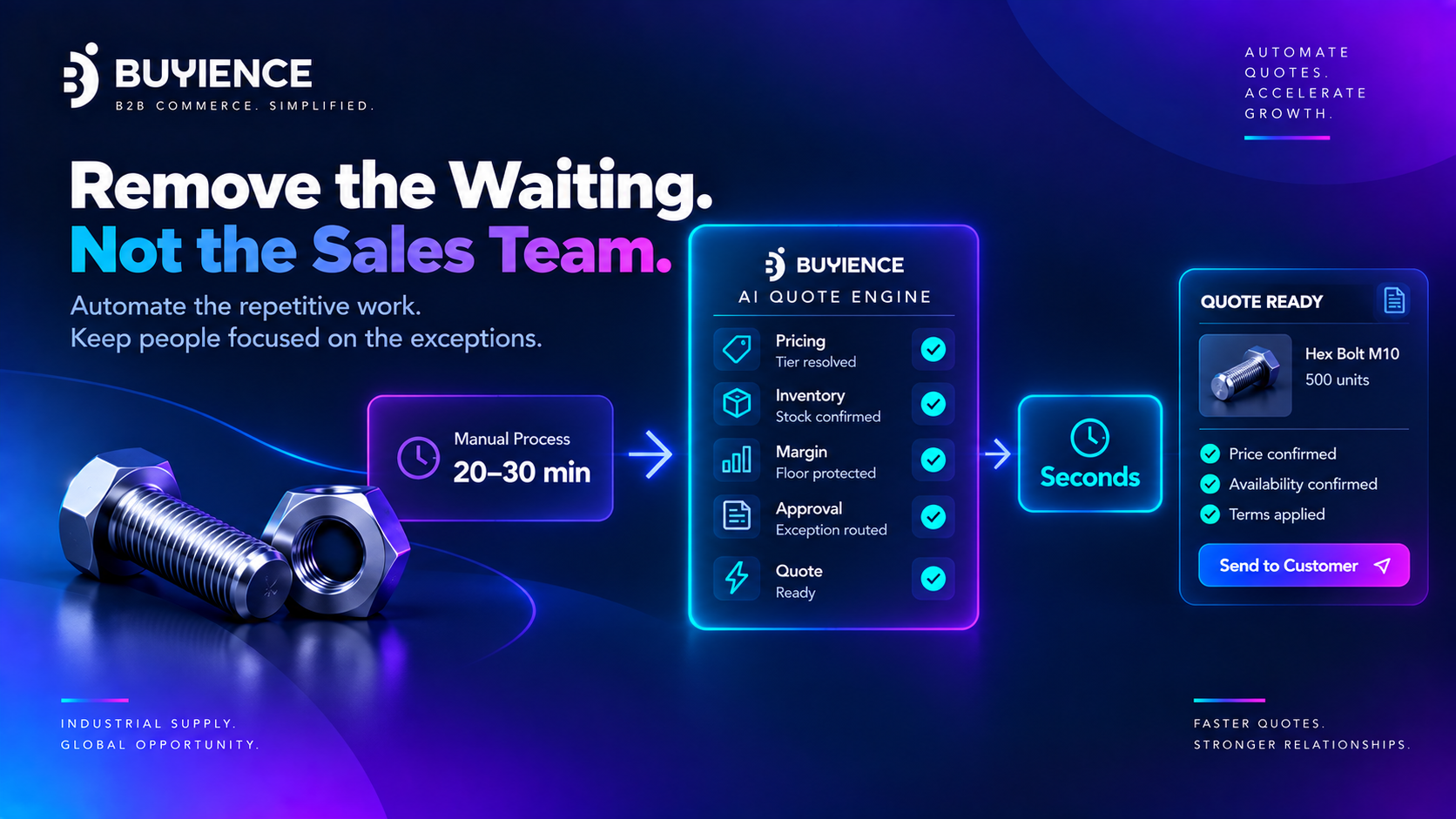
- Automate pricing resolution — If tiered, volume, and contract pricing resolve automatically rather than being manually checked and calculated, the single largest chunk of quoting time disappears without asking anyone to work faster or cut corners.
- Give reps real-time inventory visibility — A rep who can see current, accurate stock across all warehouses at the moment of quoting doesn't need to pause the process to check with someone else.
- Set clear, fast-tracked approval thresholds — Most quotes shouldn't need approval at all if they fall within standard pricing rules. Reserve manual approval for genuine exceptions, and route those automatically rather than depending on catching a specific manager in person.
- Use a quote template that generates automatically from the underlying data — If pricing, quantities, and terms already exist as structured data, formatting a clean quote document should be close to instantaneous, not a separate manual task.
- Measure and review turnaround time regularly, not just once — Like any operational metric, it tends to drift back toward slower once attention moves elsewhere — a periodic review keeps the improvement from quietly eroding.
How Nova Core helps
Nova Core's AI Quote Engine resolves tiered, volume, and contract pricing automatically at the line-item level, pulls real-time inventory across all warehouses, and generates a complete, formatted quote in seconds rather than the 20–30 minutes per line item that manual quoting typically requires. Combined with defined margin floors and automated approval routing for genuine exceptions, it removes the steps that usually account for most of a quote's turnaround time — without asking reps to simply move faster through the same manual quote-to-order process.
Buyience offers a 14-day free trial with full access to every feature — no credit card required to start. Visit buyience.com to start your free trial — or request a demo.
Questions, answered
What's a good quote turnaround time for fastener distributors?
There's no universal industry standard, but a same-day target for standard, single-line quotes is a reasonable starting benchmark for most distributors, with a separately defined, longer window for complex or custom requests.
How should quote turnaround time actually be measured?
Start the clock when the request is received and stop it when the quote is delivered to the customer — not when internal work is finished. Track the distribution of turnaround times, not just a single average, since averages can hide a long tail of slow quotes.
Why does quote speed matter so much in fastener and MRO distribution specifically?
A large share of fastener and MRO purchasing is transactional and comparison-driven, with buyers often requesting quotes from multiple suppliers at once. A slower but slightly cheaper quote frequently loses to a faster one that arrives while the buyer is still actively deciding.
Where does the most time typically go in manual quoting?
Commonly: time waiting for a request to be picked up, manually checking current pricing and inventory, waiting on approval for anything outside standard terms, and manually formatting the final quote document. No single step is usually dramatic, but they add up.
Does automating pricing actually reduce quote turnaround time significantly?
Removing the manual step of checking and calculating tiered, volume, and contract pricing typically removes the largest single chunk of time in a manual quoting process, since that step is both time-consuming and a common source of delay while waiting for current data.
How often should quote turnaround time be reviewed?
Regularly, not as a one-time fix. Like most operational metrics, it tends to drift back toward slower once attention moves elsewhere, so periodic review helps sustain any improvement.
Related articles
Spreadsheet-to-Quote: Why Manual B2B Quoting Is Costing You Deals
Manual quoting rarely loses a deal in a way anyone records. It loses deals through delay — the quote that arrives after the buyer decided — and it loses margin through inconsistency nobody traces back. The cost is invisible precisely because the failures look like normal business: a slow week, a competitive loss, a thin month. This post maps the five stages where a spreadsheet quote leaks, and which one to fix first.

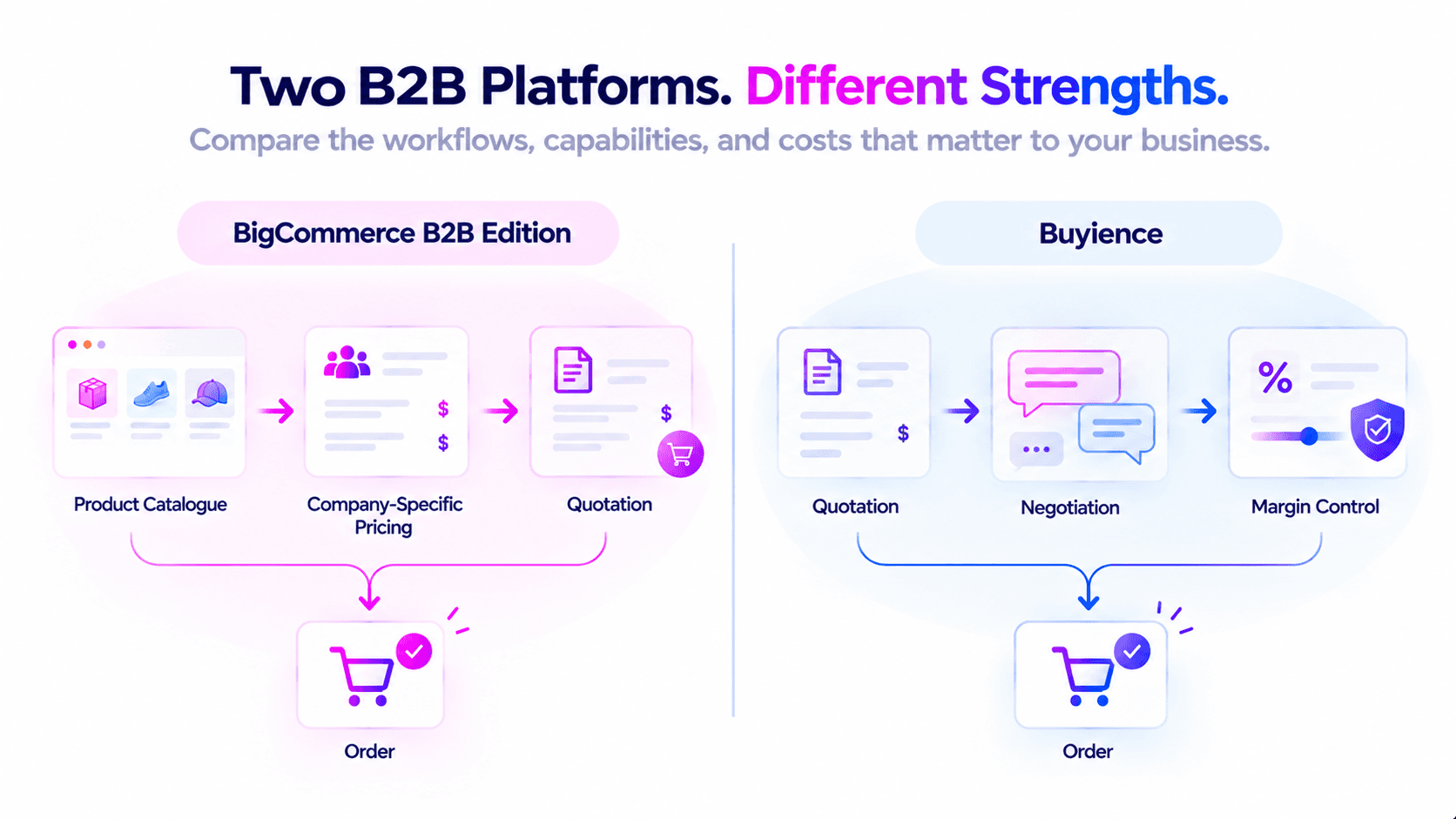
Buyience vs BigCommerce B2B Edition: A Side-by-Side Comparison
BigCommerce B2B Edition is a genuinely capable B2B platform with native quoting, company accounts, price lists and purchase order workflows — it is not a consumer cart with wholesale bolted on. The honest comparison with Buyience comes down to two things: cost tier, since B2B Edition is Enterprise-only with custom pricing, and what happens during negotiation rather than during quoting. If you have the budget and your quoting is structured rather than negotiated, B2B Edition is a strong choice.
The Best B2B Commerce Platforms for SMB Distributors in 2026
Most "best B2B platform" lists are published by vendors who rank themselves first. This one is too — we build Buyience — so the useful thing we can offer is published pricing where it exists, honest placement of where each platform actually fits, and a clear statement of which distributors should rule us out. For SMB distributors the real shortlist is short: BigCommerce B2B or Shopify for catalogue-led wholesale, Sana or an ERP-led option if your ERP governs pricing, OroCommerce if you have genuine enterprise complexity and the budget, and quoting-led platforms including ours if your revenue arrives through negotiated quotes.