
Spreadsheet-to-Quote: Why Manual B2B Quoting Is Costing You Deals
Manual quoting rarely loses a deal in a way anyone records. It loses deals through delay — the quote that arrives after the buyer decided — and it loses margin through inconsistency nobody traces back. The cost is invisible precisely because the failures look like normal business: a slow week, a competitive loss, a thin month. This post maps the five stages where a spreadsheet quote leaks, and which one to fix first.

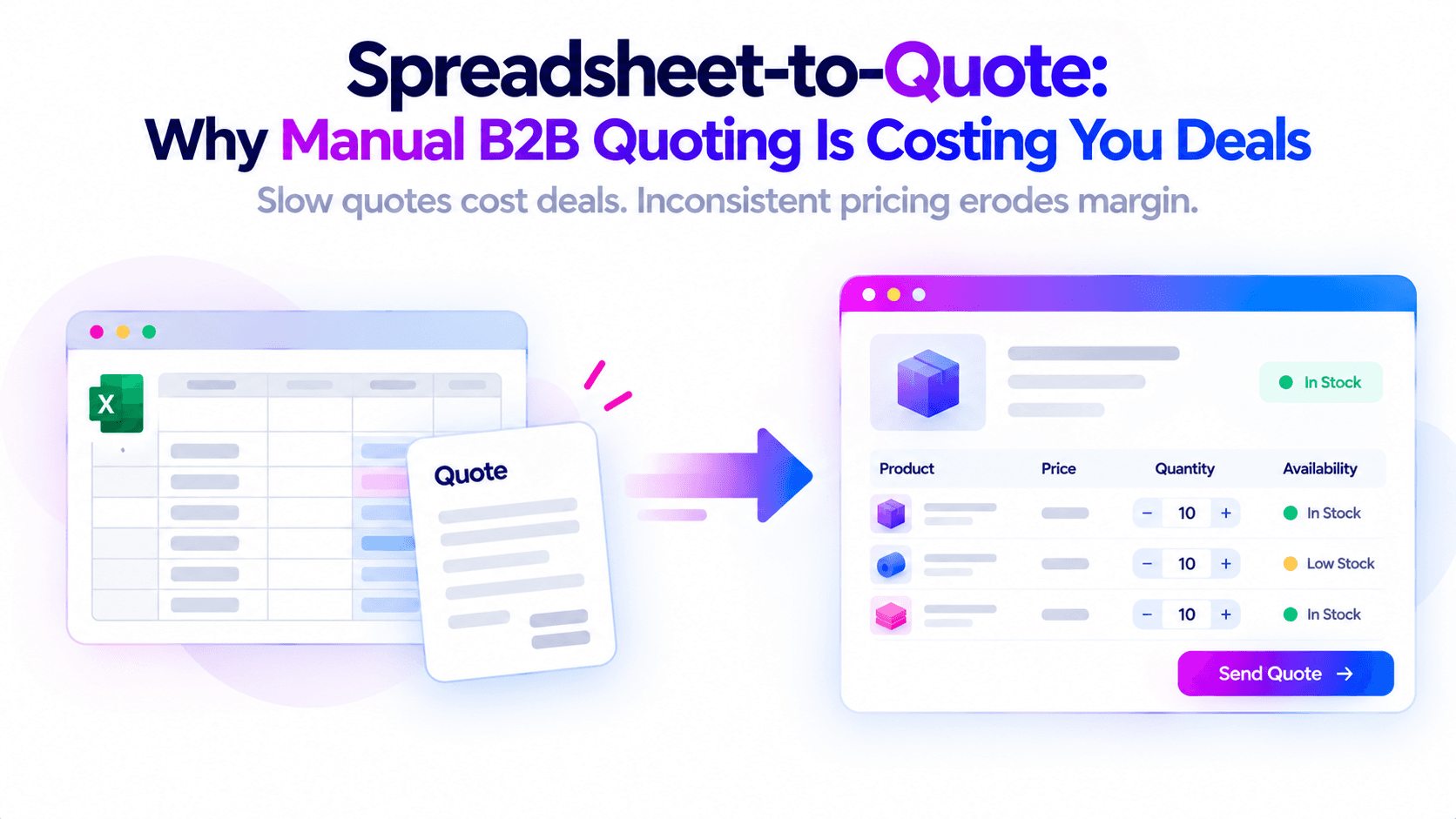
No distributor loses a deal because of a spreadsheet, as far as the CRM is concerned. The deal gets marked lost to price, or to a competitor, or it simply goes quiet. The spreadsheet never appears in the reason field.
That's the problem with manual quoting as a business issue: it produces losses that are individually explainable and collectively expensive. Nobody can point to the quarter where spreadsheets cost you £40,000, because the damage arrives as a slightly lower win rate and a slightly thinner margin across hundreds of transactions.
The deal you lose without knowing why
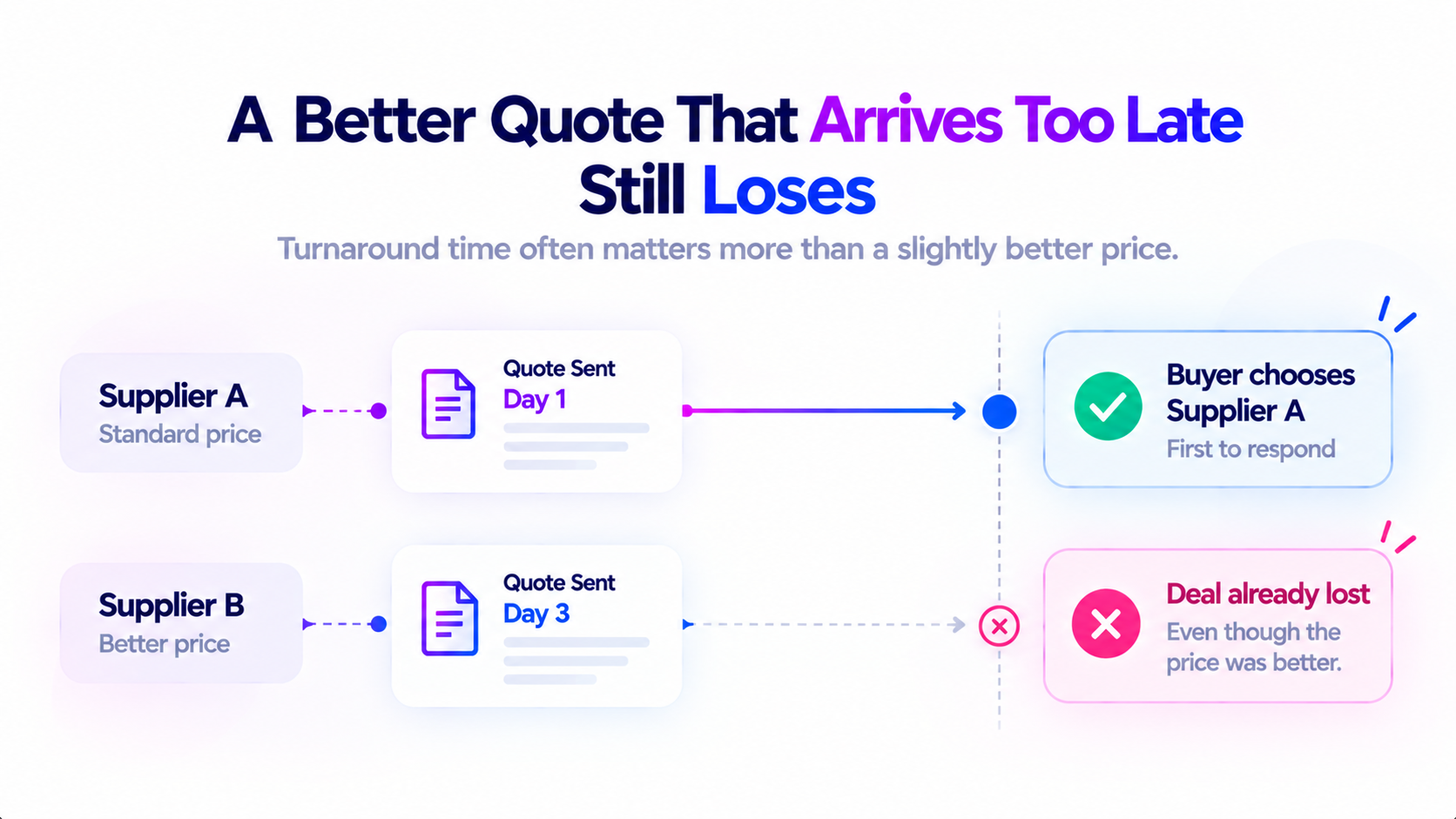
Start with the clearest case. A buyer needs 400 units of a part and asks three suppliers. Two respond within a day. You respond on day three with better pricing than either of them.
You lose, and the CRM records a competitive loss. The actual cause was turnaround time, and nothing in your reporting will tell you that.
This is the most common manual-quoting failure and the hardest to see, because losing a deal you quoted competitively looks like a market problem rather than a process problem. In commoditised categories — fasteners, MRO parts, industrial consumables — where several suppliers can fulfil the same requirement at similar cost, being first with a credible number is frequently the deciding factor. Better pricing that arrives late is not better pricing. We cover that metric in more depth in Quote Turnaround Time: The Metric Fastener Distributors Ignore.
The five stages where a spreadsheet quote leaks
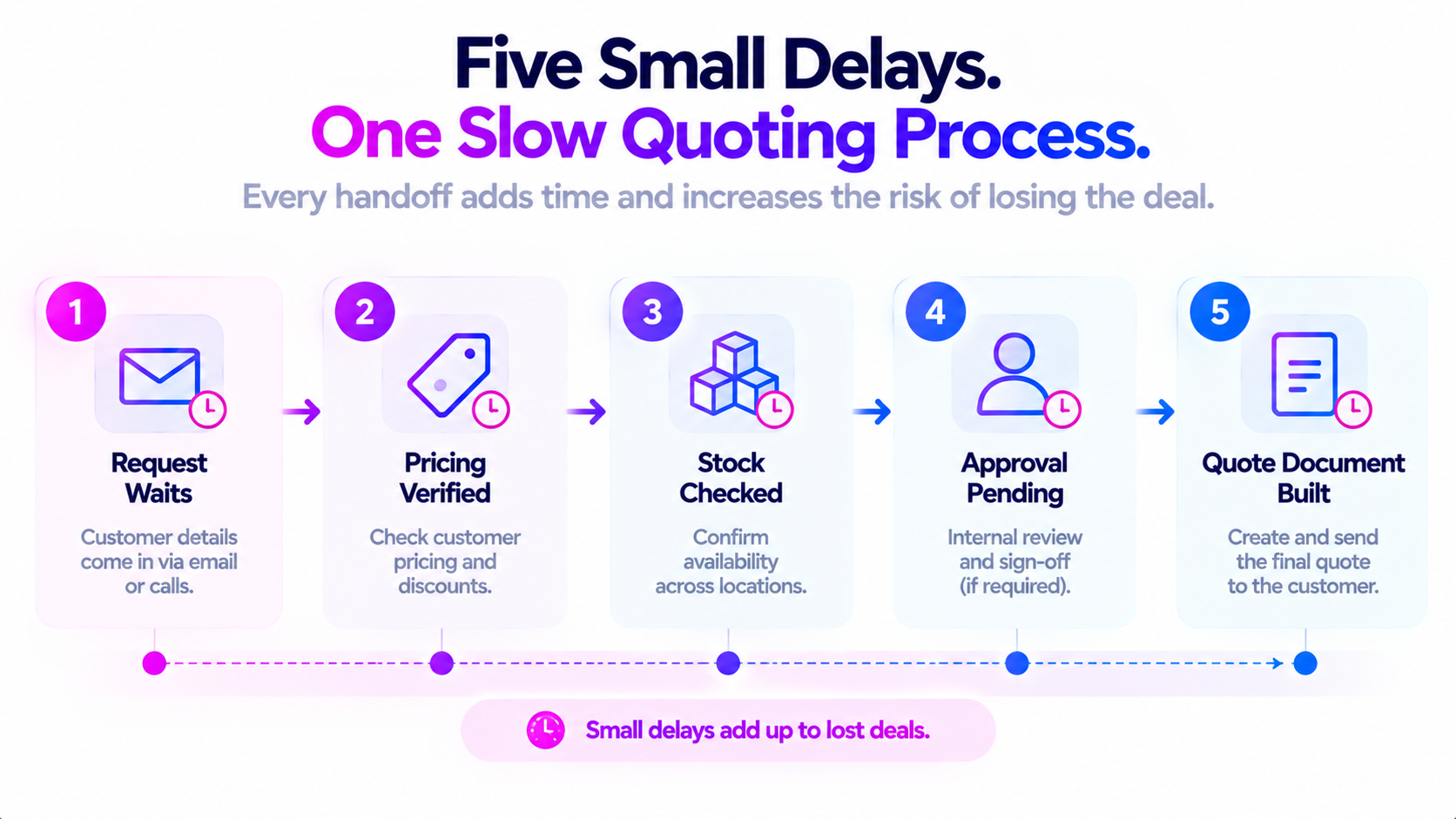
Manual quoting isn't one slow step. It's five, each small enough to seem reasonable.
1. The request waits before anyone sees it
Requests arriving in a shared inbox or via a general line sit until someone picks them up. Outside business hours, during a busy stretch, or when the relevant rep is with another customer, that wait can be hours or a full day — before any work has started.
2. Pricing gets verified by hand
This is usually the largest single consumer of time. A rep has to establish current cost, identify the customer's tier, apply volume breaks, check for contract rates, and confirm nothing has changed since the price sheet was last updated. Each check is quick. Together, on a multi-line quote, they aren't.
The deeper problem is that this step is where inconsistency enters. Two reps pricing the same customer on the same part in the same month can reach different numbers, because what's being applied is interpretation rather than a rule — the same pattern we describe in how fastener distributors lose margin on manual quotes.
3. Availability gets checked separately
If stock sits across multiple warehouses without real-time visibility, the rep pauses to find out what's actually available and where it would ship from. Often that means asking someone else, which means waiting for them. See multi-warehouse inventory for industrial suppliers for how that visibility should work.
4. Approval, if the quote needs it
Anything outside standard pricing needs sign-off. This is frequently the longest single delay in the whole process, because it depends on a specific person being available. A quote can sit complete for a day waiting on a decision that takes two minutes to make. Related: the real cost of manual quote approvals in B2B.
5. The document gets built
Even with pricing and availability settled, turning that into a clean, professional quote the buyer can act on is its own task. Done manually for every request, it consumes real time and introduces transcription errors.
Add these up and the total routinely exceeds what either you or the buyer would call fast — without any individual step being obviously broken. That's why "we need to be quicker with quotes" rarely works as an instruction. The time isn't in one place to be found.
The margin leak running alongside
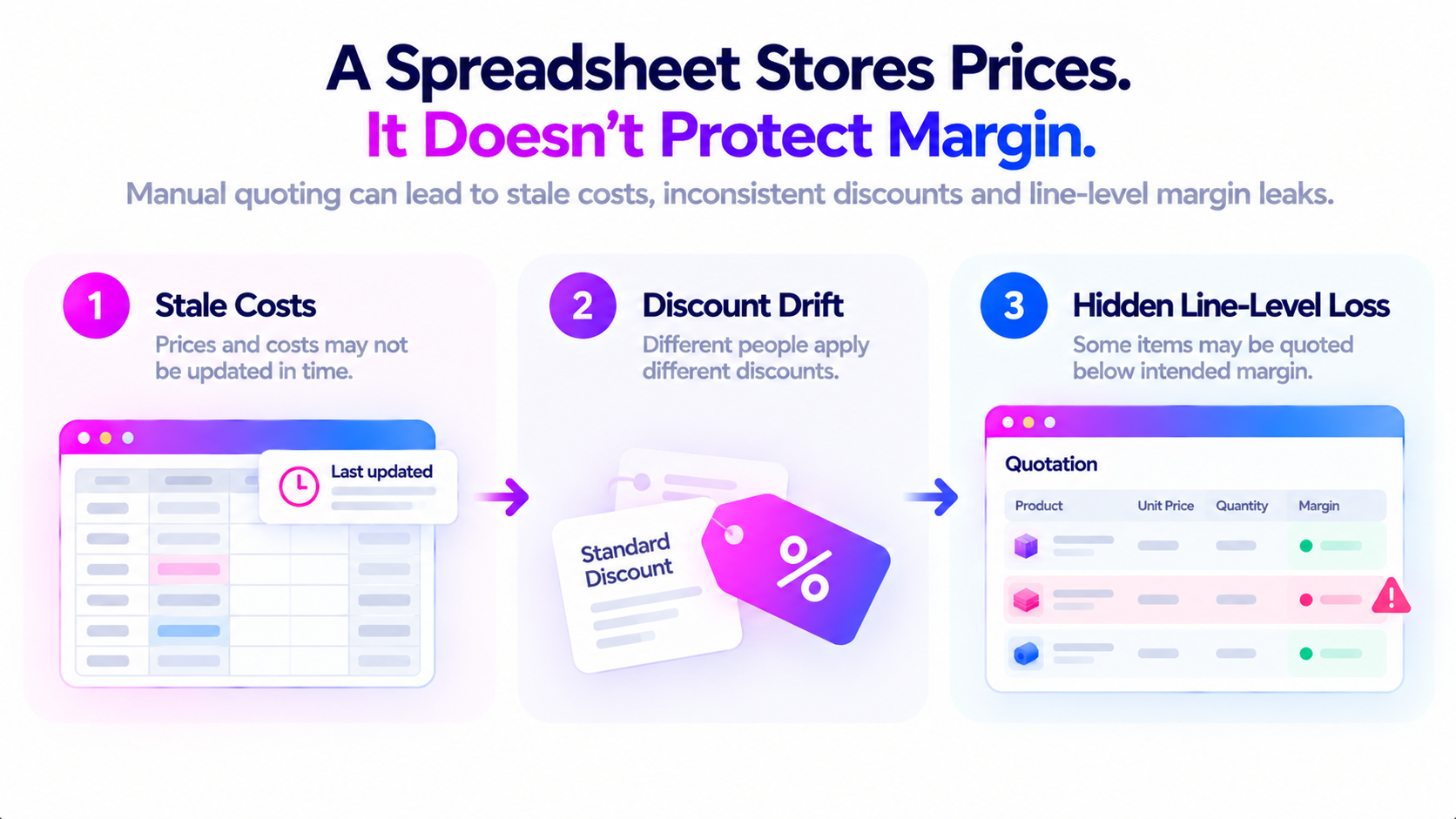
Speed is the visible cost. Margin is the larger one.
A spreadsheet holds numbers. It doesn't enforce anything. So when a rep discounts to close a deal, nothing checks that concession against your actual floor before the quote goes out. You find out afterwards, if you find out at all.
Three specific patterns:
Stale cost data. A price sheet last updated two months ago, in a category where input costs have moved, produces quotes priced against costs you no longer pay.
Discount drift. A one-off concession granted to smooth over a service issue becomes the customer's expected price, because they remember it and the next rep matches it. Nobody decided this.
Blended line items. On a multi-line quote, a thin-margin line and a healthy one average out to something acceptable overall — while individual lines sit below cost. Line-level margin is invisible when the quote is assembled by hand.
None of these produce an obvious event. They produce a gross margin that's a point or two lower than it should be, which gets attributed to market conditions.
Why "work faster" doesn't fix it
The instinct is to push the team to turn quotes around quicker. It doesn't work, for two reasons.
The delay is structural, not effort-related. A rep who already knows the process can't compress the time spent waiting on a manager's approval or on someone else to check stock. Those waits aren't caused by insufficient urgency.
And speed pressure applied to a manual process increases errors. A rep working faster through five manual steps makes more transcription mistakes, skips more verification, and reaches for the price they remember rather than the one that's current. You get faster quotes that are less accurate — which creates a different, worse problem when the invoice doesn't match.
What to fix first
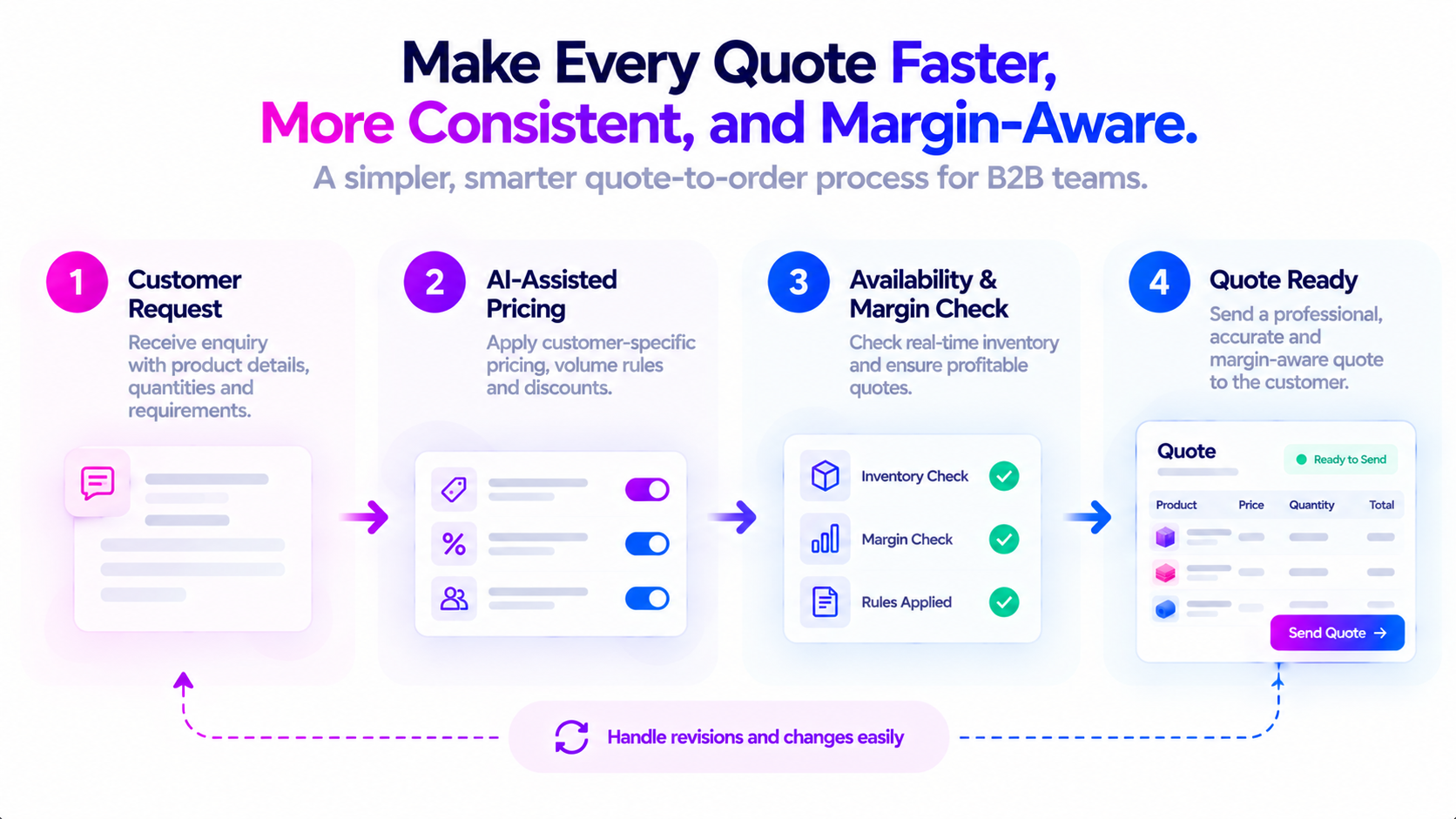
Not everything at once. In rough order of return:
- Make pricing resolve itself. Encode tier, volume and contract pricing as rules the system applies, rather than values a rep looks up. This removes the largest time cost and the main source of inconsistency simultaneously. It's the highest-leverage single change. See how B2B teams manage customer-specific pricing at scale.
- Enforce a margin floor before the quote is sent. Not a guideline reps are asked to respect — a floor the system checks, with anything below it routed for approval. This converts margin discipline from a matter of individual judgement under pressure into a property of the process. Related: pricing and margin control.
- Give reps real-time inventory visibility. Removes stage three entirely. A rep who can see available-to-promise stock across warehouses doesn't need to interrupt the quote to ask.
- Set approval thresholds that don't bottleneck. Most quotes within standard pricing shouldn't need approval at all. Reserve it for genuine exceptions and route those automatically rather than depending on catching someone.
- Generate the document from the data. If pricing, quantities and terms already exist as structured data, producing the quote document should be instant rather than a separate manual task.
How to find out what this is actually costing you
Before investing in a fix, measure the problem. Three things, each findable from records you already have:
Measure real turnaround time. Clock from request received to quote delivered — not from when work started. Track the distribution rather than an average: your median, and the percentage taking longer than a day. Averages hide a long tail.
Count revisions per quote. Quotes needing several rounds indicate either pricing that's hard to get right first time or negotiation your process doesn't support well.
Audit effective margin against intended margin. Take a sample of recent orders and calculate the margin actually achieved per line, against what your tier and volume structure should have produced. The gap is your drift, and it's usually larger than expected.
That third number is the one that tends to change minds, because it's specific and it's yours.
Where Buyience fits
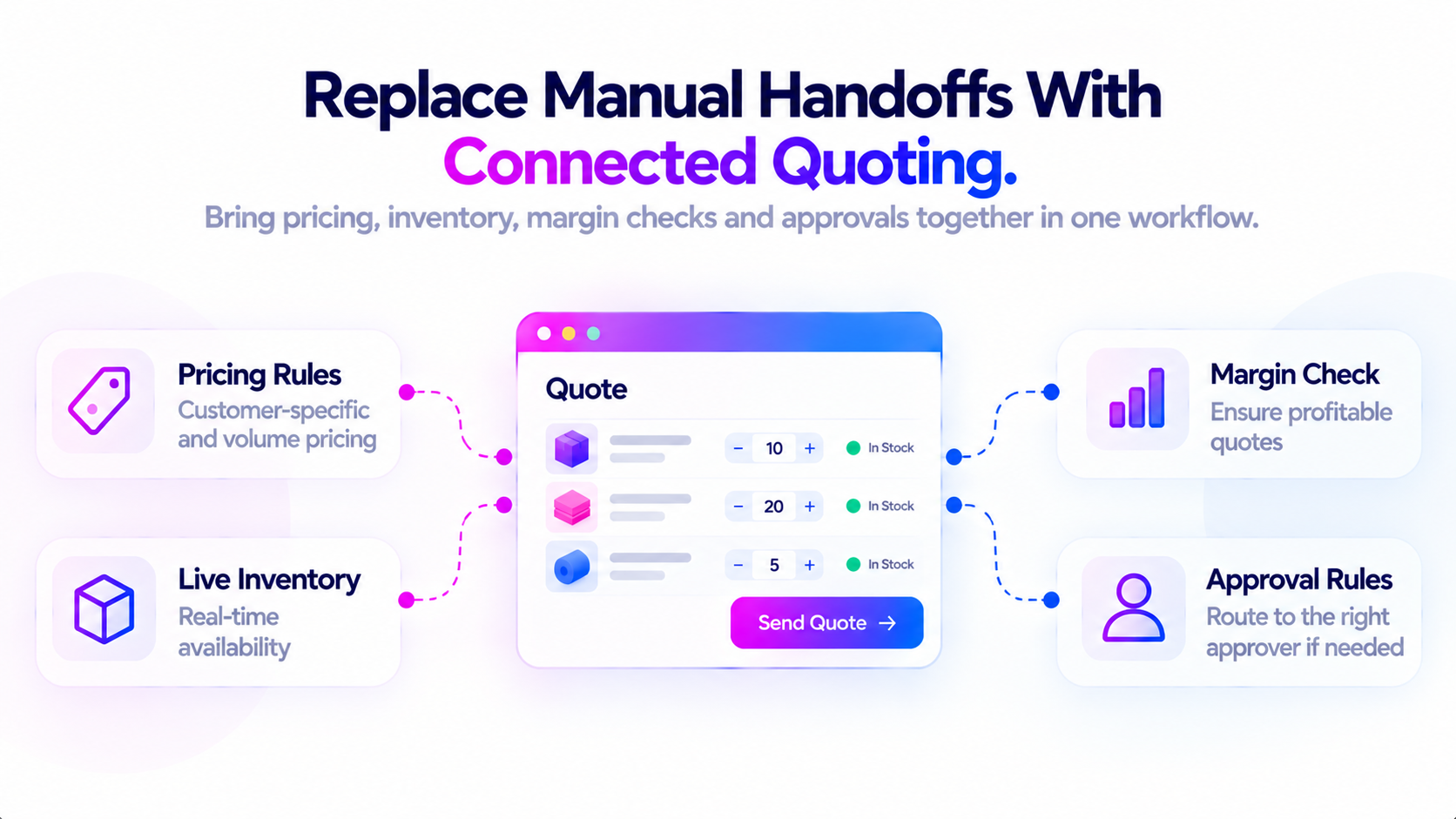
Nova Core's AI Quote Engine resolves tier, volume and contract pricing automatically at line level, pulls real-time inventory across warehouses, enforces margin floors before a quote is sent, and generates the quote document from the underlying data — removing the four stages that account for most manual quoting time, rather than asking anyone to move faster through them.
Start your free trial → — 14 days, no card required.
Want to see what your real quote turnaround time is? Request a demo and we'll help you benchmark it.
Questions, answered
How does manual quoting actually lose deals?
Usually through delay rather than price. In commoditised categories where several suppliers can fulfil the same requirement, a quote arriving on day three loses to one arriving on day one, even with better pricing. The CRM records it as a competitive loss, so the real cause stays invisible.
Where does the time go in manual quoting?
Five places: the request waiting to be picked up, verifying current pricing by hand, checking stock availability separately, waiting on approval for anything non-standard, and building the quote document. Each is individually small; together they exceed what buyers consider fast.
Why doesn't telling the team to quote faster work?
Because the delays are structural rather than effort-related — a rep can't compress time spent waiting on an approval or on someone else to check stock. Speed pressure on a manual process also increases transcription errors and skipped verification.
How does manual quoting erode margin?
A spreadsheet holds numbers but enforces nothing. Stale cost data, one-off discounts becoming expected prices, and individual loss-making lines hidden inside an acceptable blended quote margin all pass through unchecked, because nothing tests a concession against the floor before the quote is sent.
What should a distributor fix first?
Automatic pricing resolution. Encoding tier, volume and contract rules so they apply themselves removes the largest single time cost and the main source of pricing inconsistency at the same time.
How do I measure what manual quoting is costing us?
Three measurements: real turnaround time from request received to quote delivered, tracking the distribution not the average; revisions per quote; and effective margin achieved per line against what your pricing structure should have produced. The third gap is usually the most persuasive number.
Related articles
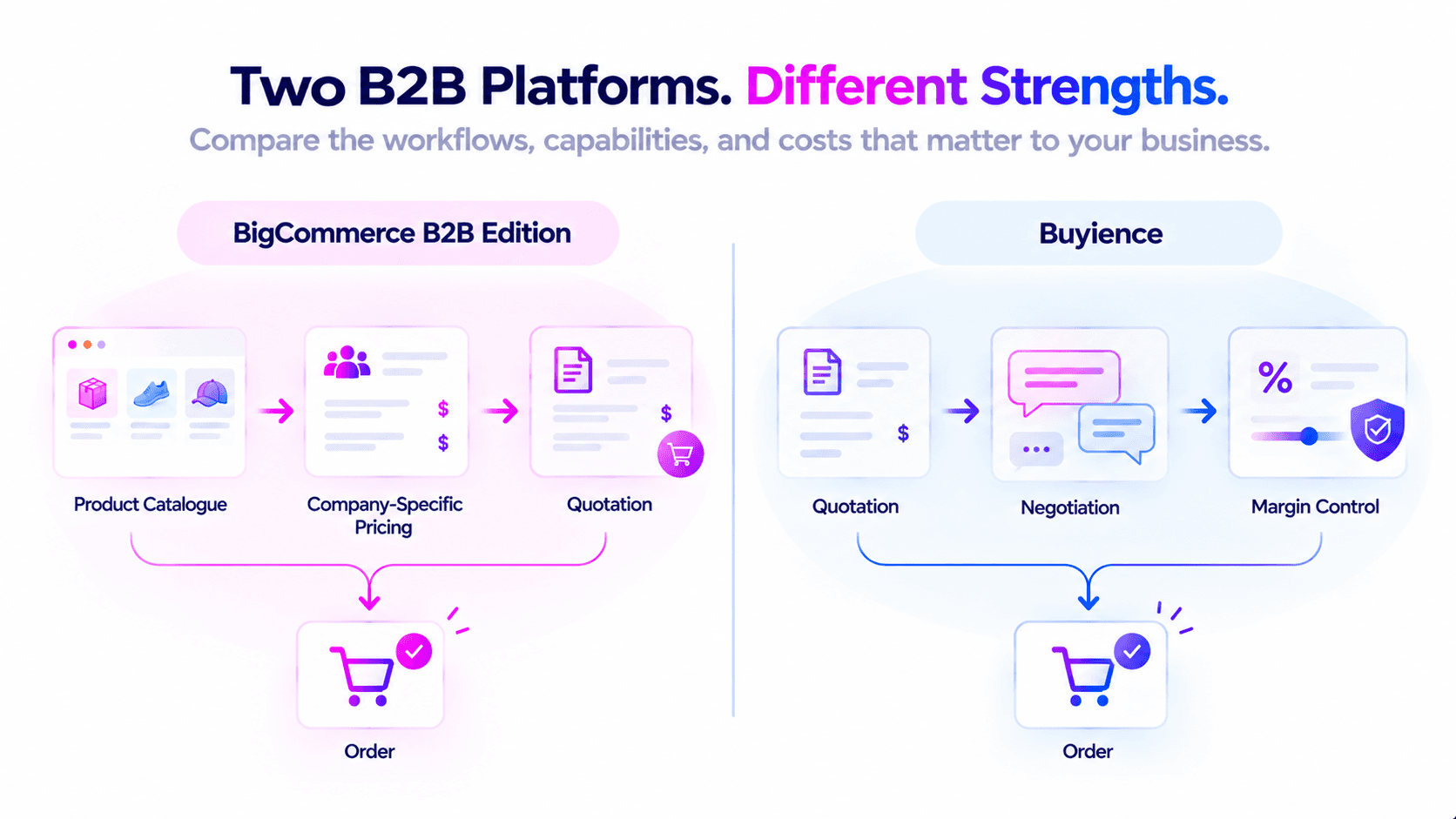
Buyience vs BigCommerce B2B Edition: A Side-by-Side Comparison
BigCommerce B2B Edition is a genuinely capable B2B platform with native quoting, company accounts, price lists and purchase order workflows — it is not a consumer cart with wholesale bolted on. The honest comparison with Buyience comes down to two things: cost tier, since B2B Edition is Enterprise-only with custom pricing, and what happens during negotiation rather than during quoting. If you have the budget and your quoting is structured rather than negotiated, B2B Edition is a strong choice.
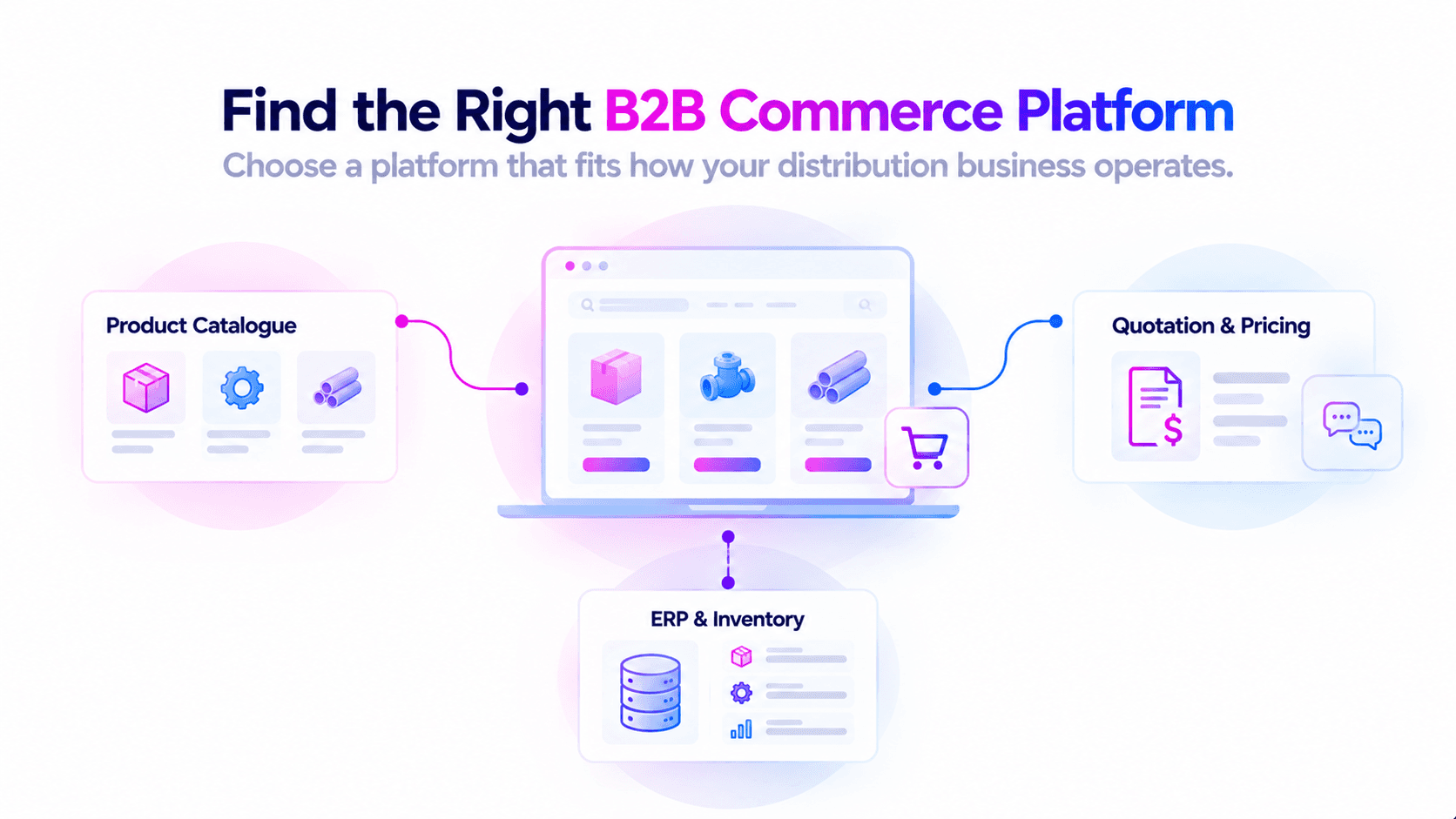
The Best B2B Commerce Platforms for SMB Distributors in 2026
Most "best B2B platform" lists are published by vendors who rank themselves first. This one is too — we build Buyience — so the useful thing we can offer is published pricing where it exists, honest placement of where each platform actually fits, and a clear statement of which distributors should rule us out. For SMB distributors the real shortlist is short: BigCommerce B2B or Shopify for catalogue-led wholesale, Sana or an ERP-led option if your ERP governs pricing, OroCommerce if you have genuine enterprise complexity and the budget, and quoting-led platforms including ours if your revenue arrives through negotiated quotes.

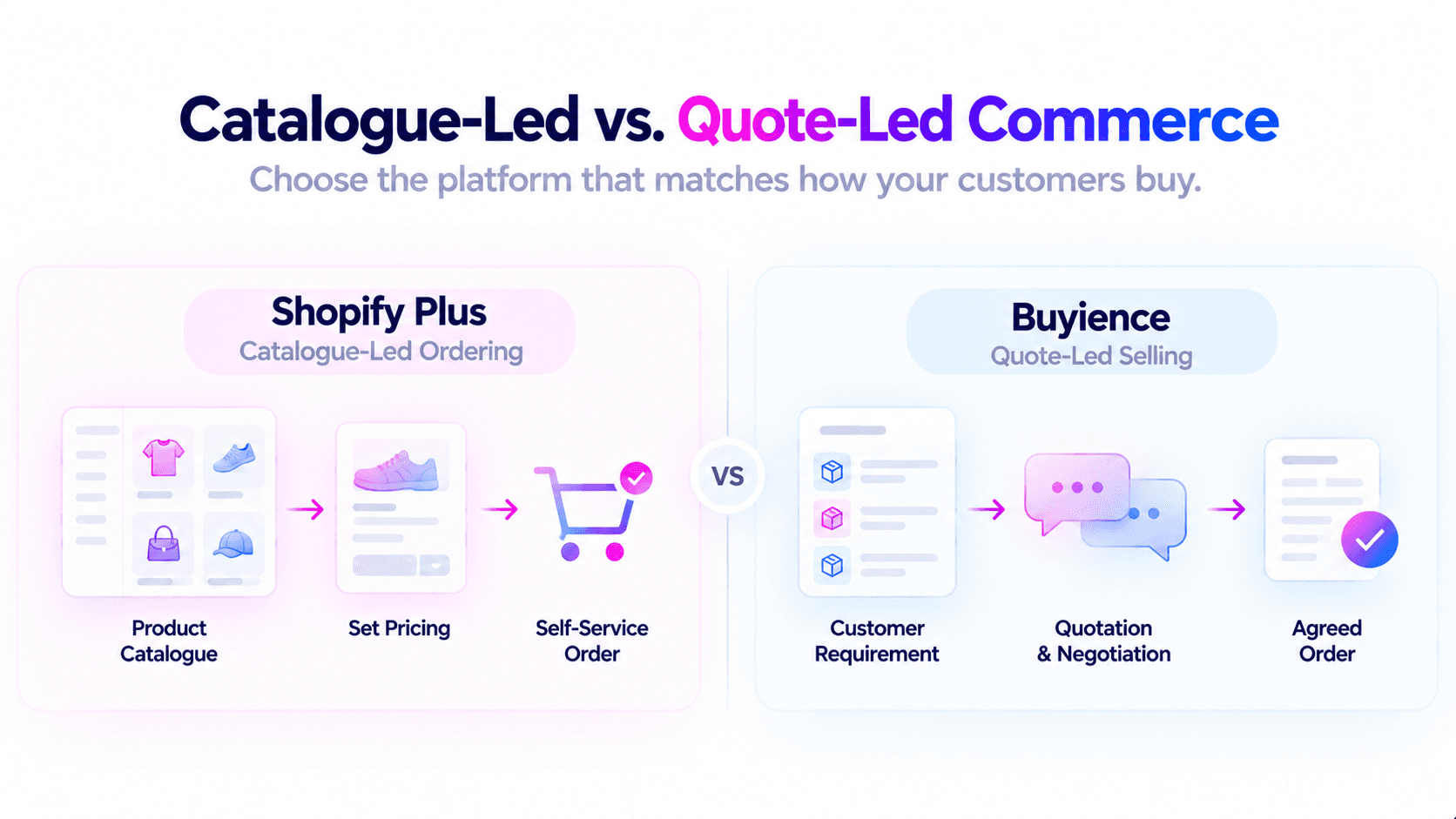
Buyience vs Shopify Plus for B2B: Which Fits Wholesale Distributors
Shopify Plus and Buyience solve different problems. Shopify is catalogue-and-checkout commerce with a strong B2B layer added — excellent if your wholesale motion is buyers logging in and ordering from a catalogue at their agreed prices. Buyience is quoting-and-negotiation commerce — built for distributors whose deals are won or lost on how fast and how accurately they can quote, revise, and negotiate. If most of your revenue arrives through self-service reordering, Shopify is likely the better fit. If most of it arrives through quotes, it probably isn't.