How B2B Teams Manage Customer-Specific Pricing at Scale

How B2B Teams Manage Customer-Specific Pricing at Scale

How B2B Teams Manage Customer-Specific Pricing at Scale

B2B pricing software is a system that centralizes and automates pricing logic across customers, products, and channels—ensuring consistent, real-time pricing without manual intervention.

13 min read

13 min read

Blog Image

What Is B2B Pricing Software?

B2B pricing software is a system that centralizes and automates pricing logic across customers, products, and channels—ensuring consistent, real-time pricing without manual intervention.

It replaces:

  • Spreadsheets

  • Manual sales overrides

  • Hardcoded ecommerce pricing rules

Introduction: The Pricing Problem Nobody Fixes Properly

Most B2B companies don’t struggle with pricing because it’s complex.

They struggle because pricing is handled in the wrong place.

  • Pricing rules buried in spreadsheets

  • Discounts managed through sales reps

  • Logic hardcoded into ecommerce platforms

  • ERP systems acting as bottlenecks

At small scale, this works.

At growth stage, it breaks—fast.

And that’s where B2B pricing software becomes a necessity, not an upgrade.

Why Customer-Specific Pricing Gets Out of Control
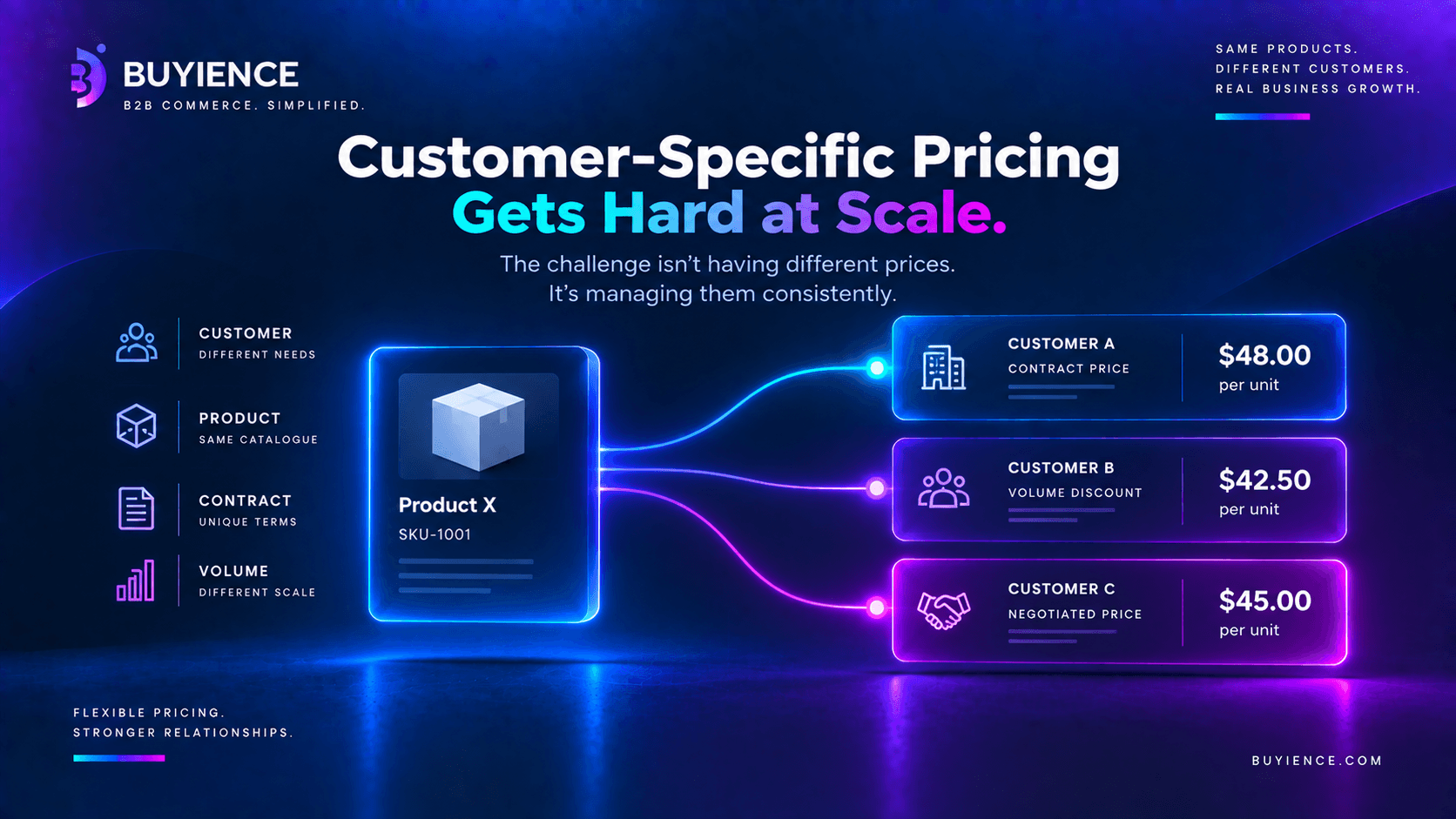
Customer-specific pricing is not optional in B2B.

Common Pricing Structures in B2B

  • Contract pricing

  • Volume-based discounts

  • Customer tiers

  • Negotiated deals

  • Region-based pricing

  • Product-level overrides

The problem isn’t complexity.

The problem is fragmentation.

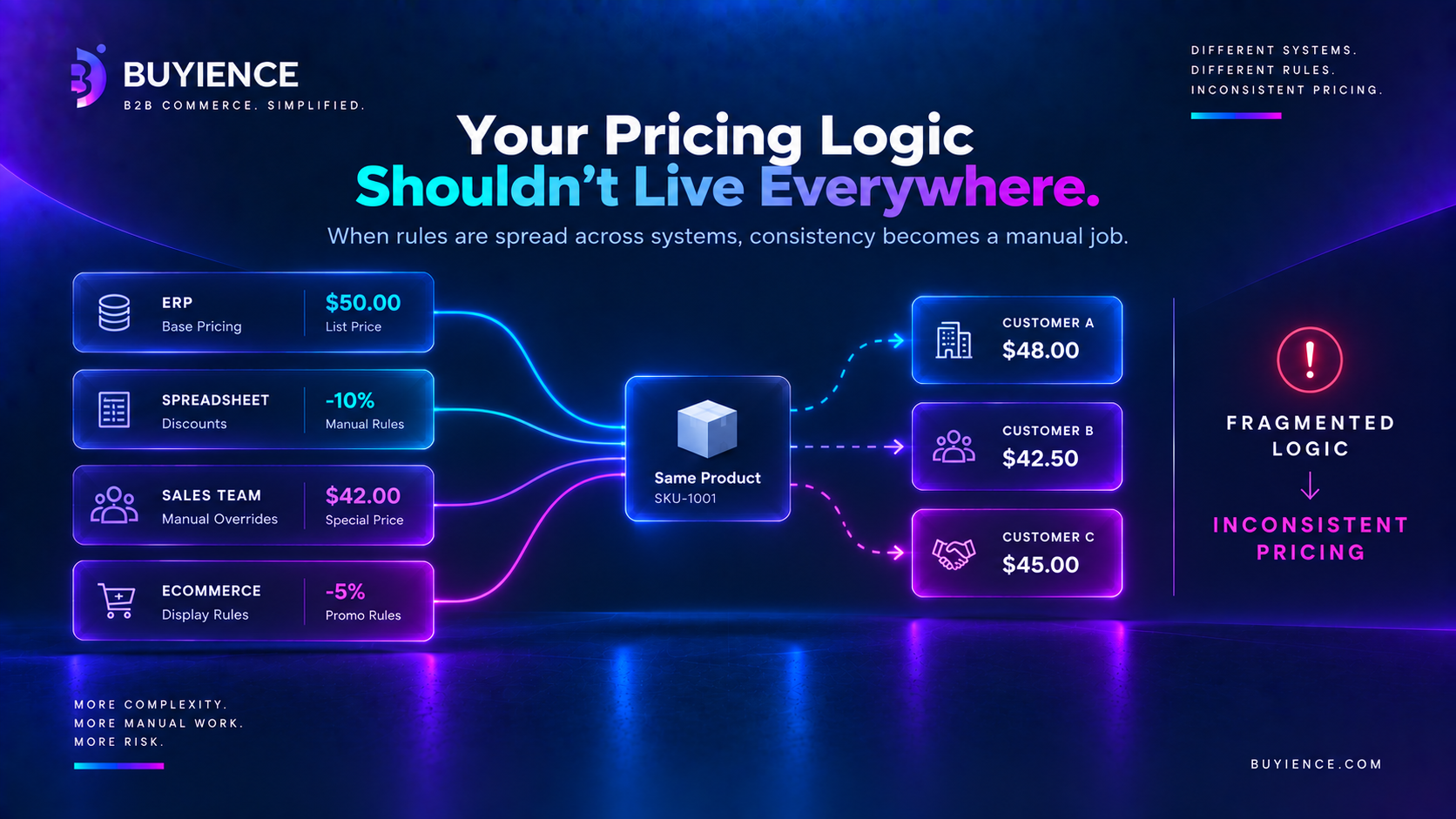
Typical Broken Pricing Setup

  • ERP stores base pricing

  • Sales team overrides pricing manually

  • Ecommerce platform displays inconsistent prices

  • Finance audits after the fact

Resulting Issues

  • Pricing inconsistencies

  • Margin leakage

  • Slow quoting cycles

  • Customer distrust

Why Most B2B Pricing Systems Fail

Most B2B pricing systems fail because they:

1. Store pricing logic across multiple systems

2. Rely on manual overrides from sales teams

3. Use ecommerce platforms to calculate pricing

4. Depend on ERP systems not built for real-time pricing

5. Lack a centralized rule engine

The Core Issue: Pricing Is Treated Like a Display Problem
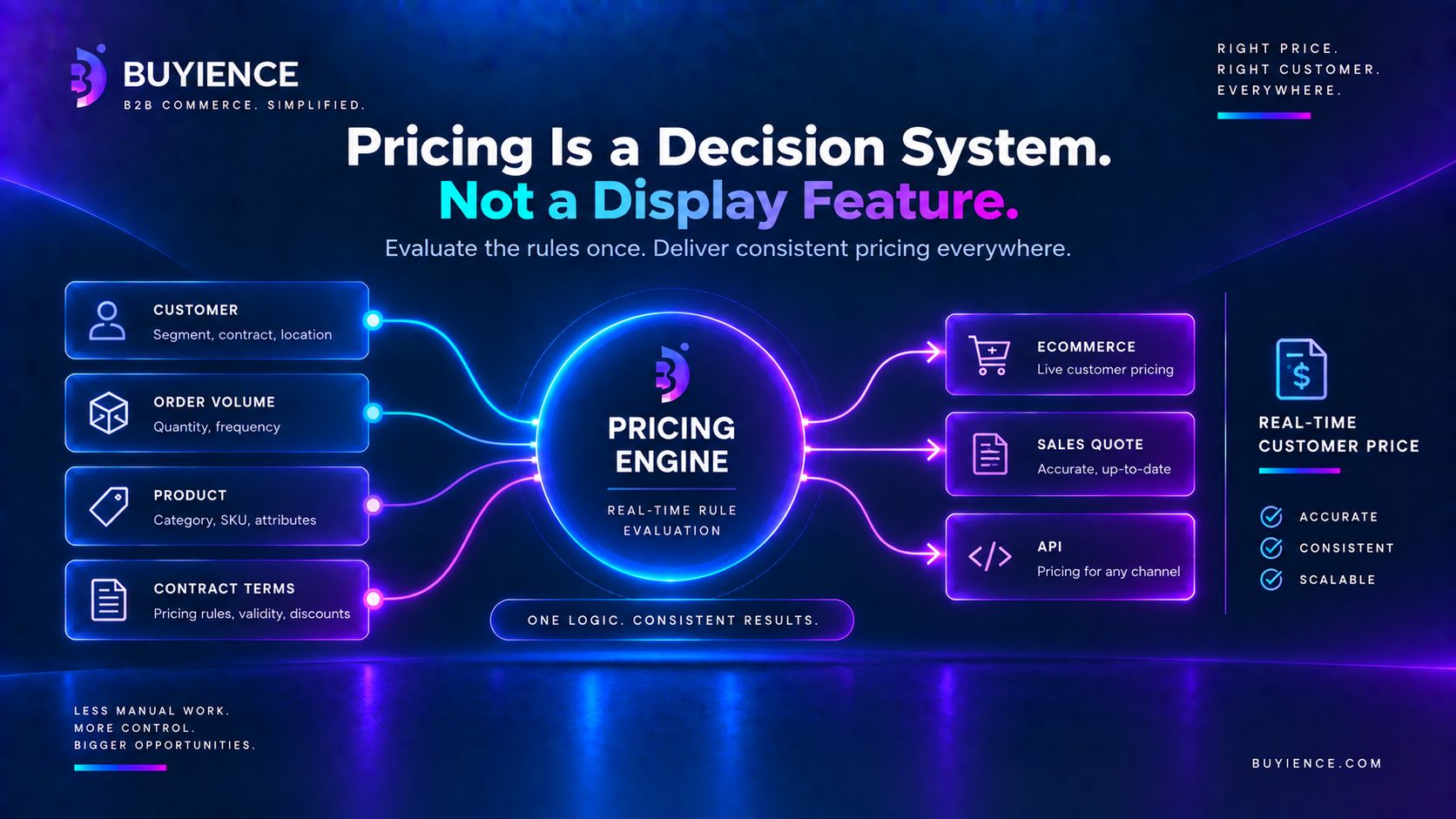
Most platforms treat pricing as something to show, not something to compute.

That’s the mistake.

Pricing Is NOT:

  • A frontend feature

  • A theme setting

  • A simple discount engine

Pricing IS:

  • A real-time decision system

  • A rule engine

  • A core part of your infrastructure

What Scalable B2B Pricing Requires
1. Centralized Pricing Logic

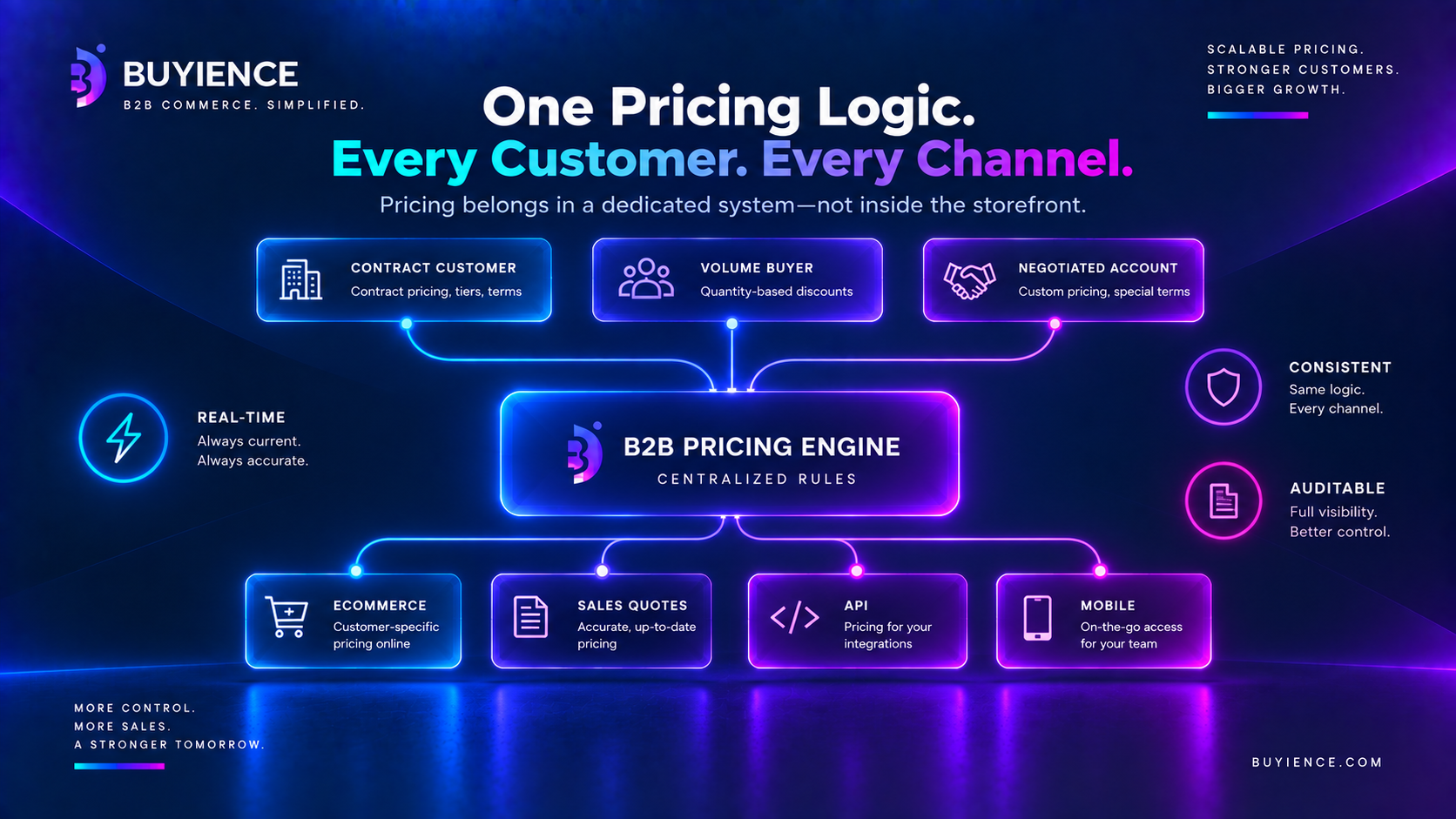
All pricing rules must live in one system.

Not:

  • Part ERP

  • Part spreadsheet

  • Part ecommerce

2. Real-Time Rule Evaluation

Pricing must dynamically adjust based on:

  • Customer identity

  • Order volume

  • Product combinations

  • Contract terms

3. Separation from the Storefront

Your storefront should:

  • Display prices

  • Fetch prices

Not:

  • Calculate pricing

  • Store pricing logic

Where Most B2B Pricing Approaches Break Down

1. ERP-Centric Pricing

Why it fails:

  • Not built for real-time decisions

  • Slows down frontend performance

  • Difficult to scale rules

2. Spreadsheet-Based Pricing

Why it fails:

  • No governance

  • No audit trail

  • No scalability

3. Ecommerce Plugin Pricing

Why it fails:

  • Limited flexibility

  • High maintenance

  • Breaks at scale

What B2B Pricing Software Solves (Clear Breakdown)

1. Centralized Pricing Engine

A dedicated system that:

  • Pulls data from ERP

  • Applies rules dynamically

  • Distributes pricing everywhere

2. Rule-Based Pricing at Scale

You can define:

  • Customer-specific price lists

  • Contract-based pricing

  • Tiered discounts

  • Conditional logic

Without custom development.

3. Omnichannel Pricing Consistency

Same pricing across:

  • Ecommerce

  • Sales quotes

  • APIs

  • Mobile apps

Benefits of B2B Pricing Software

Key benefits of B2B pricing software include:

  • Faster quote generation

  • Improved margin control

  • Consistent pricing across channels

  • Reduced manual work

  • Scalable pricing operations

Real-World Example: Before vs After

Before Implementation

  • Manual pricing adjustments

  • Inconsistent customer pricing

  • Delayed approvals

  • ERP dependency

After Implementation

  • Automated pricing rules

  • Instant quote generation

  • Consistent pricing across channels

  • Faster updates

Key Features to Look for in B2B Pricing Software

Must-Have Features

  • Rule-based pricing engine

  • Real-time pricing APIs

  • Customer-specific pricing support

  • ERP integration

  • Pricing audit logs

Advanced Capabilities

  • AI-driven pricing recommendations

  • Margin analytics

  • Scenario testing

When Do You Need B2B Pricing Software? (Checklist)

You likely need B2B pricing software if:

  • You manage 50+ pricing rules

  • Sales teams frequently override pricing

  • Pricing inconsistencies are common

  • ERP is slowing down pricing decisions

  • You’re scaling product catalogs or customer segments

The Bigger Shift: Static Pricing → Dynamic Systems

B2B companies are moving from:

  • Static pricing tables

  • Manual overrides

To.

  • Dynamic pricing systems

  • Automated decision engines

Conclusion: Pricing Should Be Infrastructure, Not Configuration

If pricing is still treated as:

  • A workaround

  • A manual process

  • A frontend configuration

You’ll continue to hit scaling limits.

The shift is clear:

Pricing logic belongs outside the storefront—and inside a dedicated system.

Evaluate Your Pricing Architecture

If your pricing lives across:

  • ERP

  • Spreadsheets

  • Ecommerce plugins

You already have a scalability problem.

The next step isn’t buying software blindly.

It’s understanding your architecture.

We help B2B teams map their pricing systems, identify bottlenecks, and design a scalable pricing layer—without disrupting existing operations.

Request a walkthrough of your current pricing setup and see what’s limiting your growth.

FAQs: B2B Pricing Software & Customer-Specific Pricing

What is B2B pricing software?

B2B pricing software is a system that centralizes and automates pricing logic across:

  • Customers

  • Products

  • Contracts

  • Order conditions

It ensures consistent, real-time pricing without relying on manual processes or hardcoded rules.

Why is customer-specific pricing important in B2B?

Customer-specific pricing is essential because B2B businesses often operate with:

  • Contract-based pricing

  • Volume discounts

  • Negotiated deals

  • Tiered customer pricing

Without proper systems, managing this at scale becomes inefficient and error-prone.

What are the biggest challenges in managing B2B pricing?

Common challenges include:

  • Pricing rules spread across multiple systems

  • Manual overrides by sales teams

  • Inconsistent pricing across channels

  • Lack of real-time pricing updates

  • Difficulty scaling pricing logic

Why do traditional systems fail to handle B2B pricing?

Traditional systems fail because:

  • ERP systems are not designed for dynamic pricing

  • Ecommerce platforms cannot handle complex pricing logic

  • Spreadsheets lack scalability and control

This leads to fragmented pricing and operational inefficiencies.

Where should pricing logic live in a B2B system?

Pricing logic should live in a dedicated pricing or workflow layer, not in:

  • ERP systems

  • Ecommerce platforms

  • Spreadsheets

This ensures flexibility, consistency, and scalability.

How does B2B pricing software improve operations?

B2B pricing software improves operations by:

  • Automating pricing rules

  • Reducing manual errors

  • Ensuring consistent pricing across channels

  • Accelerating quote generation

  • Improving margin control

What features should B2B pricing software include?

Key features include:

  • Rule-based pricing engine

  • Customer-specific pricing support

  • Real-time pricing APIs

  • ERP integration

  • Audit logs for pricing changes

How does pricing software impact sales and revenue?

Effective pricing systems help:

  • Speed up sales cycles

  • Prevent unauthorized discounts

  • Improve pricing accuracy

  • Increase customer trust

This directly impacts revenue and profitability.

When should a company invest in B2B pricing software?

You should consider it if:

  • Pricing rules are becoming complex

  • Sales teams frequently adjust pricing manually

  • Pricing inconsistencies are common

  • ERP is slowing down pricing decisions

  • You are scaling products or customer segments

  • How is B2B pricing different from B2C pricing?

  • B2C pricing is mostly fixed and uniform

  • B2B pricing is dynamic and customer-specific

B2B requires:

  • Contract pricing

  • Volume-based adjustments

  • Negotiation-based pricing

What Is B2B Pricing Software?

B2B pricing software is a system that centralizes and automates pricing logic across customers, products, and channels—ensuring consistent, real-time pricing without manual intervention.

It replaces:

  • Spreadsheets

  • Manual sales overrides

  • Hardcoded ecommerce pricing rules

Introduction: The Pricing Problem Nobody Fixes Properly

Most B2B companies don’t struggle with pricing because it’s complex.

They struggle because pricing is handled in the wrong place.

  • Pricing rules buried in spreadsheets

  • Discounts managed through sales reps

  • Logic hardcoded into ecommerce platforms

  • ERP systems acting as bottlenecks

At small scale, this works.

At growth stage, it breaks—fast.

And that’s where B2B pricing software becomes a necessity, not an upgrade.

Why Customer-Specific Pricing Gets Out of Control

Customer-specific pricing is not optional in B2B.

Common Pricing Structures in B2B

  • Contract pricing

  • Volume-based discounts

  • Customer tiers

  • Negotiated deals

  • Region-based pricing

  • Product-level overrides

The problem isn’t complexity.

The problem is fragmentation.

Typical Broken Pricing Setup

  • ERP stores base pricing

  • Sales team overrides pricing manually

  • Ecommerce platform displays inconsistent prices

  • Finance audits after the fact

Resulting Issues

  • Pricing inconsistencies

  • Margin leakage

  • Slow quoting cycles

  • Customer distrust

Why Most B2B Pricing Systems Fail

Most B2B pricing systems fail because they:

1. Store pricing logic across multiple systems

2. Rely on manual overrides from sales teams

3. Use ecommerce platforms to calculate pricing

4. Depend on ERP systems not built for real-time pricing

5. Lack a centralized rule engine

The Core Issue: Pricing Is Treated Like a Display Problem

Most platforms treat pricing as something to show, not something to compute.

That’s the mistake.

Pricing Is NOT:

  • A frontend feature

  • A theme setting

  • A simple discount engine

Pricing IS:

  • A real-time decision system

  • A rule engine

  • A core part of your infrastructure

What Scalable B2B Pricing Requires

1. Centralized Pricing Logic

All pricing rules must live in one system.

Not:

  • Part ERP

  • Part spreadsheet

  • Part ecommerce

2. Real-Time Rule Evaluation

Pricing must dynamically adjust based on:

  • Customer identity

  • Order volume

  • Product combinations

  • Contract terms

3. Separation from the Storefront

Your storefront should:

  • Display prices

  • Fetch prices

Not:

  • Calculate pricing

  • Store pricing logic

Where Most B2B Pricing Approaches Break Down

1. ERP-Centric Pricing

Why it fails:

  • Not built for real-time decisions

  • Slows down frontend performance

  • Difficult to scale rules

2. Spreadsheet-Based Pricing

Why it fails:

  • No governance

  • No audit trail

  • No scalability

3. Ecommerce Plugin Pricing

Why it fails:

  • Limited flexibility

  • High maintenance

  • Breaks at scale

What B2B Pricing Software Solves (Clear Breakdown)

1. Centralized Pricing Engine

A dedicated system that:

  • Pulls data from ERP

  • Applies rules dynamically

  • Distributes pricing everywhere

2. Rule-Based Pricing at Scale

You can define:

  • Customer-specific price lists

  • Contract-based pricing

  • Tiered discounts

  • Conditional logic

Without custom development.

3. Omnichannel Pricing Consistency

Same pricing across:

  • Ecommerce

  • Sales quotes

  • APIs

  • Mobile apps

Benefits of B2B Pricing Software

Key benefits of B2B pricing software include:

  • Faster quote generation

  • Improved margin control

  • Consistent pricing across channels

  • Reduced manual work

  • Scalable pricing operations

Real-World Example: Before vs After

Before Implementation

  • Manual pricing adjustments

  • Inconsistent customer pricing

  • Delayed approvals

  • ERP dependency

After Implementation

  • Automated pricing rules

  • Instant quote generation

  • Consistent pricing across channels

  • Faster updates

Key Features to Look for in B2B Pricing Software

Must-Have Features

  • Rule-based pricing engine

  • Real-time pricing APIs

  • Customer-specific pricing support

  • ERP integration

  • Pricing audit logs

Advanced Capabilities

  • AI-driven pricing recommendations

  • Margin analytics

  • Scenario testing

When Do You Need B2B Pricing Software? (Checklist)

You likely need B2B pricing software if:

  • You manage 50+ pricing rules

  • Sales teams frequently override pricing

  • Pricing inconsistencies are common

  • ERP is slowing down pricing decisions

  • You’re scaling product catalogs or customer segments

The Bigger Shift: Static Pricing → Dynamic Systems

B2B companies are moving from:

  • Static pricing tables

  • Manual overrides

To.

  • Dynamic pricing systems

  • Automated decision engines

Conclusion: Pricing Should Be Infrastructure, Not Configuration

If pricing is still treated as:

  • A workaround

  • A manual process

  • A frontend configuration

You’ll continue to hit scaling limits.

The shift is clear:

Pricing logic belongs outside the storefront—and inside a dedicated system.

Evaluate Your Pricing Architecture

If your pricing lives across:

  • ERP

  • Spreadsheets

  • Ecommerce plugins

You already have a scalability problem.

The next step isn’t buying software blindly.

It’s understanding your architecture.

We help B2B teams map their pricing systems, identify bottlenecks, and design a scalable pricing layer—without disrupting existing operations.

Request a walkthrough of your current pricing setup and see what’s limiting your growth.

FAQs: B2B Pricing Software & Customer-Specific Pricing

What is B2B pricing software?

B2B pricing software is a system that centralizes and automates pricing logic across:

  • Customers

  • Products

  • Contracts

  • Order conditions

It ensures consistent, real-time pricing without relying on manual processes or hardcoded rules.

Why is customer-specific pricing important in B2B?

Customer-specific pricing is essential because B2B businesses often operate with:

  • Contract-based pricing

  • Volume discounts

  • Negotiated deals

  • Tiered customer pricing

Without proper systems, managing this at scale becomes inefficient and error-prone.

What are the biggest challenges in managing B2B pricing?

Common challenges include:

  • Pricing rules spread across multiple systems

  • Manual overrides by sales teams

  • Inconsistent pricing across channels

  • Lack of real-time pricing updates

  • Difficulty scaling pricing logic

Why do traditional systems fail to handle B2B pricing?

Traditional systems fail because:

  • ERP systems are not designed for dynamic pricing

  • Ecommerce platforms cannot handle complex pricing logic

  • Spreadsheets lack scalability and control

This leads to fragmented pricing and operational inefficiencies.

Where should pricing logic live in a B2B system?

Pricing logic should live in a dedicated pricing or workflow layer, not in:

  • ERP systems

  • Ecommerce platforms

  • Spreadsheets

This ensures flexibility, consistency, and scalability.

How does B2B pricing software improve operations?

B2B pricing software improves operations by:

  • Automating pricing rules

  • Reducing manual errors

  • Ensuring consistent pricing across channels

  • Accelerating quote generation

  • Improving margin control

What features should B2B pricing software include?

Key features include:

  • Rule-based pricing engine

  • Customer-specific pricing support

  • Real-time pricing APIs

  • ERP integration

  • Audit logs for pricing changes

How does pricing software impact sales and revenue?

Effective pricing systems help:

  • Speed up sales cycles

  • Prevent unauthorized discounts

  • Improve pricing accuracy

  • Increase customer trust

This directly impacts revenue and profitability.

When should a company invest in B2B pricing software?

You should consider it if:

  • Pricing rules are becoming complex

  • Sales teams frequently adjust pricing manually

  • Pricing inconsistencies are common

  • ERP is slowing down pricing decisions

  • You are scaling products or customer segments

  • How is B2B pricing different from B2C pricing?

  • B2C pricing is mostly fixed and uniform

  • B2B pricing is dynamic and customer-specific

B2B requires:

  • Contract pricing

  • Volume-based adjustments

  • Negotiation-based pricing

GET STARTED

Ready to Stop Fighting Your Platform?

Ready to Stop Fighting Your Platform?

Ready to Stop Fighting Your Platform?

Start your 14-day free trial. No credit card required. Full access to all features.

Start your 14-day free trial. No credit card required. Full access to all features.

Start your 14-day free trial. No credit card required. Full access to all features.