
Digital Sales Room (DSR)
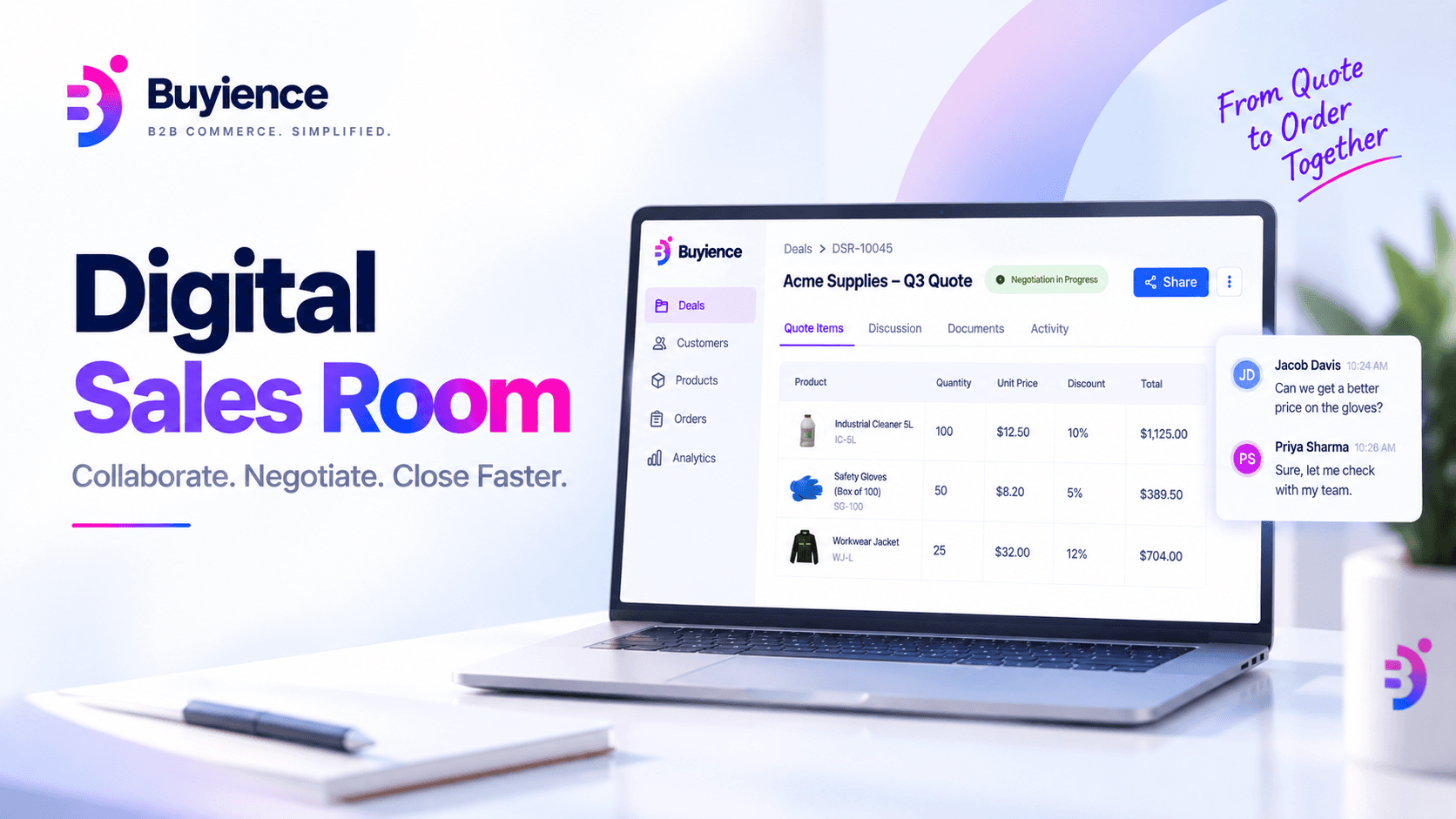
A digital sales room (DSR) is a secure, shared online workspace where a seller and a buyer work through a deal together — reviewing quotes, negotiating pricing, exchanging questions, and reaching agreement — in one place, with a record of everything that happened.

What is a digital sales room?
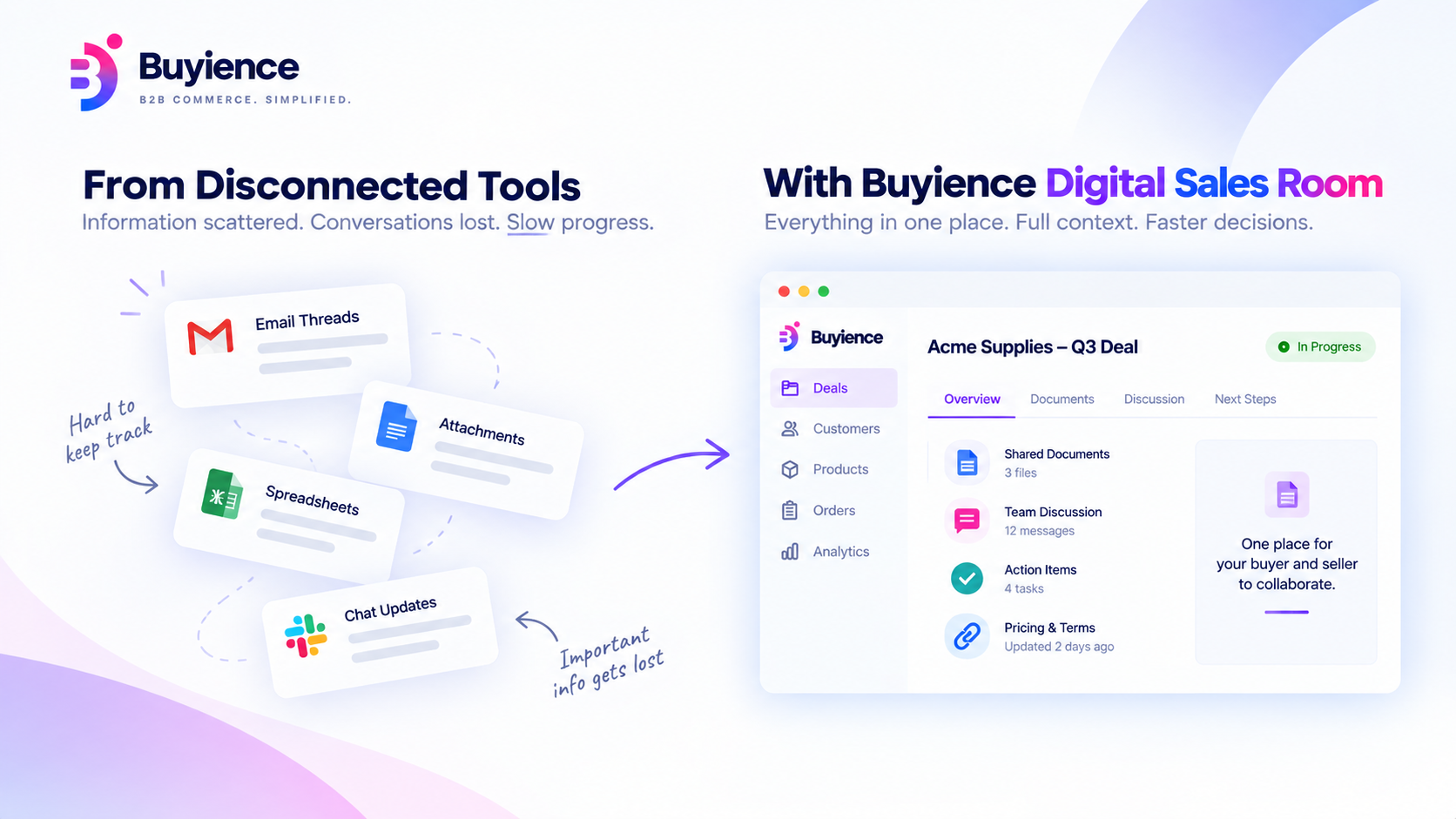
Instead of a deal living across an email thread, a PDF attachment, a phone call, and someone's memory, it lives in a single space both sides can open. The buyer sees the current quote rather than trying to work out which of four attachments is the latest. The seller sees what the buyer has looked at and where they hesitated. When the terms change, both parties see the change and the reason for it.
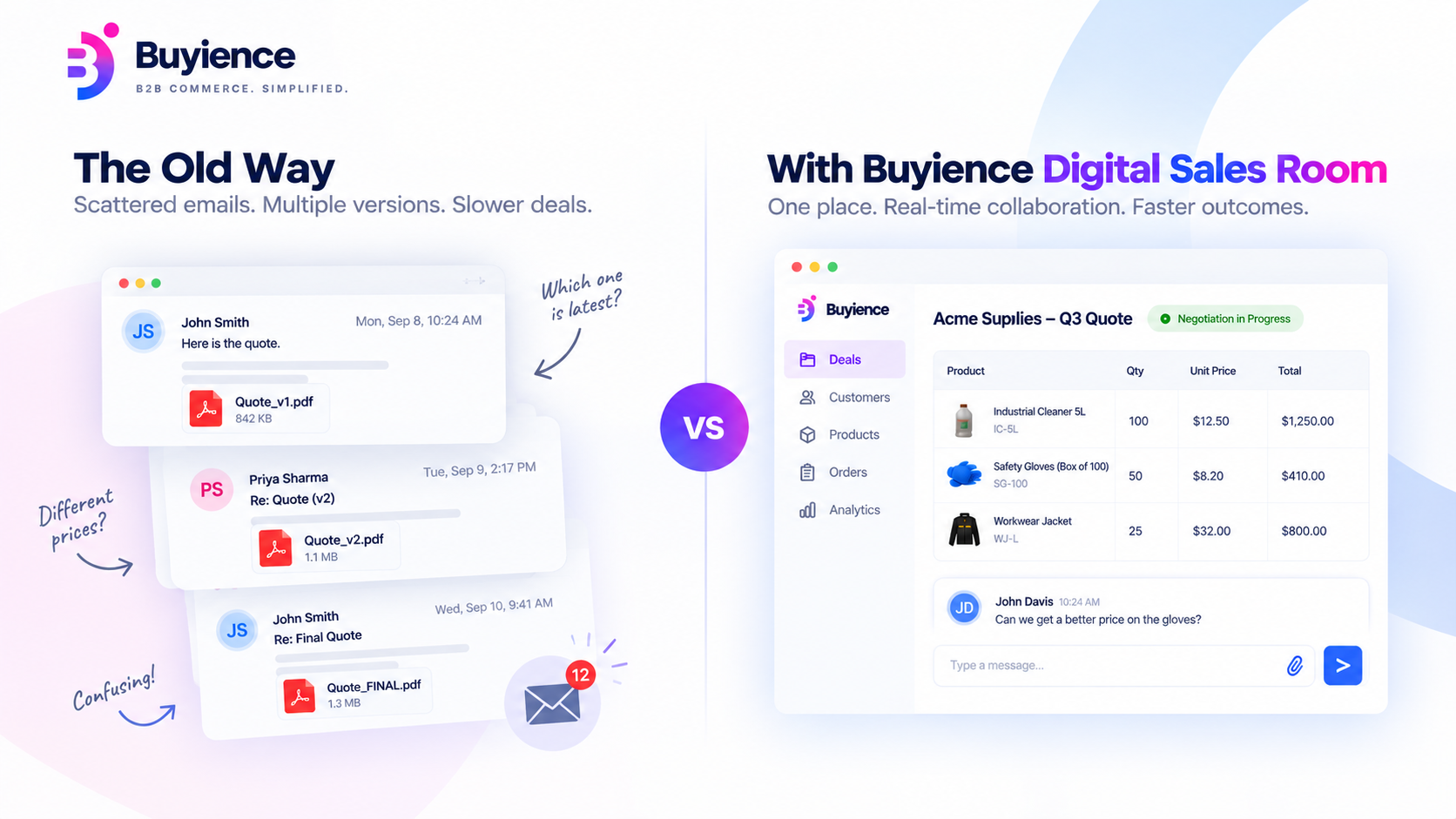
In B2B distribution specifically, a digital sales room addresses a problem that gets worse as deals get more complex: a multi-line quote with tiered pricing, volume breaks, and negotiated terms is genuinely hard to discuss over email. Every revision produces a new attachment, every concession lives in a sentence buried in a reply, and neither side is fully certain what the current agreement actually is until someone rebuilds it by hand.
Synonyms and related terms
- DSR
- Virtual deal room
- Digital deal room
- Sales microsite
- Buyer portal
- Digital sales proposal
- Deal workspace
Note that a virtual data room (VDR) is a different thing — those are used for due diligence in M&A and financing, focused on secure document access rather than active sales negotiation.
What problem does a digital sales room solve?
The scattered deal
A typical B2B distribution deal generates a quote, at least one revision, a question about lead times, a counter-offer, a request for different payment terms, and a final agreement. Handled conventionally, these are spread across an email thread with several participants, a couple of PDF attachments, a phone call nobody documented, and possibly a text message.
The practical consequences are familiar to anyone who sells this way:
- Version confusion. The buyer references pricing from revision two while the seller is working from revision four.
- Lost concessions. A rep agreed to absorb freight on a call. Nobody wrote it down. It surfaces as a dispute at invoicing.
- Invisible stalls. A deal goes quiet. The seller has no idea whether the buyer is comparing quotes, waiting on internal approval, or has moved on.
- Rebuild cost when someone changes. If the rep who owns the relationship leaves or goes on holiday, the deal's entire history has to be reconstructed from an inbox.
What changes with a shared workspace
A digital sales room makes the deal itself the container, rather than the correspondence about the deal. There is one current quote, one negotiation history, and one place where the terms live. Both sides are looking at the same thing at the same time.
How a digital sales room works
- The seller creates a room for a specific deal. It's tied to a customer and typically to a quote — with the customer's actual pricing applied, not a generic list price.
- The buyer opens it, usually via a link, without needing to install anything. Good implementations don't require the buyer to create an account and adopt a new tool just to review a quote.
- Both parties work in the space. The buyer reviews line items, asks questions, and counters. The seller responds, revises, or explains. Because it happens in one place, the exchange is faster than email and more documented than a call.
- Revisions are versioned, not replaced. Each version of the quote is preserved. When either side asks what changed between round two and round three, the answer is visible rather than reconstructed.
- The seller sees engagement signals. Which line items got attention, whether the buyer returned to the quote, whether they shared it internally. Not surveillance — just the visibility a seller would naturally have in a room but loses entirely over email.
- Agreement is reached and recorded in place. The accepted terms are the ones in the room, with a complete record of how they were arrived at.
Key features of a digital sales room
- Live, current pricing. The quote in the room reflects the customer's actual pricing — their tier, applicable volume breaks, any contract rates — rather than a static document that was accurate when generated. In distribution, where a single customer can have several pricing layers applying simultaneously, this matters more than it does in flat-rate SaaS selling.
- Real-time negotiation. Both parties can be in the room at once, working through terms live. A counter-offer appears immediately rather than waiting for an email cycle. For deals where speed is a competitive factor — and in fastener, MRO, and industrial distribution it usually is — this compresses a multi-day exchange into a single session.
- Full negotiation history. Every offer, counter, and revision is preserved with its reasoning. This is the feature buyers underrate and sellers come to rely on: six months later, when a customer asks why their price is what it is, the answer exists rather than depending on someone's recollection.
- Margin visibility for the seller. The seller's view shows where a proposed price sits relative to the margin floor — before the concession is made, not after the order ships. The buyer doesn't see this. It's the difference between a rep negotiating with information and a rep negotiating on instinct.
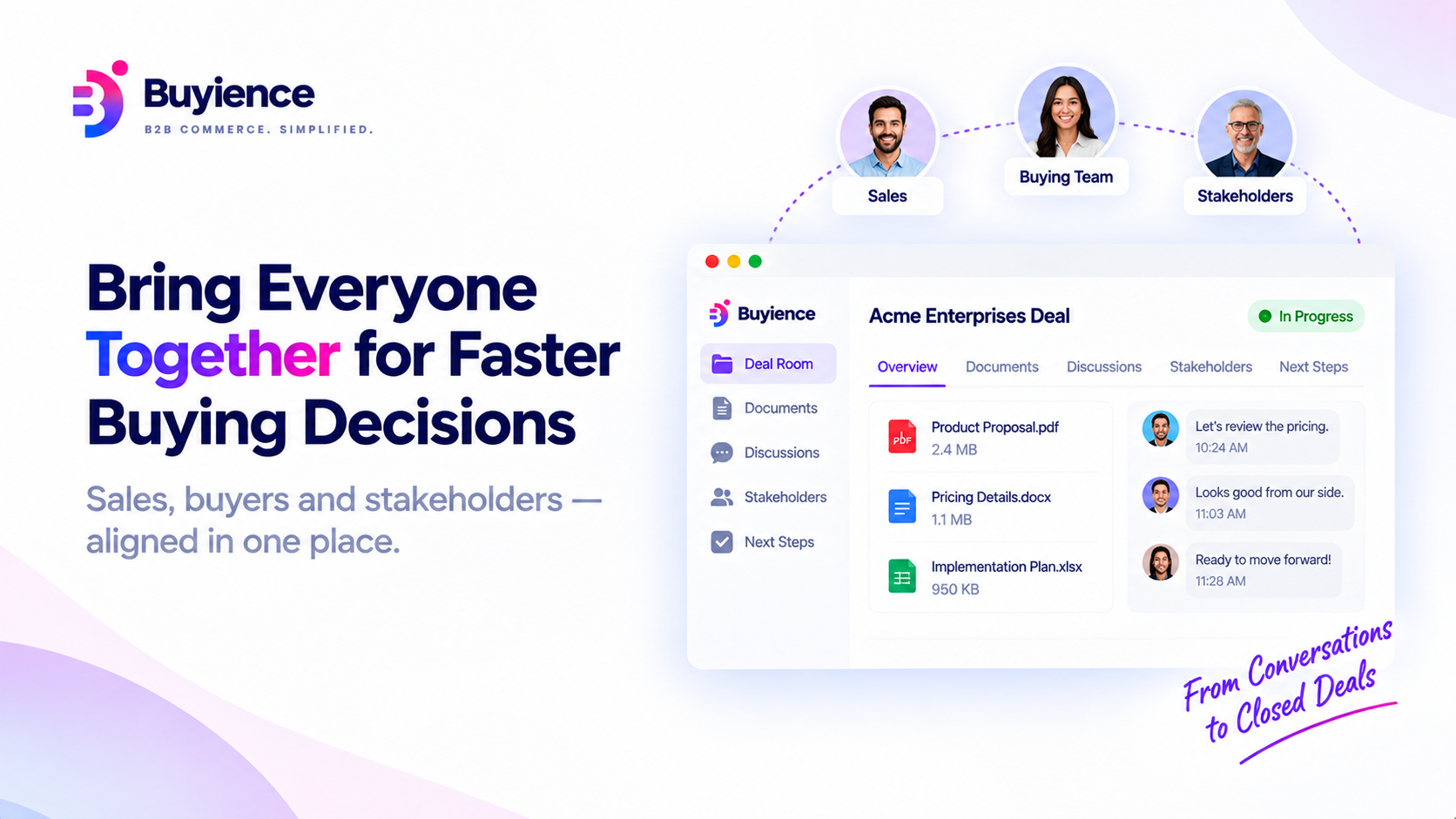
- Multi-stakeholder access. B2B buying decisions rarely involve one person. A purchasing manager may need a maintenance lead to confirm specifications and a finance contact to approve terms. A shared room lets a buyer bring colleagues in without forwarding a chain of attachments and hoping the right version travels.
- Engagement signals. Which items the buyer examined, how long they spent, whether they came back. These indicate where the real questions are — a buyer who repeatedly returns to one line item is telling you something that their polite email reply isn't.
- Document and specification handling. Spec sheets, compliance documentation, certificates of conformance, drawings. In industrial distribution these are frequently part of the deal, and they belong with the quote rather than as separate attachments in a parallel thread.
- Approval routing. When a requested price falls below the margin floor, the exception routes for approval from within the room, rather than pausing the negotiation for manual quote approvals while the rep tracks down a manager.
- Conversion to order. The accepted terms complete the quote-to-order process directly, without manual re-entry — which removes a genuine source of error, since retyping an agreed quote into an order system is exactly where transcription mistakes happen.
- Access control and audit trail. Role-based access, a record of who saw what and when, and a defensible history of what was agreed. This matters for internal governance as much as for customer disputes.
Digital sales rooms in B2B distribution vs. SaaS sales
Most writing about digital sales rooms assumes a SaaS sales motion: a long cycle, a large committee, a subscription contract, heavy sales collateral. Distribution is a different shape, and the useful features differ accordingly.
| SaaS sales | B2B distribution | |
|---|---|---|
| Deal shape | One product, tiered plans | Many SKUs, many line items |
| Pricing complexity | Plan-based | Customer tier × volume breaks × contract rates, per line |
| Cycle length | Weeks to months | Hours to days for transactional orders |
| What's negotiated | Seats, term, discount | Unit price, quantity, freight, lead time, payment terms |
| Key collateral | Case studies, demos, security docs | Spec sheets, compliance certs, availability |
| Repeat frequency | Annual renewal | Weekly or monthly reorders |
| Biggest risk | Losing a large deal | Margin erosion across many small deals |
The distribution implications:
- Line-level negotiation matters more than deal-level. A buyer isn't negotiating one number — they're pushing on specific lines. A DSR built for distribution has to support that granularity.
- Speed matters more. When a buyer is quoting three suppliers on a commoditized part, a same-session negotiation beats a three-day email exchange regardless of who has better pricing.
- Margin protection matters more. Distribution margins are thinner. A concession that's rounding error on a SaaS contract is a meaningful share of gross profit on a parts order.
- Availability is part of the negotiation. "Can you get 400 by the 15th" is often the actual question. A DSR without live inventory visibility can't answer it in the room.

What a digital sales room is not
- Not a shared folder. Dropbox or Drive gives both parties file access. It doesn't give live pricing, negotiation structure, versioned terms, or engagement visibility.
- Not a proposal tool. Proposal software produces a polished document to send. A DSR is a workspace to negotiate in. Sending is a one-way act; negotiating is not.
- Not a CRM. A CRM records what happened for the seller's benefit. A DSR is where it happens, with both parties present.
- Not a replacement for the relationship. This is the one distributors ask about most. A DSR doesn't remove the rep — it removes the administrative overhead around the rep, so the conversation is about the deal rather than about which attachment is current.
Who benefits from a digital sales room
- Distributors and wholesalers with multi-line quotes, tiered pricing, and negotiated terms — where email-based negotiation is genuinely difficult to manage accurately.
- Manufacturers selling direct to distributors or large accounts, where configurations and volume commitments require back-and-forth.
- Sales teams competing on responsiveness, in categories where the first credible answer frequently wins.
- Businesses with margin discipline problems, where deals are closing but effective margin is drifting below intent without anyone able to point to when it happened.
It's less useful for simple, fixed-price transactions with no negotiation — a self-service reorder of a known SKU doesn't need a negotiation workspace, it needs a good storefront.
Implementation considerations
- Start with deals that actually involve negotiation. Routine reorders belong in self-service. Reserve the DSR for deals where the back-and-forth is real.
- Don't require the buyer to work hard. If accessing the room means creating an account and learning an interface, adoption suffers. The buyer should be able to open a link and understand what they're looking at.
- Connect it to real pricing and inventory. A room showing stale prices or unavailable stock is worse than email, because it looks authoritative while being wrong.
- Decide what buyers see. Margin position is internal. Be explicit about the seller view versus the buyer view rather than discovering the distinction the hard way.
- Set the margin floor before rollout. A negotiation tool without an enforced floor makes it easier to concede faster. The floor is what turns speed into an advantage rather than a liability.
The digital sales room in Buyience Nova Core
Buyience Nova Core's Digital Sales Room is built for distribution deal shapes: line-level negotiation across multi-SKU quotes, customer pricing resolved automatically from tier and volume rules, real-time margin floor visibility for the seller, and live inventory so availability questions get answered in the room. Negotiation history is preserved per revision, and accepted terms convert directly to an order without re-entry.
It works alongside the AI Quote Engine, so a quote can go from request to negotiated agreement without leaving the platform.
Buyience offers a 14-day free trial with full access to every feature — no credit card required to start. Visit buyience.com to start your free trial — or request a demo and we'll walk through a Digital Sales Room with your deal shape.
Related terms
- CPQ (Configure, Price, Quote)
- Quote turnaround time
- Margin floor
- Tiered pricing
- B2B self-service ordering
- Net terms
Questions, answered
What is a digital sales room in simple terms?
A shared online space where a buyer and seller work through a deal together — reviewing the quote, negotiating terms, and reaching agreement in one place, with a record of what was agreed and how.
How is a digital sales room different from just emailing a quote?
Email scatters a deal across attachments and replies, with no single current version and no record of verbal concessions. A digital sales room keeps one current quote, preserves the negotiation history, and shows the seller where the buyer's attention actually went.
Do digital sales rooms replace sales reps?
No. They remove administrative overhead — version control, rebuilding history, chasing approvals — so reps spend time on the negotiation rather than on managing the paperwork around it.
Are digital sales rooms only useful for large enterprise deals?
No, and in distribution the opposite is often true. Small, frequent, price-sensitive deals are where speed and margin discipline compound most — a small margin leak repeated across hundreds of orders adds up faster than one large deal going wrong.
What's the difference between a digital sales room and a virtual data room?
A virtual data room is for secure document access during due diligence in M&A or financing. A digital sales room is for active sales negotiation, with live pricing and interactive terms.
Does a digital sales room work for distributors with thousands of SKUs?
It needs to be built for it. High SKU counts mean line-level pricing resolution and real-time availability across multiple warehouses — capability that tools designed for single-product SaaS deals generally don't have.
What should a buyer be able to see in a digital sales room?
Their current quote with correct pricing, line-level detail, availability and lead times, relevant documentation, and the negotiation history. Internal margin position stays on the seller's side.
How does a digital sales room protect margin?
By showing the seller where a proposed price sits relative to the margin floor at the moment of negotiation, and by routing anything below the floor for approval — so the constraint is enforced before a concession is made rather than discovered afterward.
Related articles
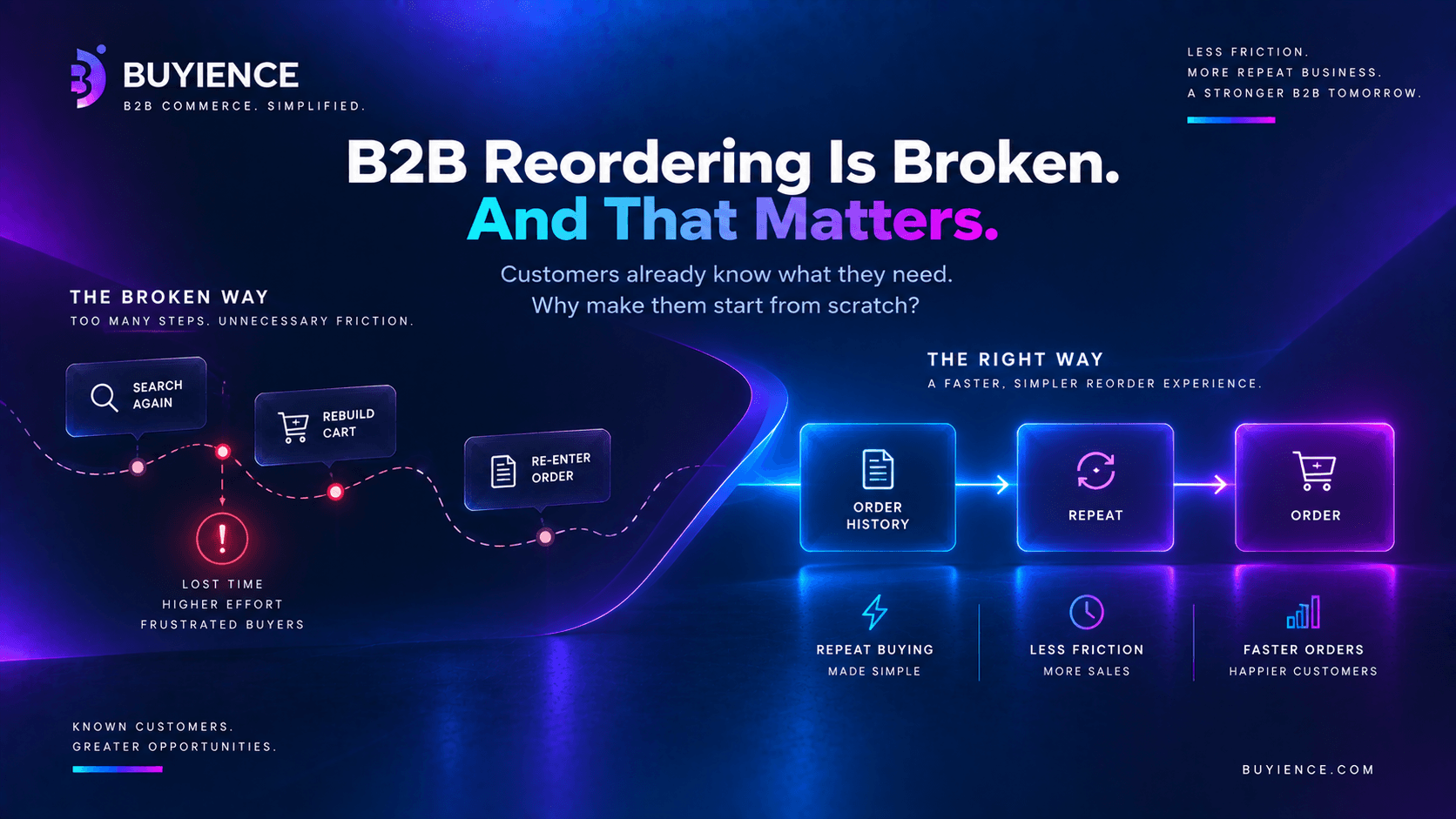
B2B Reordering Is Broken — and Why That Matters
A B2B reorder portal is a system that allows customers to quickly repeat previous purchases using saved order history, predefined product lists, or contract-specific pricing—without starting from scratch.
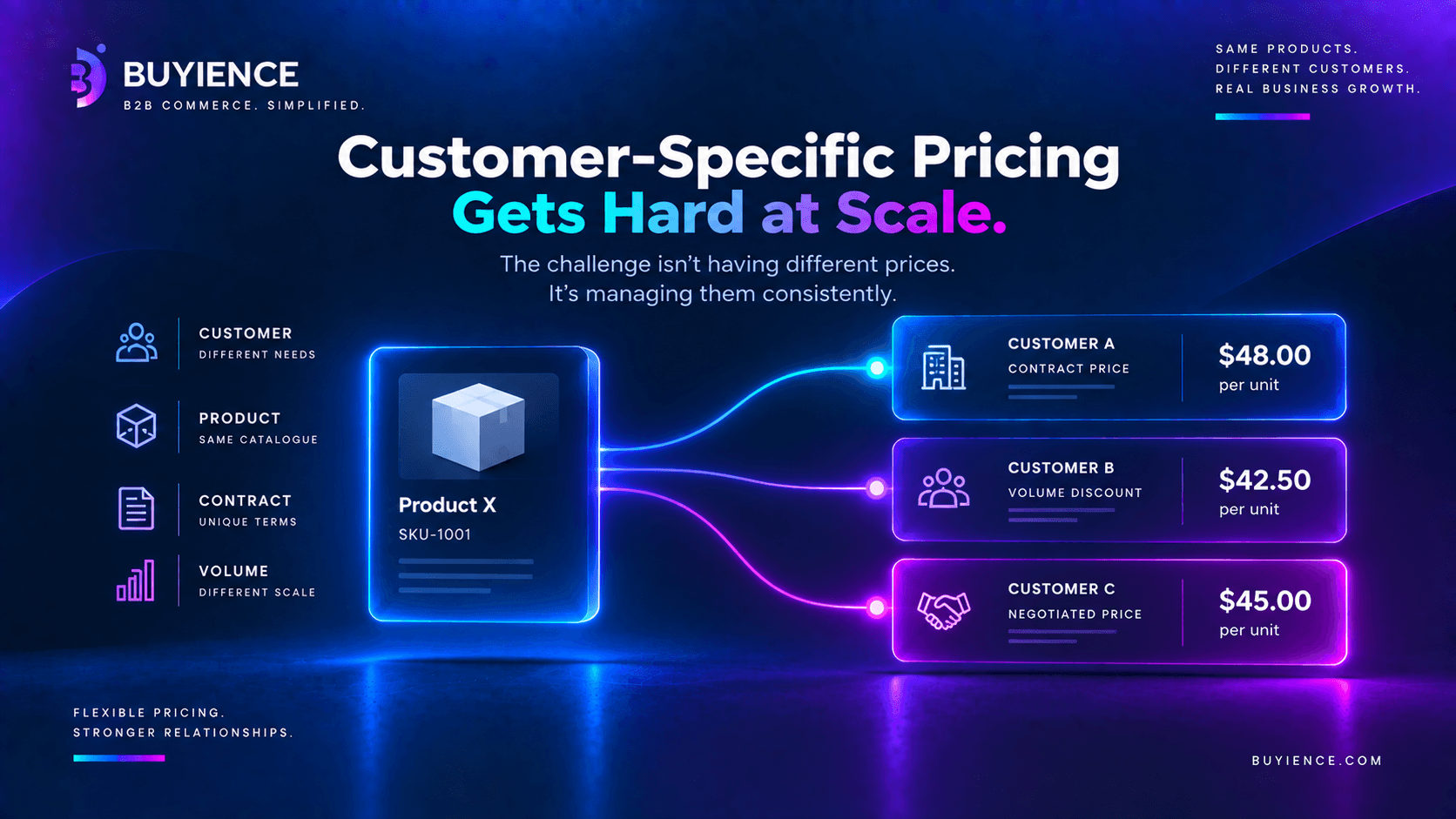
How B2B Teams Manage Customer-Specific Pricing at Scale
B2B pricing software is a system that centralizes and automates pricing logic across customers, products, and channels—ensuring consistent, real-time pricing without manual intervention.
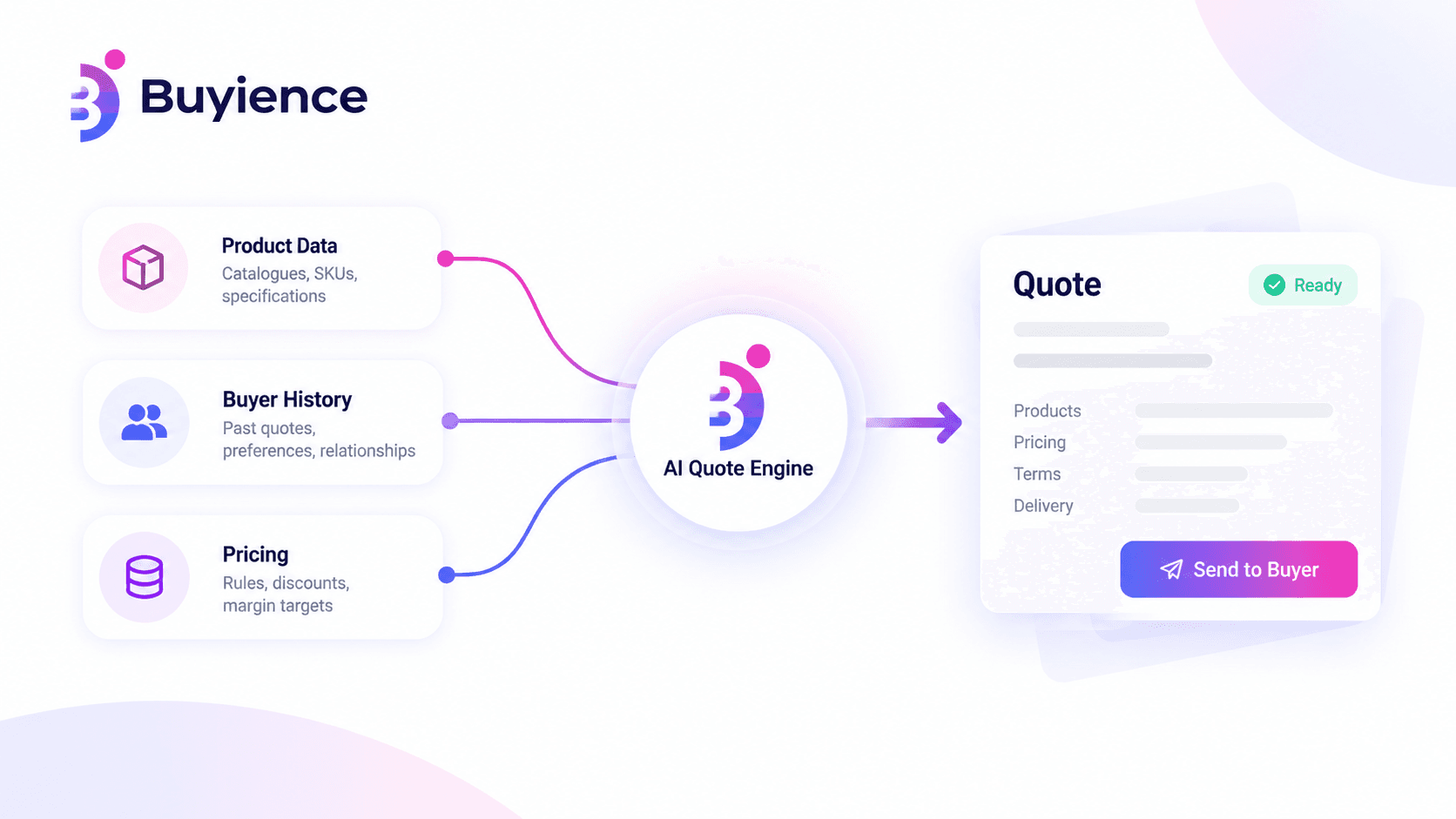
Quote in B2B & AI Quote Engine: How It Works
Discover how an AI quote engine transforms B2B commerce with faster pricing, accurate quotes, automation, and an improved buyer experience.